August 21, 2026 • Carmen Reyes • 10 min reading time • Specs verified June 25, 2026
Antifouling Bottom Paint for Fiberglass Boats: Ablative vs. Hard in Saltwater and Fresh
You hauled your fiberglass boat last fall, stared at a hull gone fuzzy with growth, and made a mental note: next time, better bottom paint. If you’re not sure what that means exactly — bottom paint (also called antifouling paint) is the specialized coating applied below the waterline to prevent marine growth like barnacles, algae, and slime from attaching to the hull. It’s not decorative. It protects boat speed, fuel economy, and long-term fiberglass integrity. The two main technologies — ablative paints (which slowly erode away, exposing fresh biocide as they wear) and hard paints (which cure to a firm film and release biocide through the surface without eroding) — behave differently, cost differently, and suit different use patterns. Get the match right and you’re in the water for two seasons before your next haul. Get it wrong and you’re scrubbing growth in July. This guide gives you the comparison framework, the volume math, and a clear decision rule so you can spec the right system before your next haulout.
Ablative vs. Hard: The Core Tradeoff
The chemistry difference matters less than the use-case difference. Here’s the practical split:
Ablative (self-polishing) paints wear away with water friction as the boat moves. Fresh biocide — most commonly copper compounds — is continuously exposed at the surface. Because the outer layer is always fresh, ablatives resist “paint fatigue” (the gradual depletion of biocide from a hard surface) even across multiple seasons. They also sand away cleanly at haulout, which means you’re not building up an ever-thickening paint schedule the way hard paints can. The tradeoff: they need time in the water to work. A boat that sits on a trailer for six months a year gets no friction-driven wear, and the surface can skin over, reducing effectiveness.
Hard (contact-leaching) paints cure to a firm, slick film. Biocide diffuses outward through the paint matrix rather than wearing away. The surface doesn’t erode, which makes hard paints the right call for trailered boats — nothing rubs off on trailer bunks, rollers, or the bottom of your garage. Hard paints also polish to a lower-drag surface, which racing sailors and speed-conscious powerboaters prefer. The tradeoff: once the biocide near the surface is depleted, you’re painting over a dead layer. Multiple seasons of hard paint builds up film thickness that eventually requires a chemical strip or sand-down before recoating.
The real-world sorting question: How many months per year is the hull in the water, and does it move under power or sail regularly?
| Use Pattern | Recommended Type | Why |
|---|---|---|
| Kept in slip, saltwater, 6+ months | Ablative | Continuous biocide refresh, no buildup |
| Trailered, launch 20–30× per season | Hard | No bunk transfer, maintains surface |
| Freshwater, low fouling pressure | Hard or low-copper ablative | Biocide demand is lower |
| Bluewater passage making | Ablative | Self-cleaning underway, multi-season |
Practical Sailor’s multi-season bottom paint comparison tests consistently show ablatives outperforming hard paints in high-fouling tropical and subtropical saltwater environments, while hard paints hold their advantage in low-fouling freshwater and trailered applications.
Saltwater vs. Freshwater: Biocide Load and Copper-Free Zones
Saltwater harbors the full range of fouling organisms — barnacles, tubeworms, bryozoans, slime, and heavy algae. Freshwater is mostly algae and zebra mussel pressure (region-dependent). That means saltwater applications generally need higher copper content — often 40–75% cuprous oxide by weight in the dried film — while freshwater boats can frequently get adequate protection from lower-copper or copper-free formulations.
There’s a second reason copper-free matters: regulated waterways. Several states — Washington, California, and Connecticut among them — have enacted or are phasing in restrictions on copper antifouling in certain water bodies, particularly freshwater lakes and marinas with poor tidal flushing. The BoatUS Foundation’s guide to antifouling bottom paints identifies copper accumulation in marina sediment as the regulatory driver, and the trend toward copper-free products is accelerating. If you operate in a regulated area, you need to check your state’s current rules before specifying copper-containing paint — not after.
Copper-free alternatives use zinc pyrithione, econea (tralopyril), or other non-metallic biocides. Reviewers of Krypton copper-free formulations provide some of the most specific application data in this product category: documented use with HVLP spray application, zinc chromate primer as a tie coat, and specific compatibility testing with Volvo Penta stern drives and outdrives. That specificity is worth noting — copper-free paints aren’t just a regulatory workaround; in some drive-unit applications, they’re the only responsible choice (more on that below).
Product-Level Comparison: What the Review Record Shows
Three products consistently surface in intermediate-level buying decisions, and the review patterns reveal meaningful differentiators beyond the marketing copy.
TotalBoat Underdog targets the value-tier buyer who wants good single-coat coverage without a complex primer stack. The highest-rated owner reviews emphasize two things: the application supplies included in some kit configurations and notably thick, high-coverage consistency that makes a one-coat application viable for light fouling pressure. That’s a real advantage if you’re painting a 22-footer on a tight weekend timeline.
The caution, documented in at least one shipping-incident review, is packaging fragility: reviewers describe receiving multi-can orders with destroyed outer boxes, dented cans, and missing handles. For a product with heavy copper pigment settling, a damaged can isn’t just an inconvenience — it can compromise your ability to mix the pigment back into full suspension. Inspect every can on delivery. If you’re ordering online, photograph the outer box before opening it, and reject visibly damaged shipments through the retailer’s damage claim process before you sign. The Jamestown Distributors Boatbuilder Central application guides recommend thorough stirring (not shaking) to reintegrate settled pigment in copper antifoulings, which takes real time with a mixing paddle — plan for 5–10 minutes per gallon.
Interlux Aqua-One occupies a different niche: it’s a water-cleanup antifouling, meaning brushes, rollers, and spills clean up with water rather than solvent. For many owners, this is a genuine quality-of-life improvement — fewer volatile organic compounds (VOCs) to manage in an enclosed boatyard, simpler cleanup, and easier compliance with yard waste disposal rules. Owner reviews flag this consistently as a deciding factor, not a gimmick. Interlux’s published technical data sheet for Aqua-One specifies compatibility with most fiberglass substrates with appropriate primer, which aligns with the West Marine Inspiration guide’s general recommendation to confirm primer compatibility before application.
Pettit Spartan is the ablative that keeps showing up in trailered-boat discussions for a counterintuitive reason: reviewers specifically note it doesn’t transfer to bunks or rollers. For an ablative — a category that by definition erodes — that’s the key differentiator. The mechanism is that Spartan requires water contact and friction from actual boat movement to activate the ablative cycle; incidental contact with foam bunks or a roller during a short haul-out doesn’t generate enough abrasion to cause transfer. If you’re running a center console or runabout on a trailer but also keeping it in a slip 60+ nights per season, Spartan’s profile bridges the trailered/kept-in-slip gap better than most ablatives.
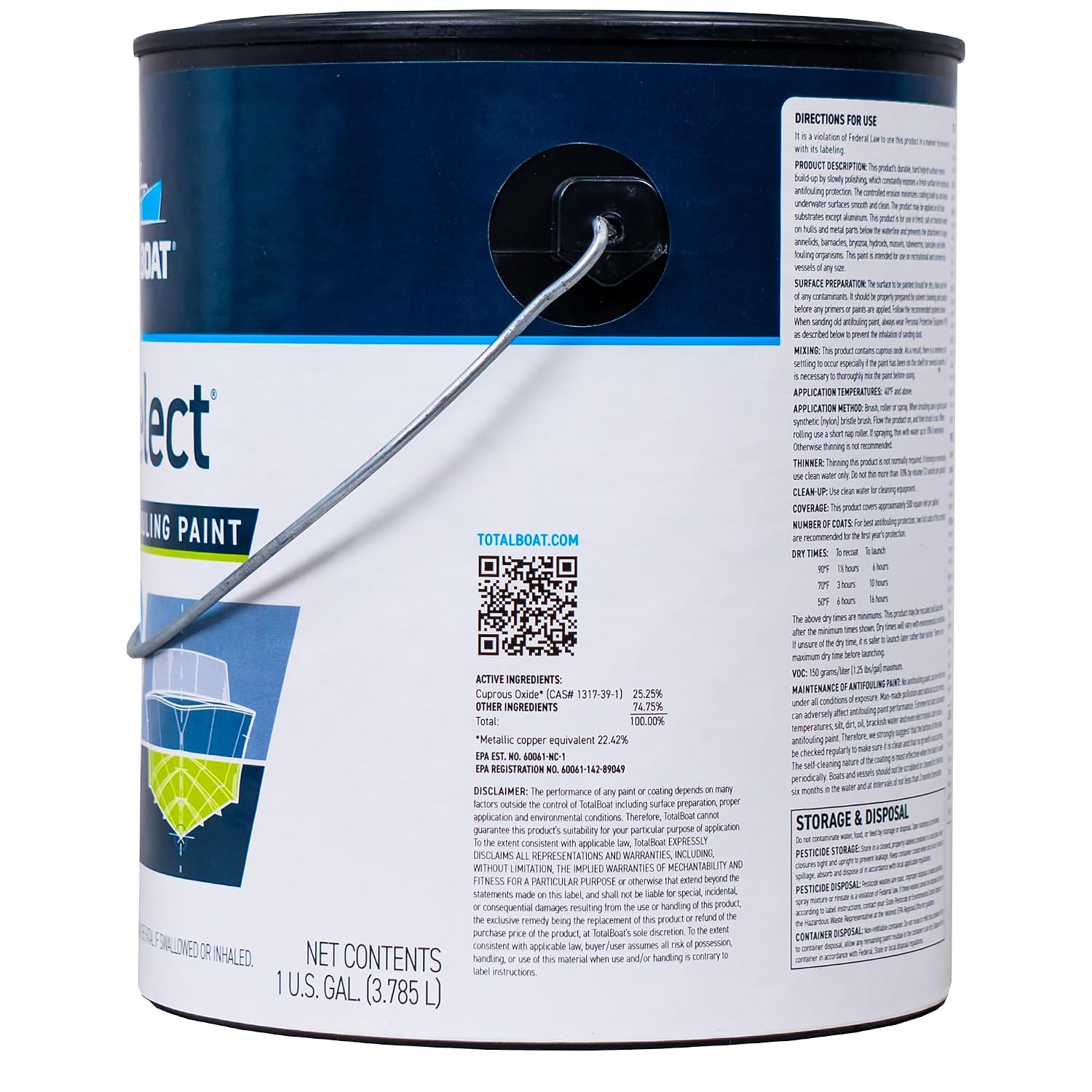
JD Select (Jamestown Distributors’ house-brand antifouling) has a review record populated with notably experienced buyers — one documented reviewer cites 40+ years of bottom painting history. The standout observation from that cohort: very little pigment settling when first opened, which suggests better pigment suspension chemistry than is typical for copper antifoulings. Anyone who has wrestled with a gallon of copper paint that’s separated into a brick on the bottom of the can appreciates what that means for job-site efficiency.
Drive Unit Painting: A Dedicated Section Most Guides Skip
Across the review record for antifouling bottom paints, a consistent and underserved use case keeps appearing: painting outdrives and stern drives, not just hulls. This matters for two reasons.
First, copper is toxic to aluminum. Aluminum outdrives — which include most MerCruiser Alpha and Bravo units, Volvo Penta I/O drives, and OMC-style sterndrives — will corrode aggressively if painted with copper-based antifouling. The electrochemical interaction accelerates galvanic corrosion (the process by which dissimilar metals in electrical contact corrode each other in the presence of an electrolyte like saltwater). This is not a nuanced risk: it will damage your drive.
Second, copper-free paints require specific primer compatibility. Krypton copper-free reviewers document the correct workflow: zinc chromate primer as a barrier/tie coat before the antifouling topcoat, HVLP spray for even coverage on complex drive geometry, and explicit confirmation of Volvo Penta compatibility. The Interlux technical data sheet for drive-compatible products similarly specifies primer stack requirements that differ from hull applications.
The practical rule: if you’re painting aluminum outdrives, stern drives, or lower units, you need a product specifically rated copper-free and aluminum-safe. Confirm the primer compatibility in the manufacturer’s TDS before you open a can.
By the Numbers: Coverage Math for a 22-Foot Fiberglass Boat
Coverage math is the question that generates the most pre-purchase confusion. Here’s a workable baseline:
22-foot fiberglass runabout, two coats: Wetted surface area ≈ 120–140 sq ft (hull bottom only, estimated) Typical coverage rate: 250–300 sq ft/gallon (per most manufacturer TDS) Two coats on 140 sq ft = 280 sq ft of coverage needed Result: 1 gallon covers two coats with margin; buy 1.5 gallons to account for a third coat on high-wear areas (keel, leading edge of rudder, bow)
For boats 30 feet and up, calculate wetted surface area using the formula: LOA (length overall) × Beam × 0.75 as a rough approximation, then divide by your paint’s published coverage rate. The West Marine Inspiration bottom paint guide uses a similar approach and recommends bumping quantity estimates up 15–20% for older or rougher hull surfaces where paint absorbs faster.
Frequently Asked Questions
Can I use an ablative bottom paint on a trailered boat without it rubbing off on the bunks? Most ablatives will transfer on extended bunk contact. Pettit Spartan is the documented exception — reviewers with trailered boats specifically call out no bunk transfer — but it still requires water friction to fully activate. For pure trailering, a hard paint is the conservative choice.
How many gallons of bottom paint does a 22-foot fiberglass boat actually need for two coats? Plan on 1 to 1.5 gallons for a 22-footer with a standard hull form. Increase to 2 gallons if the hull is rough, if you’re doing a barrier coat first, or if you want a third coat on high-wear zones.
Does TotalBoat Underdog require a barrier coat primer before application? The TotalBoat technical data sheet recommends a barrier coat (epoxy-based) on bare or previously stripped fiberglass for best osmotic blister protection. On existing antifouling in good condition, a barrier coat is optional but improves adhesion longevity. Always confirm with the current TDS, as formulations update.
What bottom paint is safe to use on aluminum outdrives or Volvo Penta stern drives? Copper-based antifoulings are not safe on aluminum. Use a product explicitly rated copper-free and aluminum-compatible — Krypton copper-free is documented by reviewers for Volvo Penta drive use — with a zinc chromate primer tie coat per the manufacturer’s TDS.
How long after applying bottom paint can I launch the boat? Most hard antifoulings specify a minimum dry time of 24–48 hours before launch; most ablatives are similar, though some require launch within 90 days to prevent surface skinning. Check the specific product’s TDS for the launch window. Launching too early (paint still tacky) or too late (ablative surface oxidized) both compromise performance.
The Decision Rule
If your boat lives in a saltwater slip for more than six months a year and moves regularly, spec an ablative. Spartan if you also trailer occasionally; a higher-copper ablative if you’re in a high-fouling tropical or subtropical environment.
If your boat is primarily trailered and launched for day use, spec a hard paint. The bunk transfer and surface-skinning problems with ablatives make hard the default.
If you’re painting aluminum outdrives or stern drives — on any hull type, in any water — copper-free only, with a compatible primer, regardless of what you use on the hull.
When in doubt, pull the current technical data sheet for the product you’re considering. Practical Sailor’s bottom paint comparison tests are the most rigorous independent reference in this category, and BoatUS Foundation’s antifouling guide provides the clearest regulatory overview. Both are worth reading before you finalize your spec.