July 10, 2026 • Carmen Reyes • 9 min reading time • Specs verified June 25, 2026
Bilge Paint and Below-Deck Coatings: Why TotalBilge Epoxy Outperforms Enamel in the Long Run
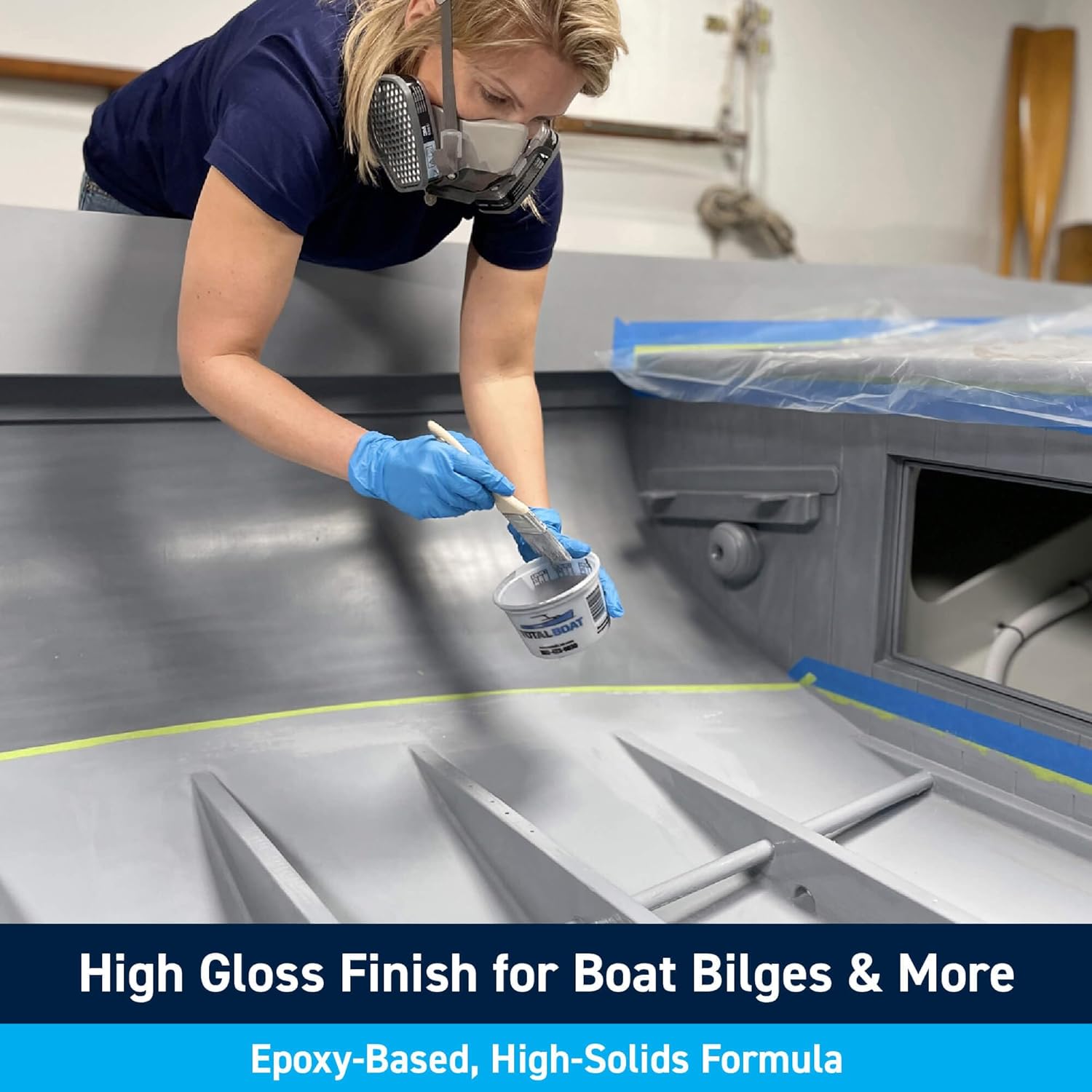
You’ve just pulled up the sole boards — those removable floor panels in the bottom of a boat — and stared into the bilge. The bilge is the lowest interior compartment of the hull, the trough where stray water, diesel drips, and general grime collect. If it’s a boat that’s been around a while, what you’re probably looking at is flaking gray paint, rust stains, and a smell you’d rather not identify. The question you’re now asking is a practical one: what do I coat this with so I’m not back here doing the same job in eighteen months?
This article answers that question directly. We’ll break down the two coating systems most widely used for bilges and below-deck spaces — alkyd enamel (the traditional choice) and two-part epoxy systems, specifically TotalBoat TotalBilge, which has become a reference product in this category — compare them on adhesion, longevity, chemical resistance, and real-world cost, and give you a clear decision rule for which system fits your project.
What “Below-Deck Coatings” Actually Means — and Why the Environment Is Brutal
The bilge is one of the harshest coating environments on the boat. That’s not an exaggeration — it’s the reason this choice matters more than, say, picking a nonskid color for the cockpit.
Here’s what a bilge coating has to survive:
- Standing and cycling water. Bilges accumulate water from condensation, deck leaks, stuffing-box (the seal where a propeller shaft enters the hull) drip, and rain intrusion. A coating that isn’t waterproof at the substrate level will eventually lift.
- Petroleum contamination. Diesel, engine oil, and hydraulic fluid are regular visitors. Alkyd enamels — which are oil-based paints similar to what you might use on a shed — have limited resistance to petroleum solvents. They soften, chalk, and delaminate.
- Flexing. Fiberglass hulls flex underway. A brittle coating cracks at stress points, opening pathways for water to migrate under the film.
- Temperature swings. A bilge in a boat stored in the Northeast or Pacific Northwest cycles between near-freezing winter temperatures and 120°F+ summer heat when the boat sits under a cover. Coatings expand and contract, and weaker bonding systems fail at the transitions.
- Dark, damp, inaccessible. You’re probably not going to prep and recoat this space every season if you can avoid it. Longevity isn’t a luxury — it’s a practical necessity.
Practical Sailor’s bilge paint comparison testing, published on practicalsailor.com, notes that the single biggest predictor of long-term bilge coating performance is bond strength to the substrate under wet and contaminated conditions — not the initial appearance of the film.
Alkyd Enamel: The Legacy Option and Its Real Limitations
Alkyd enamel bilge paints — products like Bilgekote by Pettit and similar single-part formulas — have been sold at every marina chandlery for decades. They’re inexpensive, easy to brush or roll, and dry quickly enough to get you back underway in a day.
For a boat being flipped in a season, or a freshwater runabout with a dry bilge, that profile is fine. But for anyone doing a real refit — or maintaining a boat that actually goes offshore — the limitations compound quickly.
The core problem is adhesion chemistry. Alkyd enamels form a film by oxidation (the same process that cures oil-based house paint). That film sits on top of the substrate rather than bonding chemically into it. In a clean, dry environment, that’s adequate. In a bilge, it’s not. Water and petroleum solvents work their way under the film edge. Once lifting starts at any point — a nick, a flex crack, a seam — it propagates fast. Owners who have switched from enamel to epoxy systems consistently describe the same pattern: two to three years on enamel, annual touchups, then a full strip-and-recoat cycle. BoatUS’s boat maintenance guides echo this, noting that enamel bilge coatings in working boats typically need full reapplication every two to three seasons to remain effective.
There’s also the aesthetic dimension that turns into a maintenance burden: enamel bilges show contamination staining immediately, and the porous film traps diesel and oil residue rather than releasing it when cleaned.
By the numbers — enamel vs. epoxy cost over 6 years:
| Metric | Alkyd Enamel | TotalBilge Epoxy |
|---|---|---|
| Initial material cost (avg. bilge, ~2 gal) | $45–$70 | $110–$140 |
| Recoat cycle | Every 2–3 seasons | Every 6–8+ seasons |
| 6-year total material cost (est.) | $135–$210 | $110–$140 |
| Surface prep labor each cycle | Moderate-high (stripping) | Minimal (wipe-down) |
Jamestown Distributors’ Boatbuilder Central coating guide frames this clearly: the upfront premium on a two-part epoxy system is typically recovered within the first recoat cycle you avoid.
TotalBilge Epoxy: What the Specs Actually Say
TotalBoat TotalBilge is a water-based two-part epoxy coating — “two-part” means it has a resin component and a hardener that you mix immediately before application, triggering a chemical cure rather than an oxidation cure. The resulting film is chemically cross-linked (the molecules bond to each other in a dense network), which is fundamentally different in durability from an enamel film.
Published specs from TotalBoat’s technical data sheet put the key properties this way:
- Chemical resistance: Rated for resistance to diesel fuel, motor oil, bilge water, and mild acids — the full contamination profile of a working bilge.
- Adhesion: Bonds to fiberglass, steel, aluminum, and previously painted surfaces in good condition with proper prep. The water-based formula reduces the surface tension issues that cause solvent-based epoxies to crawl on damp substrates — a practical advantage in a bilge where getting the surface completely dry is difficult.
- Film hardness: Cures to a semi-gloss, hard, cleanable surface. The hardness matters because it resists abrasion from bilge pump bases, floorboard edges, and tools being dropped during maintenance.
- VOC (volatile organic compound) profile: Significantly lower than solvent-based alternatives. In a confined space like a bilge, lower VOCs are a genuine safety advantage, not just a regulatory checkbox.
West Marine’s Inspiration guides on bilge maintenance note that water-based epoxies have closed a meaningful performance gap with solvent-based formulas over the past decade, while offering practical handling advantages for owner-applicators working without spray equipment.
Epoxy Works (the publication from Gougeon Brothers, makers of WEST SYSTEM epoxy) covers the chemistry in their below-deck application guide: the cross-linked film resists water vapor transmission at the molecular level in a way that thermoplastic films — enamel, latex — fundamentally cannot. That’s not marketing; it’s chemistry, and it’s the reason epoxy systems dominate offshore and bluewater applications where recoating on a beach in the Azores isn’t an option.
Surface Preparation: Where Most Failures Actually Start
No coating discussion is complete without the inconvenient truth about prep. Practical Sailor’s bilge paint research is consistent with almost every coating manufacturer’s TDS: the majority of premature failures — peeling, bubbling, delamination — trace back to surface prep, not product quality.
For a bilge going from bare or previously enameled to TotalBilge epoxy, the prep sequence matters:
- Degrease first, always. Petroleum contamination is the adhesion killer. A bilge with any diesel or oil history needs aggressive solvent degreasing — acetone or a dedicated marine degreaser — before any mechanical prep. Sanding contaminated surfaces drives the oil deeper into the laminate.
- Mechanical abrasion. 80-grit for bare fiberglass, 120-grit to scuff existing coatings in good condition. The goal is a uniformly dull surface with mechanical tooth for the epoxy to grip.
- Wipe down with solvent after sanding. Sanding dust contains the same oils and mold release compounds you just tried to remove. Final wipe with acetone before coating.
- Strip failing enamel completely. Applying epoxy over flaking or lifting enamel is the most common mistake owner-applicators make. Epoxy will bond to itself better than almost anything — but it will inherit the failure of whatever it’s bonded to. If the enamel underneath is soft, peeling epoxy on top of it just creates a more expensive failure.
Jamestown Distributors’ Boatbuilder Central prep guide is worth reading before you open any can: they lay out the complete sequence for fiberglass bilge prep with product-specific recommendations.
Decision Rule: When Epoxy Is the Right Call, and When Enamel Is Fine
If you’ve read this far, you can probably see the pattern. Here’s the explicit decision frame:
Choose TotalBilge Epoxy (or equivalent two-part epoxy) if:
- The boat is used in salt water, offshore, or conditions where the bilge sees regular water cycling.
- You want a 6–8+ year coating life with minimal maintenance between cycles.
- The bilge has any petroleum contamination history and you want a film that won’t stain or soften.
- You’re doing a full refit and don’t want to revisit this compartment for years.
- The boat is a liveaboard or charter vessel where accessibility for recoating is limited.
Alkyd enamel is acceptable if:
- The boat is a freshwater-only day sailor or runabout with a genuinely dry bilge.
- You’re doing a quick prep-to-splash project and long-term durability is not the priority.
- Budget is the hard constraint and you understand you’re accepting a 2–3 year ceiling before recoating.
- You’re reselling the boat within a season and the bilge is cosmetic, not structural.
The math from the table above makes the 6-year case for epoxy clearly — even at twice the upfront cost, you come out even or ahead by the second avoided recoat cycle, and that’s before counting labor time.
One honest caveat: TotalBilge is not a structural repair product. If there are stress cracks, osmotic blisters (water-filled bubbles in the fiberglass laminate), or delamination in the bilge area, those need to be addressed with an appropriate epoxy repair system — Gougeon WEST SYSTEM or MAS Epoxies are the reference choices — before any coating goes on. Coating over a structural problem seals in moisture and delays a repair that will only get more expensive.
BoatUS’s bilge care guides make this point firmly: coating is a maintenance layer, not a remediation layer. Know which problem you’re solving before you pick up a brush.
The bilge is the least glamorous compartment on the boat and the one that most directly reflects how seriously a previous owner took the boat’s long-term health. Getting the coating right is one of the highest-return moves in a below-deck refit — the materials cost is modest, the labor is a weekend, and the result pays dividends every season you don’t have to redo it.