July 5, 2026 • Carmen Reyes • 10 min reading time • Specs verified June 25, 2026
Bottom Paint for Trailered Aluminum Boats: Antifouling, Epoxy Slick Coats, and What Actually Works
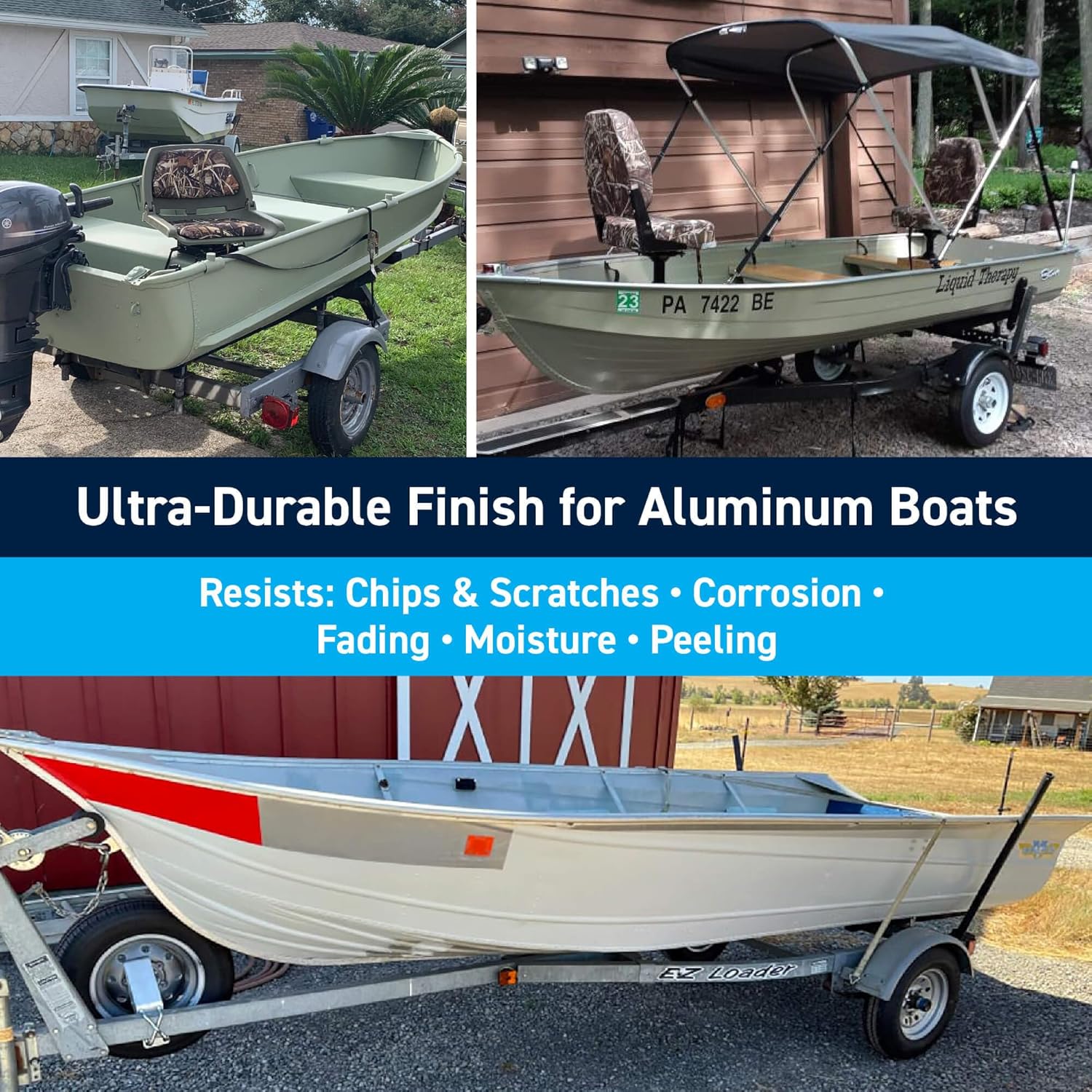
You pulled your Jon boat out after last summer’s float trip, pressure-washed the hull, and noticed the aluminum surface looked chalky, stained, and — in one corner — starting to pit. You do a quick search for “bottom paint aluminum boat” and immediately land in a minefield: copper-based antifouling (the most common boat bottom paint, which uses copper compounds to kill barnacles and algae) shows up in half the results, but several forum threads warn that copper and aluminum are a galvanic disaster waiting to happen. Galvanic corrosion — the electrochemical process where two dissimilar metals eat each other when they’re in contact with water — can quietly destroy an aluminum hull from the outside in. So what are you actually supposed to put on the bottom?
This guide is for the aluminum boat owner who trailers their vessel — meaning the hull spends meaningful time out of the water between uses — and needs to decide between antifouling coatings, epoxy slick coats, and protective barrier systems. We’ll walk through the real workflow, cover specific products that owners and reviewers consistently rate highly, call out the traps, and end with a clear decision framework.
| EDITOR'S PICKTotalBoat Underdog Marine Antif… | Mid-tierTotalBoat Krypton Copper Free A… | Budget pickTotalBoat Aluminum Boat Paint |… | |
|---|---|---|---|
| Color | Black | White | Light Gray |
| Size | 128 fl oz | Quart | 32 fl oz |
| Antifouling | ✓ | ✓ | ✗ |
| For Aluminum | ✗ | ✓ | ✓ |
| Price | $139.99 | $119.99 | $39.09 |
| See on Amazon → | See on Amazon → | See on Amazon → |
Why Aluminum Changes Everything About Bottom Paint Selection
Most bottom paint guidance is written for fiberglass boats, and it does not translate to aluminum. The critical difference is galvanic compatibility: aluminum sits low on the galvanic series (meaning it’s more “active” and prone to corrosion) while copper sits high. Put a copper-based antifouling directly on bare aluminum and you’ve essentially built a battery — the copper accelerates corrosion of the aluminum, especially in saltwater.
BoatUS’s guidance on aluminum hull corrosion confirms this directly: copper-based antifouling paints should never be applied to aluminum without a robust barrier coat, and even then, many aluminum boat owners avoid them entirely. West Marine’s Technical Library echoes the same point in its barrier coat compatibility documentation.
This creates a fork in the road early in your project:
Fork A — You need antifouling protection. Your boat stays in the water for extended periods (weeks or seasons), and you’re dealing with growth pressure from algae, zebra mussels, or barnacles. You need a paint system designed specifically for aluminum compatibility.
Fork B — You trailer regularly and the boat is only in the water for hours or days at a time. Growth pressure is minimal. What you actually need is hull protection, rivet sealing, drag reduction, and corrosion resistance — and an epoxy slick coat likely outperforms antifouling for your use case.
Most trailered aluminum boat owners are squarely in Fork B. That’s the underappreciated story in this category, and it’s where we’ll spend serious time.
The 4-Step Prep Workflow You Can’t Skip
The most common reason aluminum bottom paint fails prematurely is surface prep shortcuts. A reviewer documenting their Alumipaint AF application laid out the process in a way that’s worth internalizing as a standard workflow:
- Sand the hull — 80-grit scuff to remove oxidation and create mechanical adhesion. Don’t skip this even if the surface looks clean.
- Repair fastener holes and damage — JB Weld or a dedicated marine epoxy filler for any pinholes, especially around rivets. On a trailered boat, rivet sealing is arguably the most important step: reviewers of epoxy slick coat products like Super Slick 2000 consistently report zero water ingress at rivets after application, versus ongoing weeping on unsealed hulls.
- Etch the surface — An acid etch or aluminum-specific wash primer (Ospho and similar products are commonly used) creates a chemically receptive surface. This is the step most DIYers skip and most failures trace back to.
- Apply barrier coat, then topcoat — The barrier coat (typically an epoxy-based primer) isolates the aluminum from whatever finish coat you’re applying. This matters most if you’re running an antifouling system; it’s still good practice under a slick coat.
The Interlux Technical Data Sheet for Alumicoat AF specifies a compatible epoxy primer as a mandatory first step. TotalBoat’s TDS for their Aluminum Boat Paint similarly recommends etching or a wash primer before any topcoat. When manufacturers and reviewers align on prep requirements, that’s the workflow.
Product Breakdown: Antifouling Systems for Aluminum
TotalBoat Krypton
TotalBoat Krypton is a hard-modified epoxy antifouling paint formulated without copper — it uses a zinc-based biocide instead, making it genuinely aluminum-safe. The trust signal that matters here: Practical Sailor’s antifouling paint comparison test (referenced in aggregated reviewer citations for this product) cited Krypton among the lowest fouling growth results at the two-year mark. That’s an independent data point in a category full of manufacturer claims.
Reviewers specifically note that spray application with an HVLP gun (high-volume low-pressure spray system — a common tool for marine refinishing) delivers a noticeably smoother finish than rolling, and that TotalBoat Brushing Thinner 100 is the correct thinning agent for viscosity adjustment when spraying. Getting that pairing wrong — using an incompatible thinner — can ruin adhesion and finish quality.
Coverage reality check: Across reviewer accounts, coverage runs tighter than the label suggests. A gallon of Krypton is not going to cover a 16-foot Jon boat inside and out with two coats. See the coverage estimates below.
TotalBoat Aluminum Boat Paint
A more accessible entry point for owners who want straightforward corrosion protection and modest antifouling properties without the full Krypton system. Reviewers consistently describe this as the better choice for freshwater boats where fouling pressure is lower — the priority is oxidation and staining prevention more than aggressive biocide performance.
Alumipaint AF
Alumipaint AF (manufactured by Pettit) is a dedicated aluminum-compatible antifouling that’s been on the market long enough to accumulate a meaningful review base. It’s the product the 4-step workflow above was documented around, and it’s a solid choice for saltwater or brackish applications where biocide performance matters. Available at West Marine and Defender.
The Slick Coat Alternative: Super Slick 2000
For the majority of trailered aluminum boat owners, Super Slick 2000 is the product the category underserves in terms of awareness. It’s not an antifouling at all — it’s a two-part epoxy hull coating (a two-component system where you mix resin and hardener before application, similar to how marine epoxy works) designed to create a hard, smooth, water-shedding surface.
Why does this work for trailered boats?
- Rivet sealing: Owners consistently report that Super Slick 2000 penetrates and fills the micro-gaps around aluminum rivets, eliminating the slow water ingress that makes Jon boats and aluminum skiffs take on water at the floor.
- Drag reduction: The polished epoxy surface reduces friction against the water, which translates to modest but measurable speed and fuel efficiency gains — reviewers note this more than you’d expect for a coating product.
- No biocide concerns: Because you’re not relying on copper or zinc to kill organisms, and because your hull is regularly trailered and exposed to UV and air between uses, you sidestep the galvanic risk entirely.
- Durability: Hard epoxy coatings are significantly more abrasion-resistant than most antifouling paints, which matters when you’re launching off a gravel ramp.
The honest tradeoff: if your boat lives in the water for extended periods, a slick coat alone won’t prevent growth. Super Slick 2000 is a trailering solution, not a marina-slip solution.
Coverage: The Number That Surprises Everyone
This is where buyers consistently get caught short. The theoretical coverage numbers on product labels assume a thin, even single coat on a smooth surface. Real-world aluminum application — with etching, a porous surface, and two proper coats — runs significantly less.
Estimated coverage by hull size (two coats, bottom only):
| Hull Size | Bottom Area (approx.) | Gallons Needed |
|---|---|---|
| 14-ft Jon boat | 60–70 sq ft | 1 qt–1 gal |
| 16-ft Jon boat / skiff | 80–100 sq ft | 1–1.5 gal |
| 18–20 ft aluminum V-hull | 120–160 sq ft | 1.5–2 gal |
| 24 ft+ aluminum pontoon or deep-V | 200+ sq ft | 2.5–3+ gal |
If you’re painting interior floors and the exterior bottom (common on Jon boats), add 30–50% to those estimates. The 16-foot Jon boat reviewer who found one gallon barely covered the interior wasn’t doing anything wrong — they just encountered the coverage gap between label claim and application reality.
Buy one unit more than you think you need. Unused paint stores; a second trip to the retailer mid-project wastes a full day.
Shipping Damage: A Practical Note
Paint cans shipped via common carriers get knocked around. Across reviews for multiple products in this category — including TotalBoat Krypton, TotalBoat Aluminum Boat Paint, and Alumipaint AF — dented or damaged cans appear as a recurring complaint. A dented can isn’t automatically compromised, but it warrants inspection:
- Check that the lid seal is intact and the can hasn’t deformed enough to compromise the closure.
- Look for dried paint around the rim or lid edges, which indicates a seal breach and potential oxidation of the contents.
- If the can arrived visibly leaking or with a compromised lid, document with photos immediately and contact the retailer before opening — most will replace without requiring return shipment of a hazmat item.
- A slightly dented body with intact lid and seal is typically fine to use. Trust the seal, not the cosmetics.
Frequently Asked Questions
Can I use regular copper-based antifouling on my aluminum boat? Not without a barrier coat, and even then it’s a higher-risk approach. BoatUS’s aluminum corrosion guidance is direct: copper and bare aluminum in a marine environment is a galvanic corrosion setup. Use a zinc-based or copper-free antifouling specifically rated for aluminum, or a dedicated aluminum antifouling system like Alumipaint AF.
Do I need a barrier coat before bottom paint on aluminum? Yes, for antifouling systems — this is not optional. An epoxy barrier coat isolates the aluminum from the biocide chemistry. Under a slick coat like Super Slick 2000, the prep requirements differ (etch and mechanical scuff), but a barrier coat is still good practice for adhesion and long-term durability.
How many gallons do I need to paint my Jon boat inside and out? For a 14–16 foot Jon boat, plan for 1.5 to 2 gallons for interior plus bottom with two coats. See the coverage table above for hull-size estimates. Always round up by one unit.
Is a slick coat like Super Slick 2000 better than antifouling for a trailered boat? For a boat that trailers between uses and isn’t in the water more than a few days at a stretch — yes, usually. You get rivet sealing, better abrasion resistance, zero galvanic risk, and better drag characteristics without paying a biocide premium you don’t need.
What do I do if my paint cans arrive dented — is the paint still usable? Check the lid seal integrity first. If the seal is intact and there’s no dried paint or leakage around the rim, the paint is likely fine. Document the damage with photos regardless, and contact the retailer if the seal is compromised.
Can I spray aluminum boat paint instead of rolling it? Yes — HVLP spray application delivers a notably smoother finish and is well-documented by reviewers on products like TotalBoat Krypton. Use the manufacturer’s recommended thinner (TotalBoat Brushing Thinner 100 for Krypton), dial your viscosity, and follow the TDS spray parameters. Rolling is more forgiving for beginners; spraying rewards the extra prep.
The Decision Rule
If your boat trailers between uses and is rarely in the water more than a few consecutive days: Skip antifouling. Apply an epoxy slick coat — Super Slick 2000 is the top choice based on owner consensus — over a properly etched and primed surface. You’ll seal your rivets, reduce drag, and avoid the galvanic exposure that comes with biocide-based systems.
If your boat sits in a slip or on a mooring for weeks or seasons at a time: You need real antifouling. TotalBoat Krypton is the premium choice with the independent test data to back it up. Alumipaint AF is the proven alternative with a longer track record. Either way, the 4-step prep workflow is non-negotiable, and your gallon estimates should be conservative.
If you’re in freshwater and trailering most of the time but want some protection against algae and staining: TotalBoat Aluminum Boat Paint splits the difference — it’s protective, accessible, and well-suited to lower-pressure freshwater environments without requiring the full antifouling system commitment.
The prep work is where these projects succeed or fail. The coating choice matters less than whether the surface was properly etched, primed, and sealed before you opened the topcoat can.