July 4, 2026 • Carmen Reyes • 9 min reading time • Specs verified June 25, 2026
Epoxy Barrier Coats and Blister Prevention: TotalProtect and the Case for Doing It Right
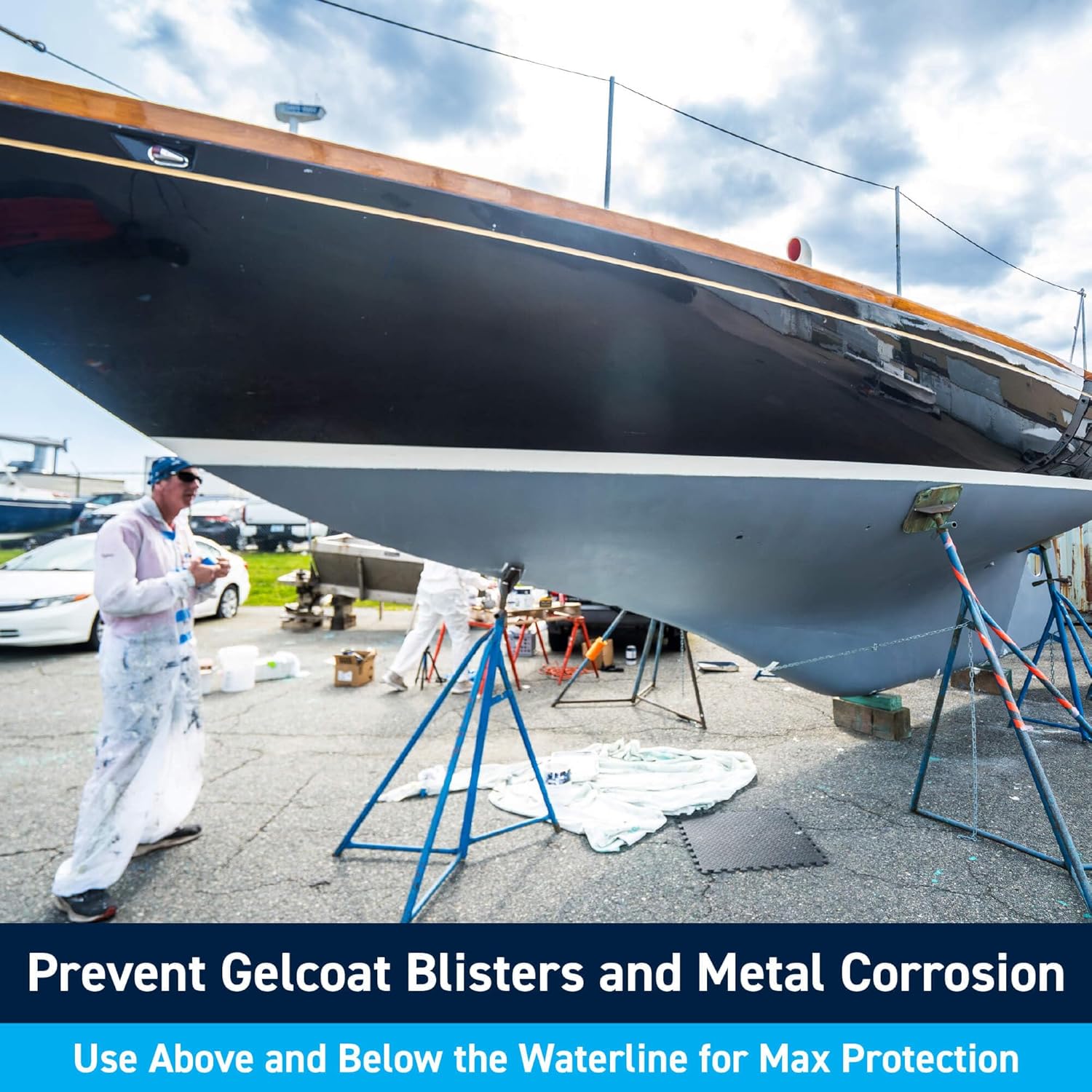
You pulled your boat last fall expecting a routine bottom job. Instead, you found a constellation of small, fluid-filled bubbles under the antifouling paint — some the size of a pencil eraser, a few as big as a quarter. That’s osmotic blistering, and it’s one of the most discouraging things a fiberglass boat owner can discover on a haulout. Osmotic blistering (from the Greek osmos, meaning “push”) happens when water molecules migrate through a fiberglass hull’s gelcoat and laminate, find something to react with — typically unreacted styrene, solvents, or other water-soluble compounds left over from original manufacture — and create pressurized pockets of acidic fluid. Left alone, those pockets keep growing, eventually delaminating the laminate structure itself. A barrier coat — specifically, a multi-layer system of high-build epoxy paint applied to the underwater hull — is the industry-standard defense. This article explains exactly how barrier coats work, where TotalProtect fits in the product landscape, how it compares against competing systems, and how to decide whether a full blister-prevention refit is the right call for your boat.
Why Fiberglass Hulls Blister (and Why Gelcoat Alone Doesn’t Stop It)
The core issue is that fiberglass-reinforced polyester — the construction material in the vast majority of production sailboats and powerboats built before the mid-1990s and many built after — is not inherently waterproof. Polyester resin is hygroscopic, meaning it absorbs water over time. Gelcoat (the pigmented outer skin of the hull) slows that absorption but doesn’t stop it. Per the BoatUS Foundation’s overview of osmotic blistering, water ingress rates through gelcoat can reach measurable levels within the first season of continuous immersion, and cumulative damage in boats kept in the water year-round accelerates significantly after the five-to-seven year mark.
The chemistry is worth understanding because it changes how you evaluate products. Water doesn’t cause blisters directly — the reaction between water and water-soluble compounds trapped in the laminate does. Those compounds (free glycols, hydrolyzed resins, acidic by-products) draw more water osmotically, building pressure inside the laminate faster than the surrounding material can equalize. The fluid inside a blister is often acidic enough to register clearly on a pH strip. Over time, the expanding blister mechanically separates glass fiber from resin matrix, weakening the hull structurally — not just cosmetically.
The epoxy barrier coat solution works because epoxy resin has a dramatically lower water vapor transmission rate (WVTR) than polyester. Per published technical data from Akzo Nobel (manufacturer of Interlux products), a properly applied five-coat system of Interprotect 2000E reduces water vapor transmission by approximately 95% compared to bare gelcoat. That’s not zero — no coating system is fully impermeable — but it slows ingress enough that osmotic chemistry essentially stalls.
The Product Landscape: TotalProtect, Interprotect, and WEST SYSTEM in Context
If you’ve priced out barrier coat systems recently, you’ve noticed the market breaks into three rough tiers.
Entry-level / value tier: TotalProtect (Interlux) TotalProtect is Interlux’s simplified, one-part barrier coat system marketed explicitly at do-it-yourself owners who want blister protection without mixing two-component epoxies. It applies like a conventional paint — roller and brush, no mixing ratio math, no pot life management — and the manufacturer rates it for use directly over sanded gelcoat or existing antifouling paint. At roughly $90–$120 per gallon (West Marine and Defender pricing as of May 2026), it’s accessible. The tradeoff is performance ceiling: TotalProtect is a modified epoxy ester, not a true two-part epoxy. Its WVTR reduction is lower than two-part systems, and Practical Sailor’s long-term barrier coat evaluations have consistently found that single-component “barrier” products underperform true two-part epoxies in sustained immersion tests. TotalProtect is appropriate for boats stored on a trailer or on the hard for most of the year, kept in fresh water (lower osmotic pressure than salt), or owners managing a budget refit who need something better than bare antifouling.
Mid-tier professional standard: Interlux Interprotect 2000E This is the system most professional yard applicators default to. It’s a two-part epoxy applied in five coats (three coats minimum per the Interlux TDS, five coats for new construction or bare fiberglass). The technical data sheet specifies a spread rate of approximately 160–200 sq ft per gallon per coat, meaning a 40-foot sailboat’s underwater hull (~450–500 sq ft) will consume roughly 12–15 gallons of mixed product for a five-coat system. At roughly $100–$130 per gallon retail (mixed), budget $1,200–$1,950 in materials alone before labor or prep costs. Interprotect 2000E requires attention to pot life (approximately two hours at 70°F), proper mixing ratios, and recoat windows — this is not a beginner product, but it’s well within reach for anyone who has done two-part epoxy work before.
Premium / performance tier: WEST SYSTEM 105 Epoxy with 205 or 206 Hardener Epoxyworks (WEST SYSTEM’s technical publication) documents a barrier coat protocol using their 105 resin thinned to approximately 15% with their 850 Fiberglass Boat Repair Compound or applied directly in multiple roller coats. This approach is common in professional refit yards handling bluewater cruisers where structural integration matters as much as water exclusion. It’s the most labor-intensive option and requires genuine comfort with WEST SYSTEM mixing protocols, but owners doing full blister repair (grind, dry, fill, re-coat) often find it cost-effective because the same resin system handles every phase of the job.
By the Numbers: Barrier Coat System Comparison
| System | Type | Approx. Retail ($/gal) | Coats Recommended | Best For |
|---|---|---|---|---|
| TotalProtect (Interlux) | 1-part epoxy ester | $90–$120 | 2–3 | Trailered/freshwater, budget refit |
| Interprotect 2000E (Interlux) | 2-part epoxy | $100–$130 (mixed) | 3–5 | Salt water, year-round immersion |
| WEST SYSTEM 105/205 | 2-part epoxy | $120–$160 (mixed) | 4–6 | Full refit, blister repair integration |
Pricing based on West Marine and Defender retail as of May 2026. Volume discounts available at Jamestown Distributors.
Surface Preparation: Where Barrier Coat Jobs Actually Fail
Here’s the frustration pattern that shows up repeatedly in owner forums and professional yard post-mortems: a boat gets a new barrier coat and blisters again within two to three seasons. In almost every case, the failure traces back to prep, not the coating system.
The West Marine blister prevention guide is direct on this point: the hull must be dry before barrier coat application. Moisture meters (the Tramex Skipper Plus is the most commonly referenced tool in marine applications) should read below 15% — ideally below 12% — throughout the laminate before you apply the first coat. A hull pulled in October and coated in November in a humid boatyard may never reach that threshold without active drying measures. Many yards now offer heated storage specifically to dry hulls between blister repair and coating. Rushing this step is the single most expensive mistake in barrier coat work, because re-doing it means grinding everything off and starting over.
Beyond moisture, surface profile matters. Two-part epoxy systems need a mechanical key — the substrate has to be sanded to 80-grit minimum (per Interlux’s published application guide for Interprotect 2000E) before the first coat. Solvent wiping with the manufacturer’s specified cleaner (not a substitute) removes surface contamination that would prevent adhesion. If you’re coating over existing antifouling, you need to confirm compatibility — not all antifouling formulas accept epoxy over the top without a full strip.
The Decision Framework: TotalProtect or Go Full System?
This is the question most practitioners are actually sitting with, so let’s make it explicit.
If your boat lives on a trailer or on the hard more than six months per year: TotalProtect is a reasonable choice. The osmotic pressure that drives blistering requires sustained immersion; seasonal use dramatically reduces the risk profile. One to two coats of TotalProtect under a quality antifouling paint addresses the realistic exposure without over-engineering the solution.
If your boat is kept in a freshwater slip year-round: The osmotic pressure differential in fresh water is lower than in salt, which slows blister formation. TotalProtect may be adequate, but if you’ve already had blister activity or if you’re doing a fresh bottom job on a bare hull, stepping up to Interprotect 2000E costs approximately $400–$600 more in materials for a 30-foot boat and dramatically extends your protection window. The math favors the upgrade.
If your boat is in salt water year-round, especially in warm water above 65°F: Warm salt water is the worst-case osmotic environment. Practical Sailor’s long-term testing has consistently documented that one-part systems underperform in sustained warm-salt immersion. Interprotect 2000E at five coats is the minimum defensible specification here. For a bluewater cruiser that will spend extended time in tropical water, the WEST SYSTEM protocol integrated with a full blister repair (if any existing damage is present) is the correct call, regardless of the additional cost.
If you’re buying a used boat with unknown bottom history: Don’t guess. Pull a core sample moisture reading before you agree to any price. Boats with existing blister damage — even repaired — should be treated as having compromised laminate until proven otherwise. Budget for the full Interprotect 2000E system at minimum, and add a 20% contingency for blister grinding and filling that always seems to expand once you’re into it.
Application Notes Worth Knowing Before You Start
A few details from manufacturer TDS documents that owners frequently miss:
Recoat windows are not optional. Interprotect 2000E has a recoat window of roughly 24–72 hours at 70°F. Apply outside that window and you need to sand between coats for adhesion. Many applicators working alone — doing one coat per day — hit this window perfectly without thinking about it. Schedule your project accordingly.
Tie-coat compatibility. If you’re transitioning from a barrier coat to an ablative antifouling (antifouling paint that wears away slowly through the season, releasing biocide), verify the manufacturer’s compatibility chart. Interlux publishes a full compatibility matrix in their product documentation. Mismatching a hard antifouling over a soft ablative base causes adhesion failure.
Temperature floors matter. Most two-part epoxy systems have a minimum application temperature of 50°F and require the substrate temperature to be at least 5°F above the dew point. Spring haulouts in northern yards frequently violate one or both conditions. An infrared thermometer and a dew point calculator (available free from NOAA’s instrumentation resources) are worth thirty minutes of your time before you crack the first can.
The bottom line is this: TotalProtect earns its place for low-immersion, budget-conscious situations, but it is not the right tool for a serious bluewater or year-round saltwater boat. The price delta between TotalProtect and Interprotect 2000E is real but modest relative to the cost of re-doing a failed job — and re-doing it means hauling the boat again, paying storage, stripping the bottom, and losing a season. Do it right the first time, prep the surface until it’s genuinely dry, follow the TDS, and a properly applied epoxy barrier coat system should give you seven to ten years of protection before you need to revisit it. That’s the investment case.