August 3, 2026 • Carmen Reyes • 11 min reading time • Specs verified June 25, 2026
Fast-Set vs. Slow-Set Marine Epoxy for Field Repairs: Matching Cure Speed to the Real Job
You’re tied to the dock for two days, the through-hull fitting collar is weeping, and you have a 6 a.m. splash scheduled. You reach into the repair kit and grab the first epoxy you see — but is it the right one? Marine epoxy (a two-part adhesive and filler system that cures through a chemical reaction between a resin and a hardener) is the backbone of field repairs on fiberglass, wood, aluminum, and most other boat substrates. The critical variable most owners overlook isn’t the brand or the color — it’s the cure speed: how fast the mixed product goes from liquid to a workable gel, and then to a fully hardened bond. Get that wrong, and you either run out of working time before the job is finished, or you’re sitting there for four hours watching a repair that should have taken forty-five minutes. This guide breaks down the real-world decision between fast-set and slow-set marine epoxies, names the tradeoffs explicitly, and gives you a clear decision rule for the most common repair scenarios.
| EDITOR'S PICKWEST SYSTEM G/flex Epoxy (2- 4o… | Mid-tierBrampton Marine Epoxy | Budget pickJ-B Weld 8272 MarineWeld Marine… | |
|---|---|---|---|
| Work Life | — | 5 min | — |
| Cure Time | — | 1 hour | — |
| Mix Ratio | — | 1:1 | — |
| Container Size | 4 oz | 4 oz | 2 oz |
| Waterproof | — | ✓ | — |
| Chemical Resistant | — | ✓ | — |
| Price | $27.90 | $12.79 | $7.29 |
| See on Amazon → | See on Amazon → | See on Amazon → |
Why Cure Speed Is the Variable That Actually Matters
Every two-part epoxy has two time windows you need to understand:
- Pot life (also called working time): how long you have after mixing before the epoxy becomes too thick or starts to gel and can no longer be applied or repositioned.
- Full cure time: how long until the bond reaches its rated mechanical strength — typically 24–72 hours depending on temperature and formulation.
These two windows are inversely related. Fast-set epoxies have short pot lives (sometimes as little as 4–6 minutes at 70°F) and reach handling strength in under an hour. Slow-set epoxies may give you 30–60 minutes of working time but won’t be load-bearing for 24 hours or more. Temperature accelerates both windows dramatically — a slow hardener that behaves reasonably at 65°F can catch you off-guard at 85°F.
According to the MAS Epoxies Slow Hardener Technical Data Sheet, pot life shrinks meaningfully as temperature climbs above 75°F. That’s a cautionary data point worth anchoring: “slow” is always relative to the temperature you’re working in, not just the label on the can. The Epoxyworks article “Choosing the Right Hardener,” published by Gougeon Brothers on epoxyworks.com, reinforces the same principle — hardener selection is fundamentally a temperature-adjusted decision, not a fixed property of the product.
The Exothermic Heat Problem
Here’s a mistake that trips up intermediate practitioners once and then never again: mixing too large a batch of fast-set epoxy in a deep cup. Epoxy cures through an exothermic reaction — it generates its own heat as it hardens. In a small, deep mass (like a mixing cup), that heat concentrates and accelerates the cure further, creating a feedback loop. The result is a cup that gets scorching hot, smokes, and hardens in under two minutes. You’ve wasted material and potentially created a fire hazard. The fix is to mix in a wide, shallow container — a disposable aluminum pie plate works well — which spreads the mass and lets the heat dissipate. This is especially critical with 5-minute formulations in ambient temps above 75°F.
The Products Worth Comparing
The comparison below is organized by cure speed tier. Each subsection identifies the product’s practical niche, its honest limitations, and the repair scenarios where it earns its spot in the kit.
Fast-Set: J-B Weld KwikWeld
J-B
$7.29
In stock on Amazon
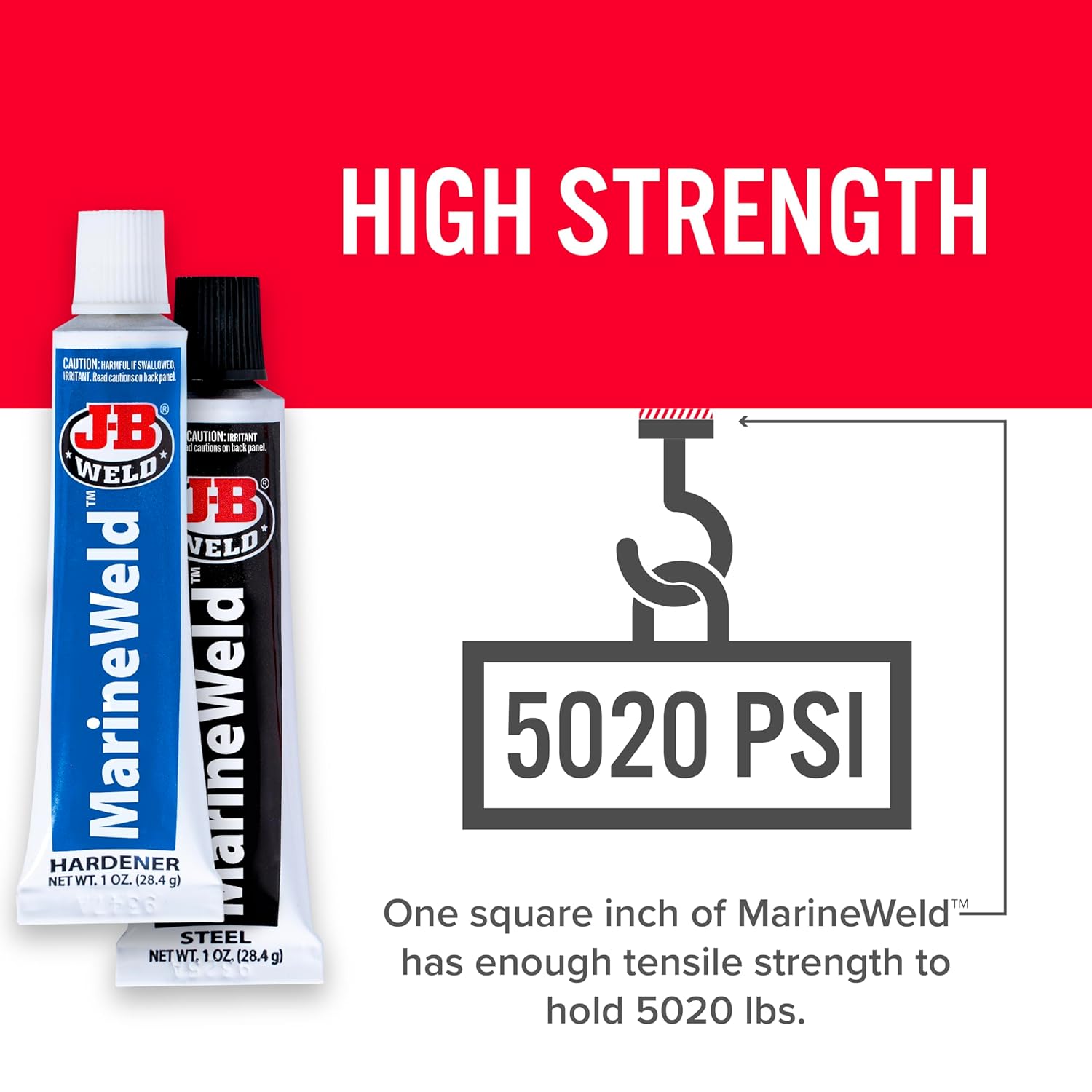
Check price on AmazonKwikWeld is the field repair standby for situations where you need a rigid structural bond in under an hour. The syringe applicator delivers a pre-measured 1:1 resin-to-hardener ratio — this is the feature that separates it from tube-style products where eyeballing the ratio is common and costly. The cured bond is hard and rigid, appropriate for non-flexing substrate repairs like fiberglass flanges, metal fittings, and through-hull seat repairs.
Per the J-B Weld KwikWeld Product Safety Data Sheet, KwikWeld requires clean, dry surfaces for a reliable bond — it is not rated for underwater application or for bonding to wet surfaces. That’s the first and most important limitation to know before reaching for it in a wet marine environment.
Working time tradeoff: With a pot life measured in minutes rather than tens of minutes, you need your surface prepped, cleaned, and clamped before you mix. At ambient temperatures above 80°F, that window compresses further. Mix in a shallow container and mix no more than you can apply in 60 seconds.
Rigidity tradeoff: KwikWeld is not suited for repairs where the substrate flexes — deck seams, rubber hose connections, or laminated core sections subject to vibration. The rigid cure that makes it excellent for metal-to-metal and fiberglass-to-metal bonds becomes a failure point under cyclic flex.
J-B
$7.29
In stock on Amazon
Check price on AmazonMid-Tier: J-B Weld MarineWeld
Brampton
$12.79
In stock on Amazon
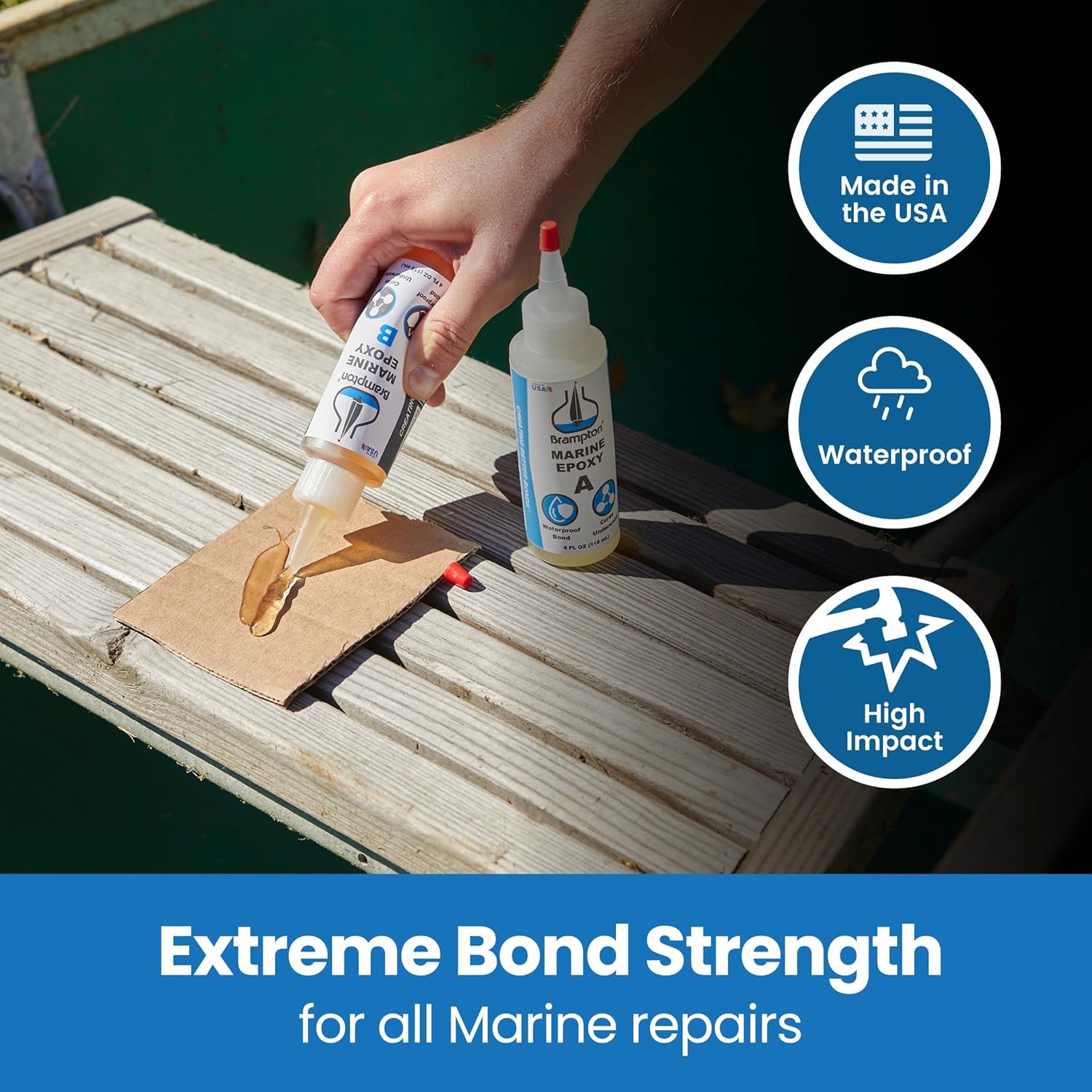
Check price on AmazonMarineWeld occupies a distinct position from KwikWeld: it is specifically formulated for wet and marine environments. Per the J-B Weld MarineWeld Product Safety Data Sheet, it is formulated to cure in the presence of water and is rated waterproof — making it the appropriate J-B Weld product for repairs where the surface is damp or will be exposed to continuous immersion after cure.
The practical profile: MarineWeld gives you slightly more working time than a 5-minute fast-set product, waterproof cure chemistry, and reliable performance across fiberglass, aluminum, steel, and wood substrates that have seen water exposure. Practical Sailor’s “Epoxy Adhesive Roundup,” published on practicalsailor.com, identifies waterproof-rated marine epoxies as consistently more reliable in wet-environment bonding tests than standard hardware-store epoxies applied to the same substrates.
Working time tradeoff: MarineWeld is faster than a slow-set flexible system but slower than KwikWeld, which makes it a reasonable middle ground when you need waterproof performance without the complexity of a two-part flexible system.
Quantity note: The syringe format is sized for small repairs. For bond areas larger than a few square inches, plan to have multiple syringes on hand before you start — running out mid-application with an open joint is one of the more avoidable repair failures.
Brampton
$12.79
In stock on Amazon
Check price on AmazonSlow-Set Flexible: West System G/flex 655
WEST
$27.90
In stock on Amazon
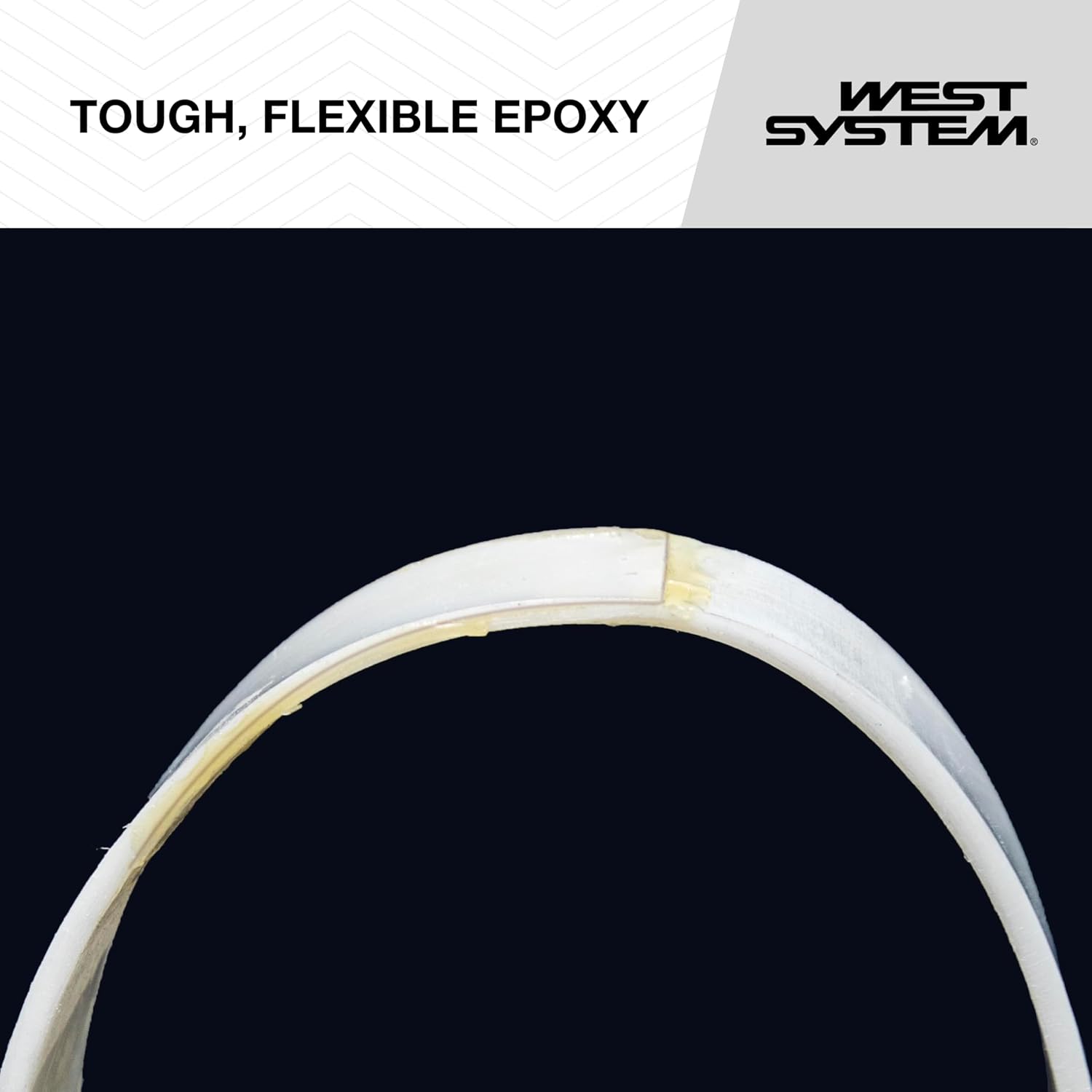
Check price on AmazonG/flex is the most-cited flexible marine epoxy in the practitioner community, and its use profile is distinctive for one reason: substrate diversity. Per the Gougeon Brothers G/flex Epoxy Technical Data Sheet, G/flex is formulated with a toughened, semi-flexible cure — not rubber-soft, but with enough elongation to absorb vibration and minor substrate movement that would crack a rigid epoxy bond. Owners report using it successfully on aluminum, steel, stainless steel, carbon fiber, fiberglass, ceramics, and rigid rubber fittings.
The Epoxyworks article “Choosing the Right Hardener” on epoxyworks.com places flexible slow-set systems like G/flex in the category of repairs involving dissimilar materials or substrate flex — specifically because the coefficient of thermal expansion differs significantly between metals and fiberglass, and a rigid bond in that joint eventually cracks under thermal cycling even if the initial adhesion is strong.
Temperature-adjusted working time: Per the Gougeon Brothers G/flex Technical Data Sheet, G/flex provides approximately 45 minutes of pot life at 70°F. At 85°F, that window compresses to roughly 20–25 minutes. Batch size matters — larger mixed volumes generate more exothermic heat and will shorten that window further. For hot-weather G/flex work, mix smaller batches and work in the shade.
Where G/flex earns the premium call: Stringer bonding, through-hull rebedding, aluminum-to-fiberglass transitions, keel joint repair, and backing plate installation on dissimilar materials. The pot life supports careful work — wetting out both mating surfaces, positioning components, and applying clamping pressure before the adhesive starts to grab — in a way that fast-set products cannot.
What G/flex is not: It is not a substitute for purpose-made inflatable boat repair adhesives. For PVC or Hypalon inflatable fabric, dedicated PVC or Hypalon adhesives are required — those substrates need a different chemistry for durable flexible bonds. G/flex works on rigid rubber fittings; it is not designed for flexible membrane repair.
WEST
$27.90
In stock on Amazon
Check price on AmazonBy the Numbers: Approximate Working Time vs. Temperature
| Product Type | 60°F | 70°F | 85°F |
|---|---|---|---|
| Fast-set rigid (KwikWeld-class) | 8–10 min | 4–6 min | 2–3 min |
| Mid-set waterproof (MarineWeld-class) | 20–25 min | 12–15 min | 8–10 min |
| G/flex 655 slow-set flexible | 60–70 min | ~45 min | 20–25 min |
| MAS or West System slow-hardener | 90+ min | ~60 min | 35–45 min |
Sources: Gougeon Brothers G/flex Epoxy Technical Data Sheet; MAS Epoxies Slow Hardener Technical Data Sheet; West Marine Technical Staff, “Epoxy Basics,” West Marine Advisor series. Times are approximate and vary with batch size and mixing container geometry.
One Field Technique Worth Knowing
With fast-set formulations on vertical or overhead surfaces, there is a useful practitioner technique: after mixing, let the epoxy sit in the cup for 30–60 seconds before applying. This allows the initial exothermic reaction to begin and the viscosity to increase slightly — which helps the material stay in place on a vertical hull surface rather than sagging. It reduces your usable window further, so you need to plan your application sequence in advance, but for gap-filling on vertical fiberglass, the slightly thickened material is far easier to control than the freshly mixed liquid.
Decision Rule: If X, Then Y
If your repair is rigid substrate + small geometry + time pressure (fitting, flange, cleat base, metal bracket): use a fast-set rigid system like KwikWeld. Mix small batches, use a shallow container, have all surfaces prepped before you crack the syringe. Confirm the surface is dry — if it isn’t, KwikWeld is not the right product.
If your repair involves wet exposure + moderate bond area + no extreme time pressure: MarineWeld gives you waterproof cure chemistry with slightly more working room than a 5-minute product. It is the right call when the substrate has seen water and will see it again.
If your repair involves dissimilar materials, a flexing substrate, or complex geometry (aluminum-to-fiberglass transition, rigid rubber hose fitting, stringer bonding, keel joint): G/flex is the call. The pot life supports careful work, and the semi-flexible cure survives the vibration and thermal cycling that would eventually crack a rigid bond.
If you’re doing a planned laminating or void-fill job where working time is the primary concern and structural load matters more than flexibility: a slow-hardener system — West System with slow hardener or MAS Slow Hardener, as detailed in the MAS Epoxies Slow Hardener Technical Data Sheet — is appropriate. But verify your pot life expectation against the manufacturer TDS for your actual ambient temperature before committing to a complex setup.
If ambient temperature is above 85°F: move everything toward the slower end of the spectrum by one step. The fast product becomes unworkably fast; the slow product becomes medium. Work in the shade, pre-chill your resin and hardener if possible, and mix smaller batches than you think you need.
Frequently Asked Questions
Can I use J-B Weld KwikWeld underwater or on a wet surface? No. Per the J-B Weld KwikWeld Product Safety Data Sheet and J-B Weld’s published product differentiation materials, KwikWeld requires clean, dry surfaces for a reliable bond. It is not rated for underwater application or for bonding to wet surfaces. MarineWeld is the appropriate J-B Weld product for those conditions.
How does cold weather affect MarineWeld cure time? Cold dramatically slows the curing reaction. Practical Sailor’s epoxy coverage notes that most two-part epoxies need ambient temperatures above 50°F for reliable cure. Below 40°F, the cure may stall or produce an incomplete bond. In cold conditions, warm the substrate and mixing area if possible, or accept that handling time will extend well beyond the label claim.
What is the actual working time of G/flex at 70°F vs. 85°F? Per the Gougeon Brothers G/flex Epoxy Technical Data Sheet and Epoxyworks editorial guidance on epoxyworks.com, G/flex provides approximately 45 minutes of pot life at 70°F. At 85°F, that window compresses to roughly 20–25 minutes. Larger mixed volumes shorten the window further due to exothermic heat concentration. For hot-weather G/flex work, mix smaller batches and work in the shade.
Why did my epoxy get extremely hot and smoke in the mixing cup? This is the exothermic reaction concentrating in a deep, small-diameter cup. When resin and hardener react, they generate heat — and in a confined geometry, that heat re-accelerates the cure, which generates more heat. The fix is to mix in a wide, shallow container (aluminum pie plates are a common field solution) and avoid mixing more than you can apply within your working window when using fast-set products.
Is G/flex flexible enough to use on inflatable boat fabric or rubber fittings? G/flex is semi-flexible and performs well on rigid rubber fittings such as those used on through-hulls and hose barbs. For inflatable boat fabric (PVC or Hypalon), dedicated PVC or Hypalon adhesives are the manufacturer-recommended approach — those substrates require a different adhesive chemistry for durable flexible bonds. G/flex is not a substitute for purpose-made inflatable repair kits on flexible membrane materials.