July 20, 2026 • Carmen Reyes • 11 min reading time • Specs verified June 25, 2026
J-B Weld MarineWeld vs. G/flex vs. KwikWeld: Matching Epoxy Working Time to the Repair
You’re standing at the workbench with a cracked bracket, a leaking through-hull fitting, or a stress fracture in a fiberglass panel — and you’re looking at three tubes of epoxy wondering which one to grab. Epoxy (a two-part adhesive that cures through a chemical reaction when a resin and hardener are mixed together) sounds simple until you realize that “marine epoxy” covers a surprisingly wide range of products with very different personalities. Working time — the window between when you mix the epoxy and when it becomes too stiff to shape or press into place — varies from about five minutes to several hours depending on the product. Pick too fast and you’re racing the clock and making mistakes. Pick too slow on a small repair and you’re babysitting a fitting for an hour when you could be moving on. This article breaks down three products that come up constantly in refitting conversations — J-B Weld MarineWeld, West System G/flex, and J-B Weld KwikWeld — so you can match the right epoxy to the actual repair in front of you.
| EDITOR'S PICKWEST SYSTEM G/flex Epoxy (2- 4o… | Mid-tierBrampton Marine Epoxy | Budget pickJ-B Weld 8272 MarineWeld Marine… | |
|---|---|---|---|
| Work Time | — | 5-Min | — |
| Cure Time | — | 1 Hour | — |
| Mix Ratio | — | 1:1 | — |
| Size | 4 oz | 4 oz | 2 oz |
| Waterproof | — | ✓ | — |
| Chemical Resist. | — | ✓ | — |
| Price | $27.90 | $12.79 | $7.29 |
| See on Amazon → | See on Amazon → | See on Amazon → |
The Three Products: What They’re Actually Designed For
These aren’t interchangeable. Each one was engineered with a specific use-case emphasis, and understanding that context changes how you evaluate reviewer complaints and praise.
J-B Weld MarineWeld: Long Open Time, Rigid Cure, White Option
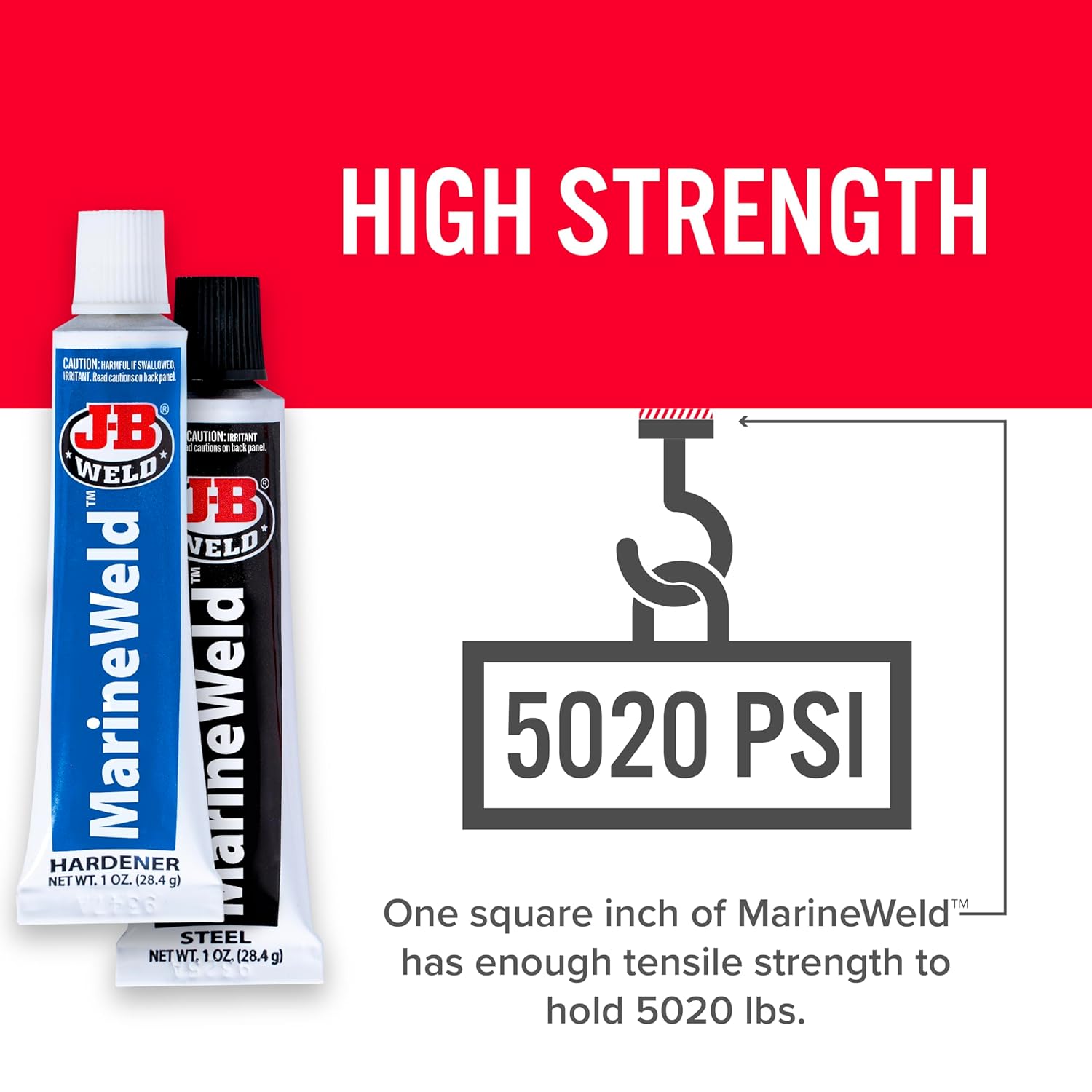
J-B Weld MarineWeld is a two-part epoxy specifically formulated for underwater and marine applications. The manufacturer-published working time is approximately 60 minutes, with a full cure at room temperature of around 15–16 hours. It cures to an off-white or white color depending on the syringe variant selected, is rated to 300°F after cure, and carries a tensile strength rating of approximately 1,300 PSI per J-B Weld’s published product technical data sheet.
The white-curing syringe version earns specific attention for fiberglass work: reviewers consistently use it on white gelcoat surfaces and fiberglass shower pans because the color match reduces the need for cosmetic rework. That same logic applies directly to white hull gelcoat repairs — a connection that doesn’t always surface in product descriptions but matters enormously when appearance counts. Practical Sailor’s epoxy adhesive comparison notes that partial-use reliability is a genuine differentiator in the two-part syringe market, where hardener components can begin to cure at the tip with poor cap design and waste expensive product. MarineWeld’s syringe cap reseals reliably between uses — a feature that shows up consistently in owner reviews as a top satisfaction driver, not just a convenience detail.
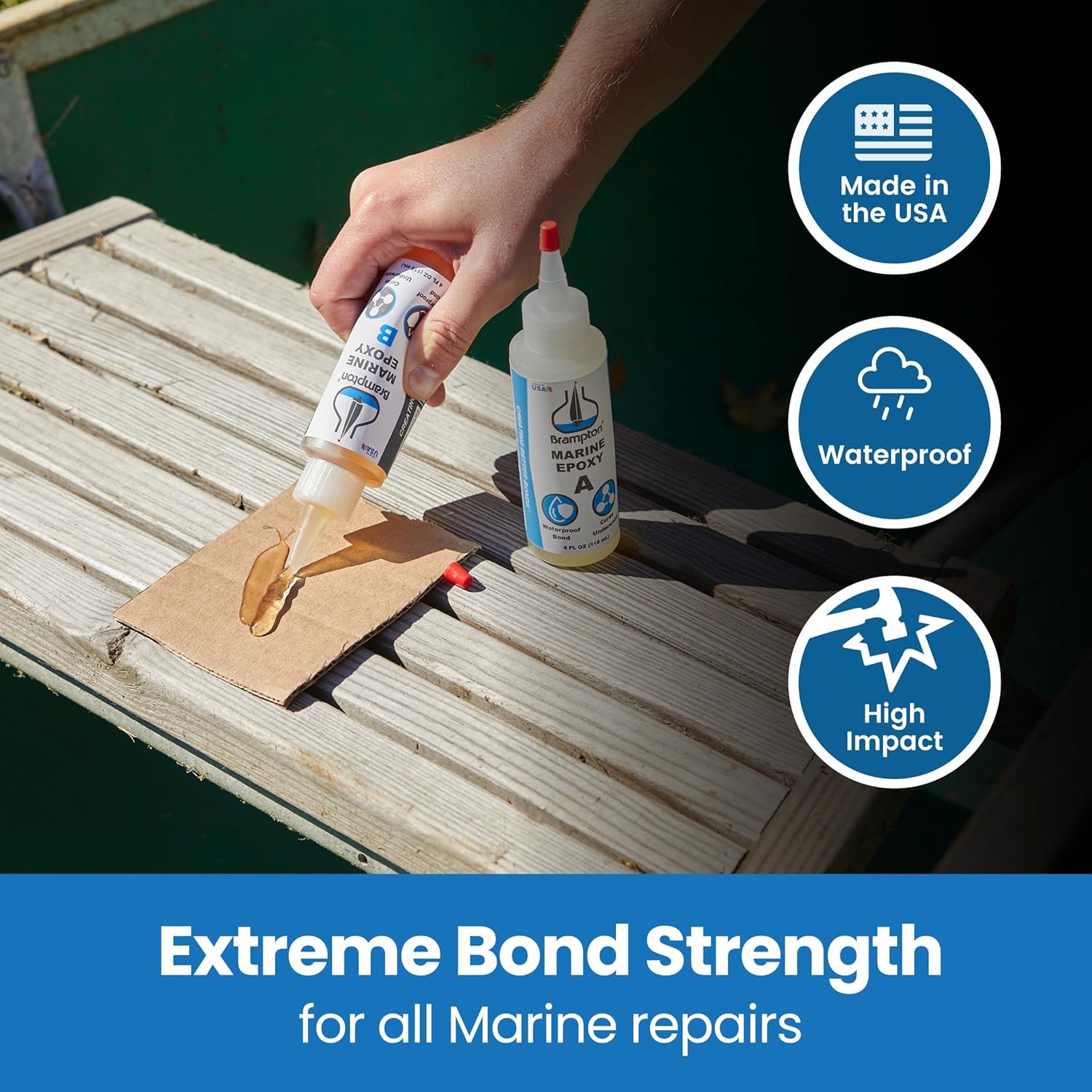
Brampton
$12.79
In stock on Amazon
Check price on AmazonWest System G/flex: Flexible Cure, Dissimilar Materials, Demanding Prep
West System G/flex is in a different category entirely. Where MarineWeld is a rigid-cure structural adhesive, G/flex is specifically engineered by Gougeon Brothers to cure to a semi-flexible state. Per the Gougeon Brothers technical overview published in Epoxyworks (the Gougeon Brothers technical journal available at epoxyworks.com), G/flex retains flexibility after cure to accommodate the movement and flex that occur in boats, vehicle panels, and composite structures underway. Working time is approximately 45 minutes.
Owner reviews span an unusually wide range of applications — snowboards, ceramic fountains, surfboards, aluminum boats, knife handles — and the through-line in positive reviews is almost always thorough surface preparation. The Gougeon Brothers G/flex technical documentation specifically names contamination as the primary bond failure mechanism, and that pattern holds in aggregated owner experience: the people who report failures almost universally skipped or rushed surface cleaning, while those who prepped methodically report bonds that outlasted the surrounding material. BoatUS Foundation’s fiberglass repair guidance (published at boatus.com) reinforces this point, noting that adhesion failures in epoxy-bonded fiberglass repairs trace most often to surface contamination, not product limitations.
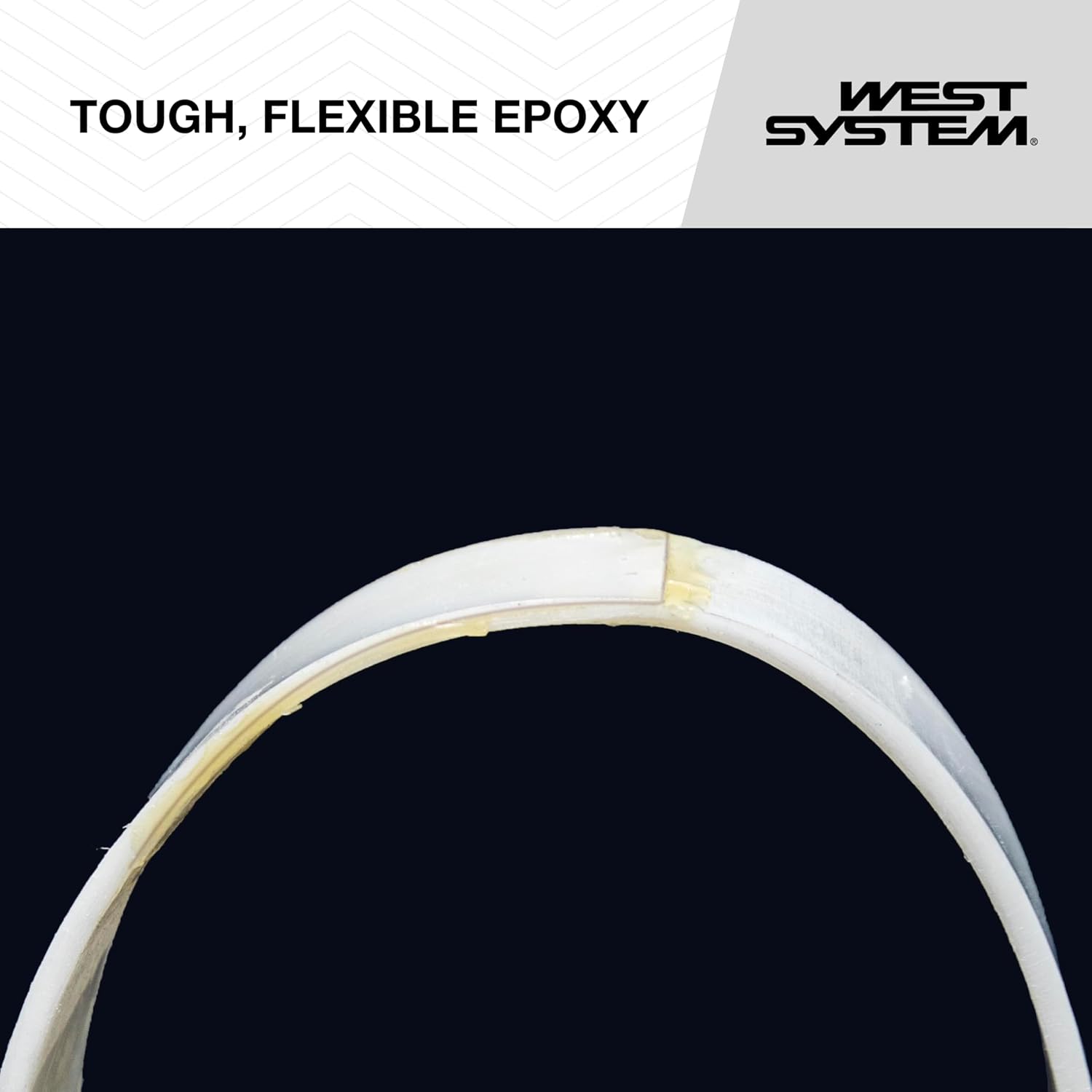
WEST
$27.90
In stock on Amazon
Check price on AmazonJ-B Weld KwikWeld: Five-Minute Window, Per-Use Freshness, Speed Premium
J-B Weld KwikWeld is the fast-cure variant — approximately 4–6 minutes of working time with full cure in about 6 hours. The 2-pack format (individual single-use packets rather than a shared syringe) is consistently flagged by buyers as a freshness advantage: each packet is sealed and mixed fresh per use, which eliminates the degradation risk from repeated openings. Reviewers note the cost-per-application feels higher than the syringe format, but the freshness guarantee is the explicit reason they keep buying it. This is the tradeoff KwikWeld asks you to make — speed and per-use reliability over volume economy. Per J-B Weld’s published product technical data sheet, KwikWeld carries a tensile strength rating of approximately 1,770 PSI after full cure.
J-B
$7.29
In stock on Amazon
Check price on AmazonWorking Time as a Workflow Decision, Not Just a Spec
Here’s where intermediate practitioners often get tripped up: working time isn’t just about how long you have before the epoxy kicks. It’s a workflow constraint that changes how you have to set up the repair.
KwikWeld’s ~5-minute window is a discipline requirement, not just a feature. Reviewers who praise it consistently report the same workflow: everything is staged, surfaces are prepped, clamping or support is ready, and mixing happens last. The ones who report failures typically describe mixing first and then discovering a fit problem or a missing tool. Treat KwikWeld’s working time as a workflow rule — prep everything, then mix — and it becomes a genuine advantage for small, clean repairs where you want to move on without waiting.
MarineWeld’s 60-minute window is the opposite kind of gift. For repairs that require repositioning, fitting a curved surface, or building up material in stages, an hour of open time is significant. It’s also the right choice when working conditions are imperfect — cooler temperatures slow epoxy cure further, and in a cold boatyard or early spring refit environment, that 60-minute rating gives you a real working buffer.
G/flex’s 45-minute window lands in the middle, but the more important property is what happens after cure. The flexibility is the primary decision variable, not the open time.
Working time and cure comparison:
| Product | Working Time | Full Cure | Tensile Strength | Post-Cure State |
|---|---|---|---|---|
| MarineWeld | ~60 min | ~15–16 hrs | ~1,300 PSI | Rigid |
| G/flex 655 | ~45 min | ~24 hrs | ~3,600 PSI* | Flexible |
| KwikWeld | ~4–6 min | ~6 hrs | ~1,770 PSI | Rigid |
*G/flex tensile strength per Gougeon Brothers published technical data sheet. Note that G/flex’s flexibility trades some compressive hardness for peel and elongation resistance — the PSI figure alone understates its practical bond strength in flex-loaded applications.
Matching Product to Repair Type
Understanding what each product was built for prevents the most common epoxy mistakes: using a rigid adhesive in a flexing joint, or using a slow system when speed is genuinely needed.
If the structure will flex underway, G/flex is the answer. A hull panel, a deck fitting in a high-stress area, an aluminum rub rail bonded to fiberglass — anywhere that the joint will see movement and peel stress, a rigid epoxy is working against you. The Gougeon Brothers Epoxyworks technical documentation and BoatUS Foundation’s fiberglass repair guidance (boatus.com) both make this point explicitly: rigid adhesives in flexible structures fail at the bond line because the epoxy cannot absorb cyclical loading. G/flex was developed specifically for this problem. Scuff with 80-grit, wipe with acetone, let it flash off completely — then apply. Done correctly, G/flex bonds regularly outlast the surrounding substrate.
If the repair is rigid-to-rigid and you have time, MarineWeld is the workmanlike choice. Below-waterline hardware, structural brackets, through-hull reinforcement, transducer mount installation — repairs where both substrates are stiff, the bond needs to hold against shear, and you want an hour to work cleanly. The white syringe variant earns specific consideration for any repair on white fiberglass where you’ll be finishing over the epoxy but want the substrate color to minimize edge bleed visibility.
If the repair is small, rigid, and speed is the priority, KwikWeld makes sense — but only if you’ve already staged everything before the packet opens. Think: a small metal fitting that worked loose, a hose clamp boss that cracked, a cleat backing plate you need to re-bond before the boat goes back in the water this afternoon. Stage, prep, then mix. Not the other way around.
Dissimilar materials — bonding aluminum to fiberglass, fiberglass to steel, or composite to wood — favor G/flex across the board. West Marine’s boating resources on epoxy selection and Practical Sailor’s epoxy adhesive comparison (practicalsailor.com) both flag differential thermal expansion (the tendency of different materials to expand and contract at different rates with temperature change) as the primary failure mechanism in dissimilar-material bonds. G/flex’s post-cure flexibility accommodates that movement. Rigid epoxies like MarineWeld and KwikWeld can handle small dissimilar-material bonds under low stress, but for anything load-bearing or exposed to temperature cycling, G/flex is the correct call.
Frequently Asked Questions
Can J-B Weld MarineWeld be used to repair a cracked fiberglass hull below the waterline?
Yes, with caveats. MarineWeld is rated for continuous water immersion per J-B Weld’s published product data, and owner experience includes below-waterline applications on hulls and fittings. However, for a structural crack in a load-bearing hull section, MarineWeld should be treated as a temporary repair or a fill-and-fair step, not a structural laminating system. A proper fiberglass hull repair involves restoring the glass fiber reinforcement — the woven or chopped strand mat that gives fiberglass its structural integrity — not just filling the crack with epoxy. MarineWeld fills and bonds; it does not reinforce. For a cosmetic crack or a pinhole in non-structural fiberglass, it is a legitimate repair. For anything that compromises structural integrity, get a marine surveyor’s opinion before trusting any adhesive-only repair.
What is the difference between the MarineWeld tube format and the syringe format beyond packaging?
The functional difference is proportioning accuracy and resealing reliability. The syringe format dispenses equal amounts of resin and hardener simultaneously through a dual-barrel mechanism, reducing the risk of off-ratio mixing — a common source of soft or tacky cures. The tube format requires manual proportioning (typically 1:1 by volume), which works fine with care but introduces more opportunity for user error. The white-curing syringe variant also serves a specific cosmetic function the standard format does not address. For most repair applications, the syringe is the better choice; the tube format makes more sense for bulk applications where larger amounts are mixed on a palette.
Does G/flex stay flexible after curing, and does that matter for hull repairs?
Yes, G/flex retains flexibility after a full cure. The Gougeon Brothers technical documentation (Epoxyworks, epoxyworks.com) describes the cured state as “toughened epoxy” with elongation-to-break characteristics significantly higher than standard rigid epoxies. For hull repairs on boats that flex underway — especially lighter fiberglass or composite boats, catamarans, or any vessel in offshore conditions where the hull works against wave loads — this matters. A rigid epoxy bond in a flexing structure is a stress riser: it concentrates load at the bond line because it cannot move with the surrounding material. G/flex distributes that stress by flexing with the joint.
Can KwikWeld be used for wet layup fiberglass laminating work?
No. Laminating fiberglass requires a low-viscosity epoxy system designed for wet layup — typically a dedicated marine laminating epoxy. KwikWeld and MarineWeld are adhesives, not laminating resins. They are too viscous to saturate fiberglass cloth properly and do not offer the extended open time needed to wet out multiple cloth layers. Using a two-part adhesive epoxy for laminating work will result in unimpregnated dry glass fiber and a structurally compromised repair. For any laminating work, use a proper marine laminating system.
How do you bond aluminum to fiberglass, and which epoxy handles dissimilar materials best?
G/flex is the consensus choice for aluminum-to-fiberglass bonds, and prep discipline matters more than the product selection itself. The Gougeon Brothers documentation recommends abrading aluminum with 80-grit sandpaper, then wiping with solvent immediately before bonding — aluminum re-oxidizes quickly, so timing between prep and application matters. The fiberglass surface should similarly be abraded and solvent-wiped. G/flex’s post-cure flexibility then accommodates the different thermal expansion rates of aluminum and fiberglass through temperature cycles. Owner experience with aluminum boat repairs using G/flex consistently attributes success to this prep sequence; reports of failures almost always describe skipped or abbreviated surface preparation.
The Decision Rule
If the joint will flex: G/flex, always. Prep the surface like you mean it.
If the joint is rigid-to-rigid, you need submersion resistance, and you have time to work: MarineWeld, syringe format. White variant if the substrate is white gelcoat.
If the joint is small, rigid, and you need it done in the next ten minutes: KwikWeld — but stage everything before you open the packet, because five minutes is not a suggestion.
The mistake to avoid is treating working time as the only variable. What the bond will experience after cure — flex, shear, peel, thermal cycling, water exposure — determines the product. Working time determines your workflow. Get both right and the repair holds; get one wrong and you’re doing it again next season.