October 18, 2026 • Carmen Reyes • 10 min reading time • Specs verified June 25, 2026
Epoxy for Non-Boat Repairs: When G/flex, MarineWeld, and TotalBoat 5:1 Go Off the Water
You’ve probably already noticed this: the marine epoxy sitting on your shop shelf is almost certainly better than whatever hardware-store adhesive you’d reach for on a house repair, a broken ski, or a cracked RV roof panel. Marine epoxy — a two-part adhesive system where a liquid resin and a hardener are mixed together in a precise ratio to create a chemical bond far stronger than glue — was engineered to survive salt water, UV exposure, freeze-thaw cycles, and constant vibration. That’s serious overkill for a shower door hinge. Which is exactly why it works so well.
This article is built around a specific decision problem: you have a non-marine repair in front of you, you already own (or are about to buy) G/flex, J-B Weld MarineWeld, or TotalBoat 5:1, and you need to know whether you’re reaching for the right tool — and how not to hurt yourself doing it. One reviewer’s TotalBoat 5:1 incident, which produced near-boiling epoxy and required emergency water dousing, is the kind of lesson worth learning secondhand.
The Three Axes That Actually Drive the Decision
Before naming products, get clear on three variables. Every off-boat epoxy decision collapses into these:
1. Does your repair surface flex or vibrate? A standard rigid epoxy — TotalBoat 5:1, MarineWeld, most two-part systems — cures to a hard, glass-like solid. That’s ideal on a static substrate like a concrete crack, a cast-iron pipe collar, or a fiberglass hull panel that doesn’t move. It is not ideal on a snowboard, a car bumper, a leaf spring mount, or anything that cycles through flex. Rigid epoxy on a flexing substrate will crack at the bond line, sometimes quickly.
2. How much working time do you actually need? Pot life — the window between mixing and the epoxy becoming too viscous to work — is temperature-dependent in ways that bite people who don’t expect it. At 65°F, a “slow” hardener gives you generous working time. At 80°F, that same hardener can gel faster than the label implies. The flip side: fast-cure systems let you get in, bond, and move on, but they punish hesitation.
3. What is your substrate, and is it contaminated? Epoxies bond to clean, sound material. Oily metal, chalky gelcoat, wet wood, and oxidized aluminum all undermine a bond before you even start. The product you choose matters less than the surface prep — but some formulations are more tolerant of marginal prep than others.
Product-by-Product: What Reviewers Keep Saying Off the Water
West System G/flex (655 Series)
G/flex is the outlier in this category because it was explicitly engineered for toughened, flexible bonding — the Gougeon Brothers’ own technical documentation describes it as designed to accommodate movement and shock loading. That’s why reviewers keep reaching for it outside the boat shed.
Across aggregated owner accounts, the pattern is consistent: G/flex shows up on snowboard delaminations (the top sheet peels away from the core and needs an adhesive that’ll survive the board flexing thousands of times), knife handle scales (handles see vibration and impact), and carbon fiber component repairs where the material itself has some give. The key published spec to know: G/flex cures to a Shore D hardness significantly lower than standard West System 105 resin, meaning it retains measurable elasticity at full cure.
The tradeoff is that G/flex’s working properties are thicker and more gel-like than liquid laminating epoxies. It’s not the right pick for thin wet-out or deep penetration into punky wood — it’s a gap-filling, bonding product for surface joints under mechanical stress.
If your repair flexes, vibrates, or absorbs impact: G/flex.
J-B Weld MarineWeld
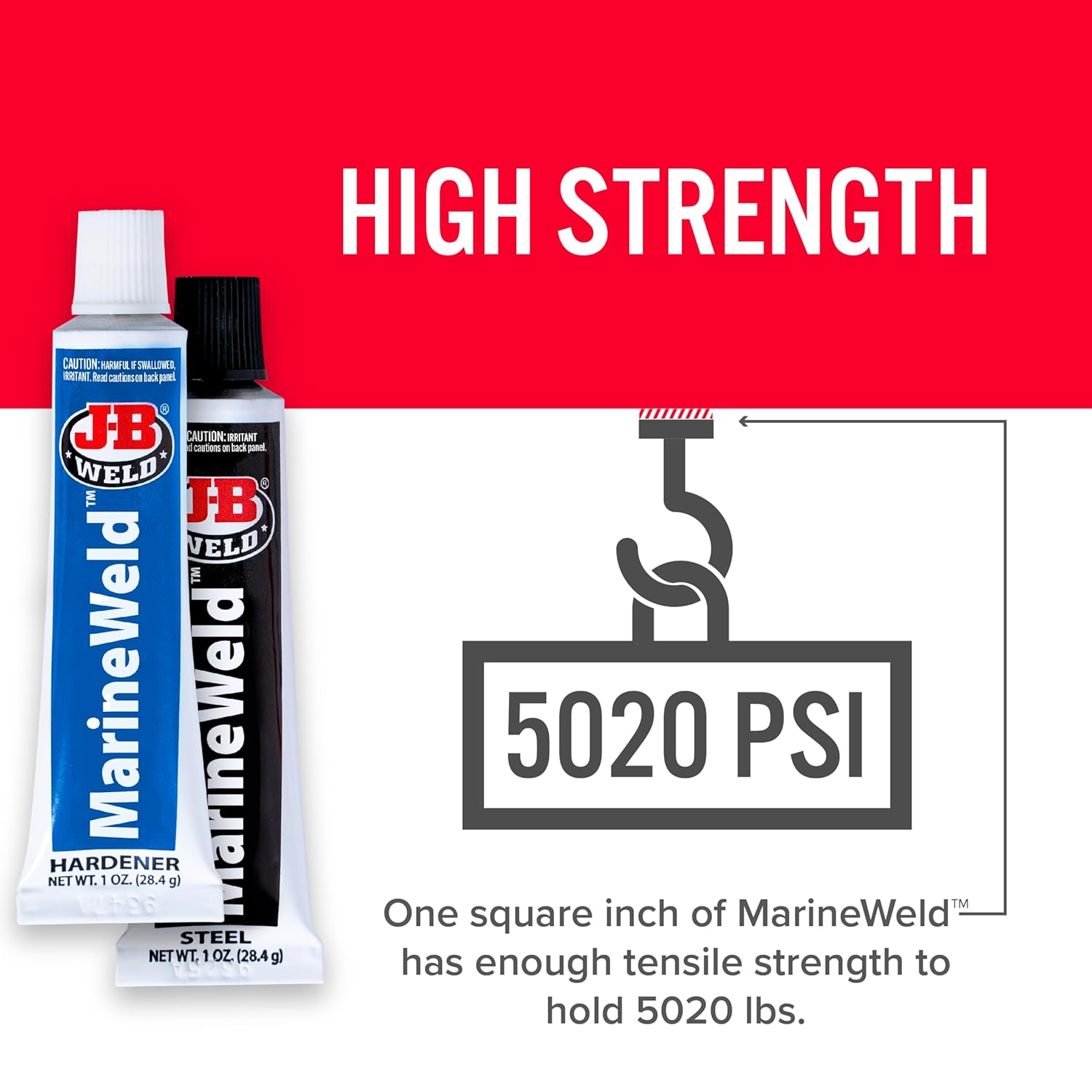
MarineWeld is a dual-syringe (two separate tubes, equal-volume mix) system — and the syringe format is the reason it keeps showing up in non-marine contexts. The mix ratio is controlled by the dispenser, removing one of the most common failure modes with two-part epoxies (getting the ratio wrong). Reviewers praise it consistently for this reason, echoing what appears across automotive forums and home repair communities: the KwikWeld and MarineWeld syringe systems are practically foolproof for small repairs.
Per J-B Weld’s own technical bulletin, MarineWeld is formulated for water immersion resistance and passes basic fuel resistance tests. Off-boat, that specification translates directly: shower door frames, pool filter housings (a repair appearing repeatedly in reviewer accounts), and PVC plumbing components in wet environments are natural fits.
The honest limitation: the cure is rigid. Per published specs, MarineWeld cures to high tensile strength but low flexibility. It is not the right choice anywhere the substrate moves. It’s also not magic on oily or contaminated surfaces — more on that in the FAQ section below.
If your repair is small, static, and in a wet environment, and you want no-fuss mixing: MarineWeld.
TotalBoat 5:1 Epoxy
TotalBoat’s 5:1 system (five parts resin to one part hardener by volume) is a workhorse laminating and filling epoxy that competes directly with West System 105/205 in the serious DIY market. Off-boat users have leaned on it for RV subfloor rot repair (replacing degraded plywood under flooring), camper roof rebuilds, and snowmobile hood repairs — applications that share the marine environment’s demand for moisture resistance and structural strength.
The 5:1 system is capable in all of these contexts. But it carries the highest risk of the exothermic incident described below, simply because it’s typically purchased and used in larger volumes, and large mixed batches in confined containers generate serious heat.
If your repair is structural, large-area, and static (RV subfloor, porch beam, rot repair): TotalBoat 5:1.
TotalBoat Penetrating Epoxy
A distinct product from the 5:1 system: penetrating epoxy is a low-viscosity (very thin, water-like) formulation designed to soak into degraded wood fibers and consolidate them from within. The Jamestown Distributors product documentation describes it specifically for stabilizing punky or partially rotted wood before filling or laminating over it.
Off-boat, this is the right call for exposed porch beams showing early rot, RV subfloor panels where the surface is soft but not fully collapsed, or any structural wood showing moisture damage. It is not a gap-filler or a structural adhesive on its own — it’s a primer system that restores the substrate so a structural epoxy can work.
By the Numbers: Pot Life Sensitivity at Temperature
| Product | Reported pot life at 65°F | Reported pot life at 80°F |
|---|---|---|
| TotalBoat 5:1 w/ Slow hardener | ~60–80 min | ~25–35 min |
| MAS Slow hardener (with compatible resin) | ~90–110 min | ~35–45 min |
| G/flex 655 | ~60 min | ~25–30 min |
| MarineWeld (syringe) | ~15–20 min | ~8–12 min |
Based on published TDS values from each manufacturer; actual results vary with mixed volume — larger batches cure faster.
The Exothermic Incident: Why Epoxy Can Smoke, Boil, and Burn You
This is the safety section, and it’s here because a TotalBoat 5:1 reviewer documented something alarming enough to be worth addressing directly: they reused mixing cups between batches, the residual cured material in the cup accelerated the reaction in the fresh batch, and the result was a smoking, near-boiling mass of epoxy that required dousing with water.
Here’s the chemistry in plain terms. When resin and hardener mix, they produce heat — this is the exothermic reaction (exothermic means “releases heat”). In a small batch spread thinly over a large surface, that heat dissipates harmlessly. In a concentrated mass — a full mixing cup, a deep pour, or a cup with residual cured epoxy acting as a catalyst — the heat builds on itself in a feedback loop. The epoxy can reach temperatures well above 200°F. It will smoke. It can melt polypropylene mixing cups. It can cause burns.
The Gougeon Brothers’ Epoxyworks technical archive addresses this directly: never mix more epoxy than you can apply within the pot life, never pour mixed epoxy back into the original containers, and never reuse mixing equipment that has residual cured material.
The rules:
- Use a fresh cup for every batch. Every time.
- Mix only what you can apply in half your expected pot life — conditions change.
- If you see steam or smoke, set the cup down on a non-flammable surface outside, do not hold it, and let it cure through.
- Keep water nearby when working with large volumes.
Frequently Asked Questions
Can you reuse epoxy mixing cups between batches safely? No. Residual cured epoxy in a cup acts as an accelerant for the next batch, dramatically compressing pot life and risking a runaway exothermic reaction. Use a fresh cup every time. This is not a cost-saving situation — cups are cheap, burns are not.
Why did my epoxy smoke and get dangerously hot during mixing? You almost certainly mixed more volume than your surface area could absorb, used a deep/narrow container that trapped heat, or reused a cup with cured residue. The heat is a normal chemical byproduct that becomes dangerous only when it can’t dissipate. Spread mixed epoxy over a large surface immediately, use wide shallow mixing containers, and keep batches small.
What is the real pot life of MAS Slow hardener at 80°F versus 65°F? Per MAS Epoxies’ hardener selection guide, their Slow hardener is calibrated for cool conditions. At 65°F, users report 90+ minutes of workable time. At 80°F, that compresses to roughly 35–45 minutes — less than half. Reviewers who lost full workdays at 80°F using MAS Slow were experiencing exactly this. In warm shop conditions, MAS Slow is still slow compared to fast hardeners, but it is not the open-ended window it is in cooler weather.
Is G/flex actually flexible enough for a snowboard or other flexing surface? Based on West System’s published specifications, G/flex cures to a significantly lower Shore D hardness than standard epoxy systems, meaning it retains meaningful elasticity. Across aggregated reviewer accounts, snowboard delamination repairs with G/flex have held through subsequent seasons of use. It is not a rubber — it doesn’t stretch — but it accommodates the flex cycling of a ski or board without the bond line cracking the way a rigid epoxy would.
Does J-B Weld MarineWeld bond to oily or contaminated surfaces without full cleaning? No. Per J-B Weld’s technical bulletin, proper surface preparation is required for full bond strength. Oily, greasy, or contaminated surfaces reduce adhesion significantly regardless of epoxy formulation. Clean with acetone or denatured alcohol, sand to expose fresh material, and re-clean before mixing. The syringe system handles mix ratio — it doesn’t handle prep shortcuts.
When should I choose a 5-minute marine epoxy over a slow-cure system for a small repair? When you need to return a part to service the same day, when you’re making a small cosmetic or structural repair that doesn’t require high fill volume, and when clamping the joint for 24 hours isn’t practical. The tradeoff is always strength and working time: fast-cure systems sacrifice some ultimate tensile strength and give you almost no time to reposition parts. For anything structural or large-area, the slow-cure system’s bond quality is worth the wait.
The Decision Rule
If your repair flexes, vibrates, or absorbs shock: G/flex, full stop.
If your repair is small, static, wet-environment, and you want foolproof mixing: MarineWeld syringe system.
If your repair is large-area structural work on wood or fiberglass in a static application (RV, camper, porch beam): TotalBoat 5:1 with the right hardener for your ambient temperature.
If your wood substrate is soft, punky, or showing early rot: TotalBoat penetrating epoxy first, then fill and laminate over it.
In every case: fresh cup, small batch, clean substrate, and know your ambient temperature before you choose a hardener. The chemistry doesn’t care about your deadline.