August 9, 2026 • Carmen Reyes • 8 min reading time • Specs verified June 25, 2026
West System, MAS, and TotalBoat Epoxy: Pot-Life and Coverage Precision for Serious Refits
You’re two weeks into a cockpit sole rebuild — the old plywood is out, the stringers are clean, and you’ve got a weekend window to laminate new substrate before the weather turns. You reach for the epoxy and realize the only system you’ve used before was a hardware-store kit that came in two syringes. That’ll work for a crack fill, but for structural laminating — bonding layers of fiberglass cloth or marine plywood together to create a strong, waterproof assembly — you need a real two-part marine epoxy system. These are resins mixed with a separate hardener at a precise ratio, and the chemistry between those two components determines everything: how long you have to work before it kicks (pot life), how well it soaks into the substrate (penetration), and ultimately how much structural integrity your repair carries forward for the next decade.
If you’re comparing West System, MAS Epoxies, and TotalBoat — the three systems that dominate serious DIY refits right now — this guide cuts through the marketing to show you the tradeoffs that actually matter when your project is already in motion.
| EDITOR'S PICKTotalBoat 5:1 Marine Epoxy Resi… | Mid-tierWest System 105-B Epoxy Resin E… | Budget pickWEST SYSTEM G/flex Epoxy (2- 4o… | |
|---|---|---|---|
| Mix Ratio | 5:1 | — | — |
| Size | Gallon | — | 8 oz |
| Cure Type | Slow | — | — |
| Applications | Bonding, filleting, coating, laminating | — | — |
| Materials | Fiberglass, wood, carbon fiber | — | — |
| Price | $135.99 | $108.20 | $27.90 |
| See on Amazon → | See on Amazon → | See on Amazon → |
Why Pot Life and Coverage Math Are the Decisions That Bite You
Most epoxy buyers fixate on price per ounce and miss the two variables that determine whether a project goes smoothly or sideways: pot life (the working time you have after mixing resin and hardener before the mixture begins to gel) and coverage (how many square feet a given volume actually wets out, at the film thickness your repair requires).
Get pot life wrong in warm weather and you’re chasing a thickening puddle with a roller. Get coverage math wrong and you run short in the middle of a laminating sequence — a genuinely bad outcome because a partially wetted laminate can trap air and create voids (weak spots where layers haven’t bonded).
Per the Gougeon Brothers West System User Manual, pot life is directly temperature-dependent: a 105/205 Fast Hardener batch that gives you roughly 9–12 minutes of working time at 77°F drops to about 5–7 minutes at 90°F. That’s not a footnote; that’s the difference between a clean laminate and a rushed mess. The MAS Epoxies Technical Data Sheet for their Low-Viscosity Hardener shows a longer pot life — approximately 20–25 minutes at 77°F in a standard 4-oz mass — which is one reason owners working in warm climates or on larger panel layups frequently choose it for open-laminating work.
Coverage, meanwhile, is rarely stated clearly on product packaging. The Jamestown Distributors Boatbuilder Central laminating guide recommends estimating 1 gallon of mixed epoxy per approximately 60–80 square feet of fiberglass laminate at a standard wet-out — but that range tightens significantly with thirsty substrates like end-grain balsa core or weathered marine plywood, which can absorb 30–40% more material in the initial penetrating coat.
By the numbers — mixed epoxy coverage at standard wet-out:
| System | Mix Ratio (by volume) | Typical Pot Life @ 77°F | Est. Coverage (1 gal mixed) |
|---|---|---|---|
| West System 105/205 (Fast) | 5:1 | 9–12 min | 60–80 sq ft (laminating) |
| West System 105/206 (Slow) | 5:1 | 20–25 min | 60–80 sq ft (laminating) |
| MAS FLAG / Low-Viscosity | 2:1 | 20–25 min | 55–75 sq ft (laminating) |
| TotalBoat Thickset Penetrating | 2:1 | 25–35 min | 50–70 sq ft (penetrating/priming) |
Sources: respective manufacturer Technical Data Sheets, 2024. Coverage varies with substrate porosity and application temperature.
West System: The Baseline Everyone’s Measured Against
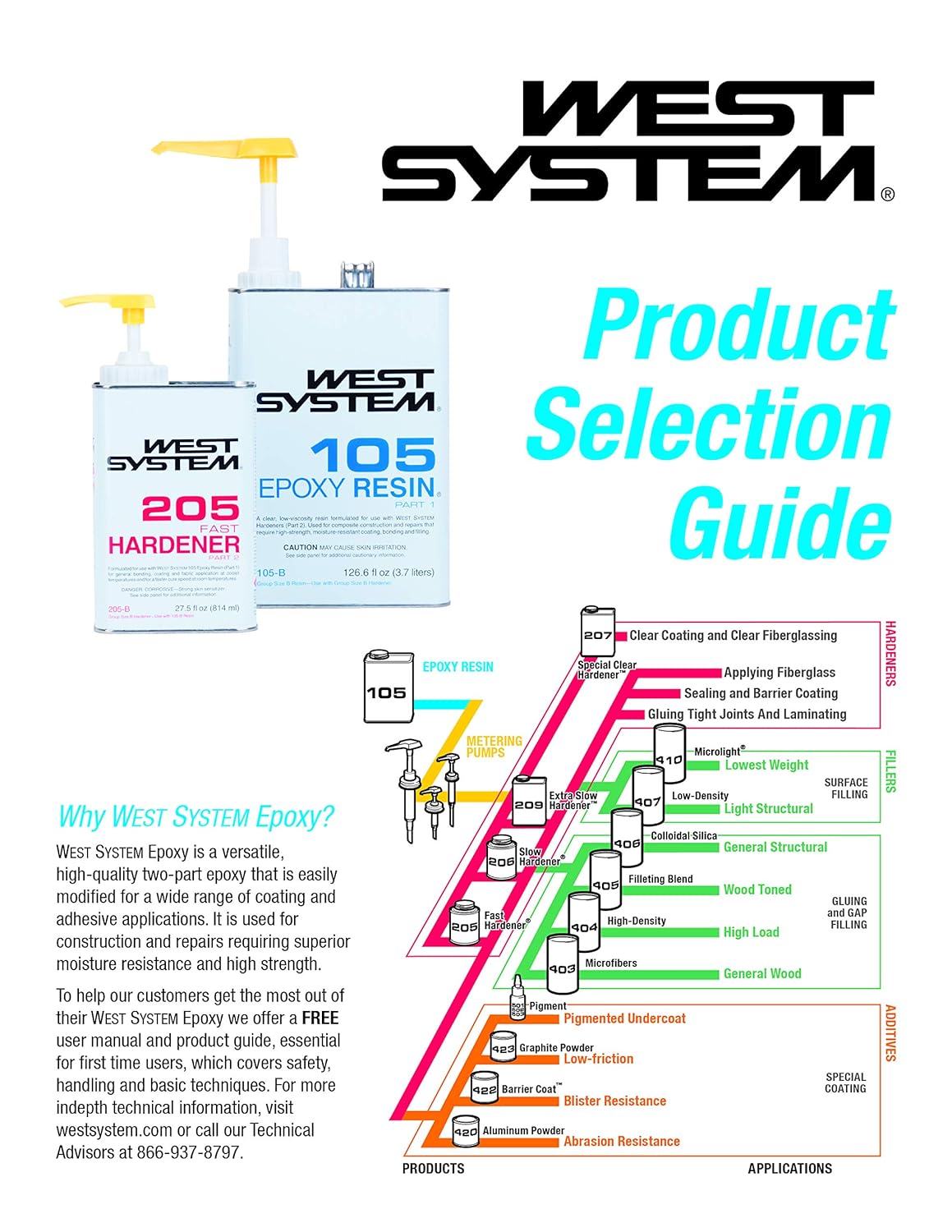
West System’s 105 Resin with the hardener family (205 Fast, 206 Slow, 207 Special Clear, 209 Extra Slow) is the closest thing marine epoxy has to a universal reference point. The Gougeon Brothers have been publishing technical documentation through their Epoxyworks journal since the 1970s, and that body of published knowledge is genuinely useful — Issue 54’s hardener selection guide alone has clarified more reader questions than most competing brands’ entire technical libraries.
The 5:1 mix ratio (resin to hardener by volume) requires slightly more precise measuring than the 2:1 systems, but West System’s metered pump dispensers handle this reliably. Practical Sailor’s epoxy roundup has noted that West System’s pump-dispensed mixing accuracy is a real workflow advantage for multi-batch days where pouring by weight slows you down.
Where West System earns its reputation is in the breadth of the system: specialized additives like 403 Microfibers (for gap-filling fillets), 404 High-Density Filler (for high-load hardware tabbing), and 407 Low-Density Filler (for fairing) are all engineered to work within the same resin matrix. Owners doing a full structural refit — plywood sub-sole, through-hull backing plates, chainplate tabbing, and fairing — can run the entire job from one resin drum, swapping fillers and hardeners by task.
The honest tradeoff: at current (May 2026) retail, West System quarts and gallon kits run toward the higher end of the category — commonly $90–$130 for a gallon of 105 Resin at West Marine and Defender, before hardener. For a $3,000–$8,000 refit where epoxy represents 10–15% of materials cost, that premium is defensible. For a tighter budget build, it’s worth running the numbers against MAS.
MAS Epoxies: The Longer-Pot-Life Case for Open Laminating
MAS is less prominent in the broad market but has a devoted following among builders and refitters who work in warmer climates or on complex curved surfaces where open time is the binding constraint. The FLAG (Flagging/Laminating) system and the separate Penetrating Epoxy are designed with a 2:1 mix ratio, which some practitioners find more intuitive when mixing small batches by weight without pumps.
The MAS Technical Data Sheet for their Low-Viscosity Hardener consistently shows that extended pot life — around 20–25 minutes in a 4-oz mass at room temperature — without sacrificing the mechanical properties that matter for structural work. Shear strength and moisture resistance numbers are competitive with West System per published spec comparisons in Practical Sailor’s epoxy roundup.
MAS also makes a strong case for the penetrating sealer application — soaking bare wood or degraded core material before laminating — where their low-viscosity formulation reportedly wets out porous surfaces well. Owners refitting balsa-cored decks frequently cite MAS penetrating epoxy in forum build logs as a first-coat preference before switching to a fairing-grade system.
The tradeoff: the MAS product line is narrower. If you need a full range of filleting and fairing compounds engineered to one resin backbone, you’re mixing systems or relying on third-party fillers with less published compatibility data. For a focused laminating or core-repair job, that’s a non-issue. For a whole-boat refit, West System’s ecosystem breadth has real value.
TotalBoat: The Value Tier That’s Earned Serious Users
TotalBoat entered the market as Jamestown Distributors’ house brand and has matured into a genuinely capable system that independent reviews no longer treat as a budget compromise. The Thickset Penetrating Epoxy and the companion high-build fairing system are the products serious refitters most often reference, and TotalBoat’s Technical Data Sheets have become more detailed over the past two years — a positive sign for a brand that early critics tagged as light on technical documentation.
The practical appeal is pricing: at May 2026 retail, TotalBoat gallon kits are commonly priced 20–35% below West System equivalents, a gap that becomes significant when you’re budgeting 3–5 gallons of mixed epoxy for a full bilge coating or multi-layer deck laminate. The Jamestown Distributors Boatbuilder Central editorial team has published favorable application notes on TotalBoat fairing epoxy specifically in the context of budget-conscious refits.
Where owners in long-run project logs push back: TotalBoat’s quality consistency has drawn more variable reviews than West System, and the technical support infrastructure — the Epoxyworks-equivalent resource — doesn’t yet exist. If you’re a first-time laminator, West System’s documentation ecosystem has genuine protective value. If you’ve run a few laminating projects and understand epoxy behavior well enough to troubleshoot a blush (an amine blush is a waxy film that forms on epoxy surfaces in humid conditions, inhibiting adhesion between coats), TotalBoat’s value proposition is real and owners consistently report solid results on structural repairs.
Decision Framework: If X, Then Y
The right system depends on your specific constraints. Here’s how to think through it:
If you’re doing a multi-system refit — structural bonding, fairing, hardware tabbing, and clear coating under a varnish — choose West System. The unified additive ecosystem and the depth of Gougeon Brothers’ published technical data justify the price premium for a project where getting one lamination wrong is expensive to redo.
If your primary constraint is working time — large open panels, warm shop, single-operator wet-out — lean toward MAS Low-Viscosity Hardener. The published pot-life advantage over West System 105/205 is real, and the 2:1 ratio is workable with a gram-accurate kitchen scale.
If you’re running a tight materials budget on a well-understood repair and you have prior laminating experience, TotalBoat’s value arithmetic is hard to ignore. A 30% cost difference on a 4-gallon epoxy budget is real money redirected to hardware, teak, or paint. Treat their TDS as your primary technical document rather than relying on online generalizations.
If you’re working below 60°F, all three systems slow dramatically and pot life becomes less relevant than amine blush risk and incomplete cure — in that case, consult each manufacturer’s cold-weather guidance before committing. West System’s published cold-cure guidance through Epoxyworks is the most detailed in the category.
One purchasing note for May 2026 conditions: all three systems have seen price increases over the past 18 months tied to resin feedstock costs, and West System in particular has had intermittent gallon kit stock gaps at West Marine. Defender and Jamestown Distributors have carried more consistent inventory on gallon-and-up quantities; if you’re planning a multi-gallon project, buying your full epoxy requirement in a single order avoids mid-project lot-number mismatches — a real (if minor) concern for color-consistent clear coating work.
The bottom line: there’s no universally superior system here, only the right fit for your project phase, your ambient temperature, and your budget ceiling. Know those three variables before you order, and the choice becomes straightforward.