July 20, 2026 • Carmen Reyes • 10 min reading time • Specs verified June 25, 2026
Non-Skid Deck Coatings on Aluminum Boats: TotalTread vs. Tuff Coat for Real Fishing Decks
Non-Skid Deck Coatings on Aluminum Boats: TotalTread vs. Tuff Coat for Real Fishing Decks
Picture this: you’ve just pulled a 14-foot aluminum jon boat out of the garage after winter storage. The factory paint on the floor is scuffed, slick in spots, and frankly a little scary when your buddy steps aboard in wet wading boots. You know you need a non-skid coating — a paint or rubber-texture product applied to a deck surface to give your feet grip and prevent falls — but the options are confusing. TotalTread and Tuff Coat both show up in the search results, both are marketed toward aluminum fishing boats, and both have enthusiastic fans and legitimate complaints. This article is for the owner who’s past the “should I bother?” stage and is now asking “which one, and exactly how do I not screw up the application?” We’ll compare the two products on prep requirements, application process, durability, and the specific tradeoffs that matter most on a bare aluminum deck.
Why Aluminum Prep Is a Different Problem Than Fiberglass
If you’ve painted a fiberglass hull before, you know the prep routine: sand, wipe with solvent, prime if needed. Aluminum is a different animal. The surface oxidizes — forms a dull gray layer of aluminum oxide — within hours of exposure to air, and that oxide layer actively resists adhesion. Any coating, whether paint, epoxy, or rubber-based texture product, needs a clean, mechanically abraded, and chemically receptive surface to bond properly. Skip this step and you’re not applying a durable coating; you’re applying a temporary sticker.
The Aluminum Boat Prep and Coating Guide published by Jamestown Distributors Boatbuilder Central makes this point clearly: bare aluminum should be cleaned with a dedicated aluminum brightener or etching wash, rinsed thoroughly, dried completely, and coated as soon as possible after prep — ideally the same day. Both TotalTread and Tuff Coat manufacturers recommend clean, dry surfaces as a baseline, but neither product’s consumer-facing documentation addresses the aluminum oxide problem in meaningful detail. That gap is the most important thing to know before you buy either product. Your application outcome will be almost entirely determined by what you do before you open the can.
Practical Sailor’s overview of deck traction and non-skid systems reinforces that adhesion failure on bare metal almost always traces to moisture trapped under the coating or inadequate surface preparation — not to product quality. This is consistent across every credible coating review in that publication’s archive: prep is not a preliminary step, it is the primary step.
A practical aluminum prep sequence for either product:
- Degrease with a marine-grade solvent wipe — acetone or a purpose-made aluminum cleaner.
- Mechanical abrasion — an 80-grit scuff pad or orbital sander breaks the oxide layer and creates tooth.
- Etch wash if bare metal — a one-part acid-based aluminum etch, neutralized and rinsed thoroughly.
- Dry completely — not surface-dry, bone dry. Use a heat gun on thick aluminum stock if humidity is a factor.
- Apply your coating the same day. Don’t let freshly abraded metal re-oxidize overnight.
Comparing the Two Products: Three Dimensions That Matter
H3: Texture Profile and Underfoot Feel
TotalTread is a water-based, acrylic non-skid coating that rolls or brushes on and dries to a gritty, granular finish — the tactile equivalent of fine sandpaper. It’s the more familiar texture to anyone who’s walked on a factory-finished aluminum fishing deck or a painted dock surface. The grip comes from mineral grit suspended in the binder, and the result is firm and aggressive underfoot.
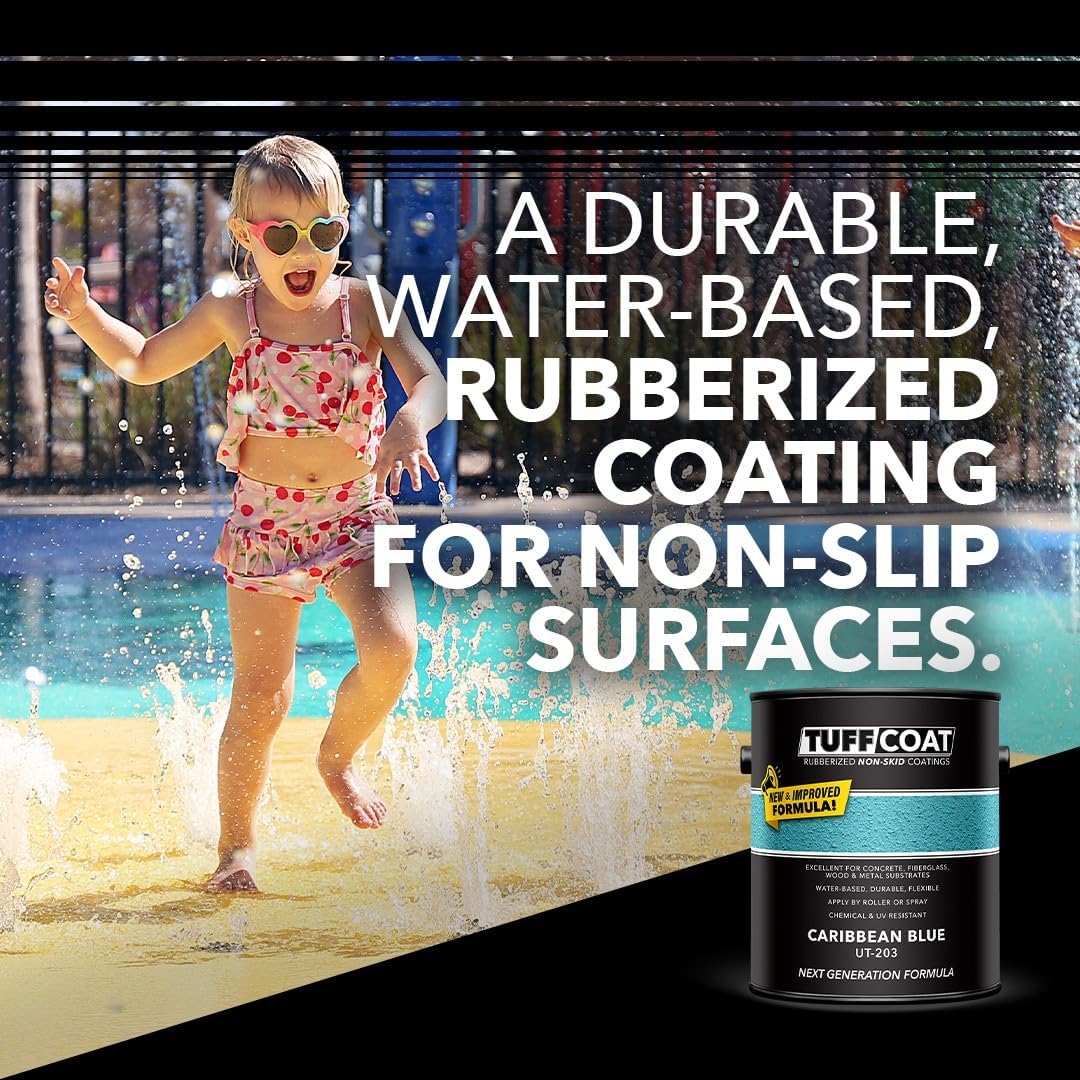
Tuff Coat (UT-100 series) takes a fundamentally different approach. It’s a rubber-particle suspension that cures to a thicker, softer surface — less like painted-on grit and more like a thin rubberized mat bonded directly to the deck. Owners who’ve used both consistently describe Tuff Coat as feeling more substantial underfoot, with a slight give that becomes meaningful when you’re standing on an aluminum floor for six hours straight. Neither texture is objectively better; the right choice depends on what you’re optimizing for.
Tuff
$105.99
In stock on Amazon
Check price on AmazonH3: Application Requirements and Critical Failure Points
TotalTread application notes:
The strongest and most consistent signal from owner reports is that surface cleanliness is the single biggest variable in the outcome. The failure pattern is predictable: rushed prep, a damp surface, or application over mill scale — the dark surface layer on new aluminum that wasn’t removed. These aren’t product failures; they’re prep failures that get attributed to the coating.
- Thin coats outperform thick ones. TotalTread levels reasonably well but tends to run on angled surfaces if applied too heavily.
- Two coats are the standard approach. The first coat seals and bonds; the second builds texture.
- Cure time before water exposure: the Rust-Oleum Marine Division product documentation and owner consensus point to at least 48–72 hours before light use in typical conditions (65–80°F), and 7 days before sustained immersion or heavy foot traffic. Do not rush this. A coating that feels firm at 24 hours may still scuff and transfer until the full cure period has elapsed.
Tuff Coat application notes:
The single most actionable and widely reported application issue with Tuff Coat is settling. The rubber particles that create the textured finish are denser than the liquid binder and settle during storage. This is not a defect; it is a physical property of a rubber-particle suspension. But if you don’t address it before application, you’ll apply a layer that’s mostly binder with all the texture-providing particles sitting at the bottom of the container — and you’ll wonder why the result looks thin and shiny.
The Tuff Coat UT-100 Technical Data Sheet published by Superior Industries specifies thorough mixing as a pre-application requirement, not a suggestion. Before opening the container, agitate aggressively. Use a paint mixing attachment on a drill for 3–5 minutes, scraping the bottom and sides to fully re-suspend the rubber particles. Check the bottom of the container before pouring; if you see dense sediment, keep mixing.
Once properly mixed, Tuff Coat applies well with a short-nap roller. Coverage per coat is thicker than TotalTread, so plan for one coat on most applications, with a second coat reserved for high-wear zones.
Tuff
$105.99
In stock on Amazon
Check price on AmazonH3: Coverage, Cost Efficiency, and Real-World Sizing
For a standard 12-foot jon boat floor — roughly 30–40 square feet of usable deck — one quart of TotalTread applied in two thin coats should cover the floor comfortably with product to spare. TotalTread’s coverage runs approximately 50–75 square feet per coat depending on application thickness, making it efficient for small boat interiors.
Tuff Coat’s thicker application rate yields approximately 40–60 square feet per quart. On a full two-coat application, one quart may be tight for a floor in the 40-square-foot range; budget for a quart plus a small reserve, or plan a careful single full coat with a second coat only on high-traffic zones near the transom and casting positions.
The price-per-square-foot calculation generally favors TotalTread on small boats. On larger aluminum deck boats — 18 feet and up with significant floor area — the gap narrows, and Tuff Coat’s single-coat capability on less-trafficked sections offsets some of its higher per-quart cost.
TotalBoat
$51.99
In stock on Amazon
Check price on AmazonSide-by-Side Reference
| Factor | TotalTread | Tuff Coat UT-100 |
|---|---|---|
| Base chemistry | Water-based acrylic | Rubber-particle suspension |
| Texture feel | Gritty/granular | Rubberized/cushioned |
| Coverage (1 qt., 1 coat) | ~50–75 sq. ft. | ~40–60 sq. ft. |
| Coats recommended | 2 | 1–2 |
| Critical prep step | Bone-dry, abraded surface | Aggressive mixing before use |
| Cure before immersion | 48–72 hrs light / 7 days full | 24–48 hrs light / 7 days full |
| Best-fit scenario | Budget-conscious, familiar application | Maximum durability, cushioned feel |
Applying Either Product Over Existing Paint
This is the most common real-world scenario: the floor isn’t bare metal but has old factory paint or a previous DIY coating that’s mostly intact. Both products can bond to existing paint under the right conditions.
The existing surface must be:
- Firmly bonded — any peeling, bubbling, or flaking paint must be removed. Coating over loose paint relocates the adhesion failure, it doesn’t solve it.
- Clean and deglossed — scuff-sand with 80–100 grit to give the new coating mechanical tooth.
- Chemically compatible — water-based coatings can sometimes lift or soften old solvent-based finishes. If the existing finish type is unknown, test a small area and let it cure before committing to the full floor.
Neither product requires a separate primer when applying over existing sound paint. If you’re going to bare aluminum, however, strongly consider a self-etching wash primer before your non-skid topcoat. This is the gap in both products’ consumer documentation: they assume a prepped surface without defining what “prepped” means on bare metal. A self-etching primer removes that ambiguity by chemically bonding to the aluminum and providing a stable foundation for the topcoat.
The Jamestown Distributors Boatbuilder Central aluminum prep guide specifically identifies self-etching primers as the recommended intermediate step when topcoating bare aluminum with products not formulated as direct-to-metal systems — a category that includes both TotalTread and Tuff Coat in their standard consumer configurations.
Frequently Asked Questions
Do I need to prime aluminum before applying TotalTread or Tuff Coat? Neither product’s consumer label requires a primer, but for bare aluminum, a self-etching primer is strongly advisable. Bare aluminum re-oxidizes quickly and resists adhesion. Over existing paint that’s firmly adhered, a primer is typically not required — scuff-sand, ensure the surface is clean and dry, and proceed with the topcoat.
How long does TotalTread need to cure before the boat goes back in the water? Based on Rust-Oleum Marine Division product documentation and owner consensus, allow at least 48–72 hours before light use in favorable conditions (65–80°F, low humidity). For sustained immersion or heavy foot traffic, the full cure period is 7 days. Rushing this is the second most common cause of peeling after inadequate prep.
Why does Tuff Coat have clumps at the bottom, and how do I fix it before application? The rubber particles that create Tuff Coat’s textured finish are denser than the liquid binder and settle during storage. This is normal. Per the Tuff Coat UT-100 Technical Data Sheet from Superior Industries, fix it by mixing aggressively with a drill-mounted paint stirrer for 3–5 minutes before application, scraping the bottom and sides of the container. Skip this step and your coating will be thin, shiny, and undersupplied with the particles that provide grip.
Can I apply either product over existing paint on an aluminum floor? Yes, with conditions. The existing paint must be firmly adhered, deglossed by scuff-sanding, and chemically compatible with a water-based topcoat. Test a small area if the existing finish type is unknown. Neither product requires a primer over existing sound paint.
How much does one quart of TotalTread cover on a 12-foot jon boat floor? A 12-foot jon boat floor typically runs 30–40 square feet of usable deck. TotalTread covers roughly 50–75 square feet per coat, so one quart should cover the floor in two coats with product remaining. Apply thin coats — the texture builds on the second pass, and heavy single coats increase the risk of runs and uneven finish.
The Decision Rule
If your priority is maximum durability and cushioned underfoot feel — and you’re willing to commit to aggressive mixing before every application session — Tuff Coat is the stronger choice for a working fishing deck. The rubber-particle formulation holds up well to boot traffic, fish slime, and UV exposure based on aggregated owner reports, and the texture is more forgiving on tired feet at the end of a long day on the water.
If your priority is ease of application, familiar paint-style handling, and a proven track record on aluminum fishing boat interiors specifically — with a slightly lower per-quart cost and efficient coverage on small floors — TotalTread is the safer starting point, provided you take the prep stage as seriously as every owner who achieved a good result demonstrably did.
As Practical Sailor’s non-skid systems reporting consistently concludes: adhesion outcomes on metal substrates are determined overwhelmingly by surface preparation quality, not by coating brand selection. Either product will perform well on a properly prepped surface. Either product will peel on a poorly prepped one.
Prep is the job. The coating is just what goes on top.