August 4, 2026 • Carmen Reyes • 10 min reading time • Specs verified June 25, 2026
Teak Cleaning Systems Decoded: One-Step Products, Two-Step Kits, and When Each Makes Sense

You’re standing on the dock at the beginning of the season, looking down at teak that’s gone the color of a parking lot — gray, chalky, cracked in the grain. Teak (a dense tropical hardwood prized on boats for its natural oils and slip resistance) doesn’t rot easily, but it does oxidize. Oxidation is what turns that warm honey-gold color into a weathered ash gray. The fix is a cleaning and brightening system, and the market gives you two broad choices: a one-step cleaner that handles everything in a single pass, or a two-step kit where you clean first and then apply a separate brightener (an acid-based solution that opens the wood grain and restores color). Both paths lead to the same destination — fresh, open wood ready for oiling — but they get there differently, suit different conditions, and cost you differently in time and product volume. This guide maps out which system belongs on which boat, shows you the coverage math, and tells you exactly when skipping the brightener step costs you three times as much down the road.
Why the Cleaner Step Is the One You Can’t Skip
Multiple reviewers across both Star Brite and AquaTeak product lines have said something that reads almost like a confession: the cleaner is the “secret ingredient.” That’s a striking thing for buyers to land on, because it implies they went in expecting the oil to do the heavy lifting — and learned otherwise. The pattern across aggregated reviews is consistent enough to treat as editorial signal: buyers who apply oil directly to gray, oxidized wood and then blame the oil for poor results skipped the prep step that would have let the oil penetrate in the first place.
Here’s why this matters at a mechanical level. Teak’s natural oils form a surface layer that, when oxidized and contaminated with salt, algae, and UV breakdown products, becomes effectively hydrophobic — it repels anything you put on top of it. WoodenBoat Magazine, in its guide “Caring for Teak and Other Oily Woods,” explains that the cleaner’s job is to break down that contaminated surface layer and lift it, while the brightener (typically a dilute oxalic or phosphoric acid solution) neutralizes tannin staining and opens the wood’s pores so subsequent treatment actually bonds. Skip the cleaner and you’re essentially painting over rust. Skip the brightener and you leave the pH of the wood surface in an alkaline state that interferes with oil adhesion.
Practical Sailor’s teak cleaner evaluations — published on practicalsailor.com under the title “Teak Cleaner Shootout” — have consistently flagged preparation thoroughness, not oil quality, as the primary predictor of long-term finish performance. The cleaning system isn’t the preamble to the real work. It is the real work.
One-Step vs. Two-Step: The Decision Frame
The core choice comes down to how compromised your wood actually is. Understanding the chemistry behind each format makes the decision obvious rather than arbitrary.
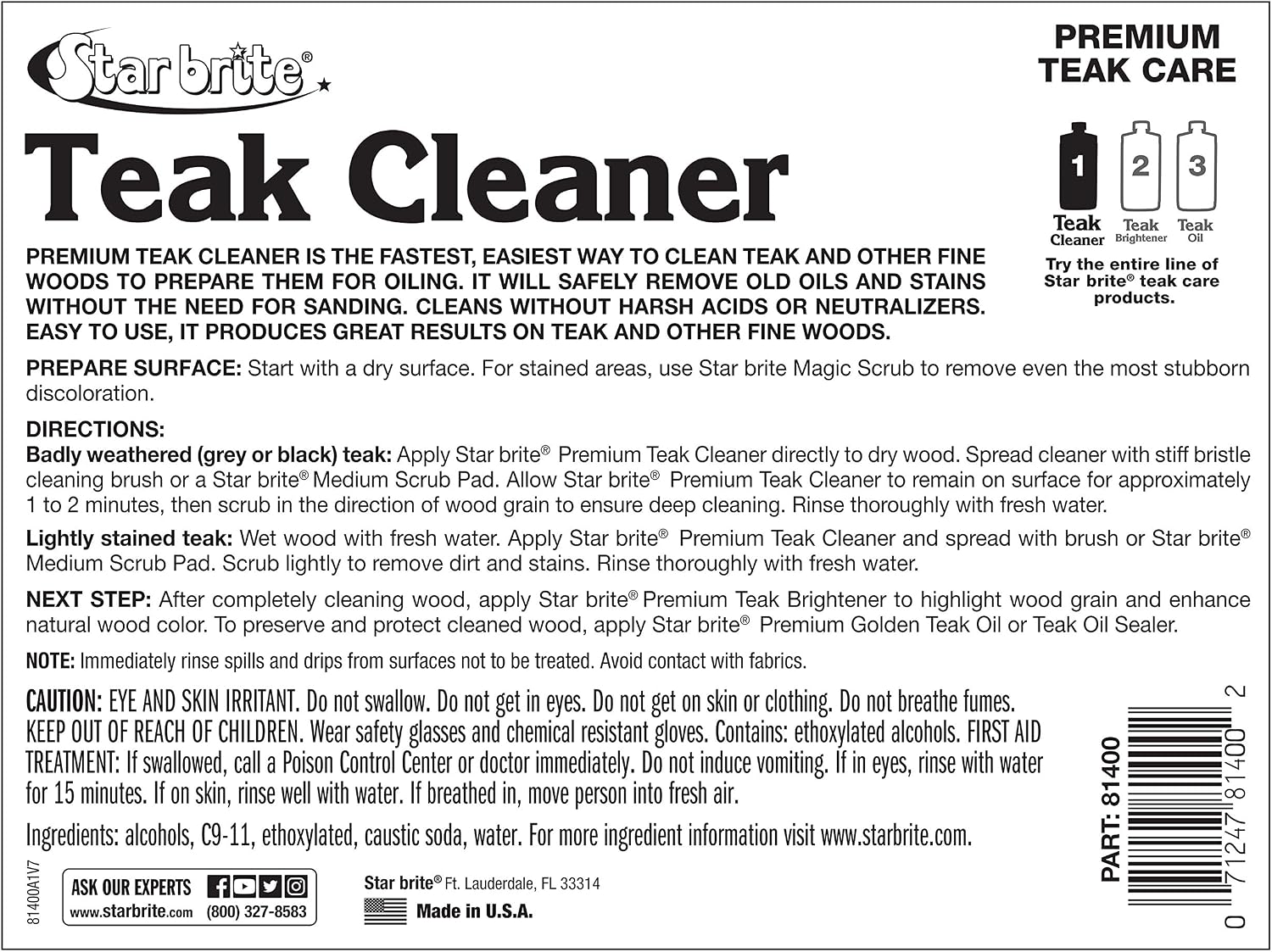
One-step cleaners combine a surfactant (cleaning agent) and a mild brightener in a single formula. They’re faster, require fewer rinse cycles, and work well on wood that’s lightly oxidized — seasonal maintenance on teak that gets attention every year, or wood that was treated within the last 6–12 months.
Two-step kits separate the cleaner (usually alkaline, to lift organic matter) from the brightener (acid-based, to restore color and neutralize). The chemistry is more aggressive and the results on neglected wood are dramatically more pronounced. Star Brite 3-Step Kit reviewers — including buyers working on outdoor teak furniture, not just boat decks — describe transformations from “dull gray” to “golden” vivid enough that neighbors stopped to ask what they’d done. That’s a reasonable benchmark for what’s possible when the system is applied correctly to heavily oxidized wood.
One additional variable worth noting before diving into product tiers: convenience packaging. Star Brite’s Cleaner & Brightener bottles use a wide-mouth cap rather than a spray nozzle — a quirk flagged by multiple reviewers. The practical fix that’s emerged in owner communities: transfer the product to a repurposed spray bottle before application. The same issue appears with AquaTeak’s Care Kit, where reviewers note the bottle opening is too large for controlled pouring. Neither packaging issue affects the chemistry — just the application experience.
Choosing the Right System: Three Tiers by Wood Condition
The following three H3 sections match product approach to wood condition. Each tier reflects a distinct rehabilitation starting point, not a price-based ranking.
One-Step Cleaner: Maintained Teak in Good Condition
Best for: Teak that was cleaned and oiled within the past 12 months, shows mild surface graying but no chalking or cracking in the grain, and is part of a regular seasonal maintenance program.
A quality one-step cleaner is faster, gentler on adjacent surfaces (caulking, gelcoat, painted nonskid), and entirely sufficient for lightly oxidized wood. The surfactant and mild acid work simultaneously, cutting the application session to 30–60 minutes for a cockpit sole. Jamestown Distributors Boatbuilder Central’s wood finishing documentation notes that light-duty cleaning products are appropriate when oxidation hasn’t yet penetrated into the open grain — surface contamination only.
Coverage on maintained teak runs approximately 30–45 sq ft per 16 oz bottle. A single 32 oz bottle handles a typical cockpit sole (40–60 sq ft) in one pass with product to spare.
STAR 081400N
$38.28
In stock on Amazon
Check price on AmazonTwo-Step Kit: Moderately Neglected Teak
Best for: Teak that’s visibly gray but not yet deeply weathered — wood that’s been skipped for one or two seasons, shows uniform surface oxidation, and responds to light scrubbing with grain still intact beneath the gray layer.
This is the largest category of teak rehabilitation work on recreational boats. A two-step kit — alkaline cleaner followed by acid brightener — restores the surface in a 90–120 minute session per section. The key procedural point, per WoodenBoat Magazine’s oily wood care guide, is that the brightener must be applied while the wood is still wet from the cleaner rinse. Letting the wood dry between steps allows tannins to re-set, and you lose most of the brightener’s benefit.
Star Brite’s Cleaner & Brightener combined product sits between these tiers; for moderate oxidation, the two-step kit format gives you more control over dwell time and chemistry strength. Coverage drops to 15–25 sq ft per 16 oz on moderately oxidized surfaces where grain is open and absorption is higher. Budget two 32 oz kits for a cockpit sole in this condition.
STAR 081202
$43.91
In stock on Amazon
Check price on AmazonThree-Step System: Severely Gray or Long-Neglected Teak
Best for: Teak that hasn’t been treated in more than 18–24 months, is uniformly ash gray, shows surface checking (small cracks running with the grain), or has accumulated years of salt, mildew, and UV breakdown.
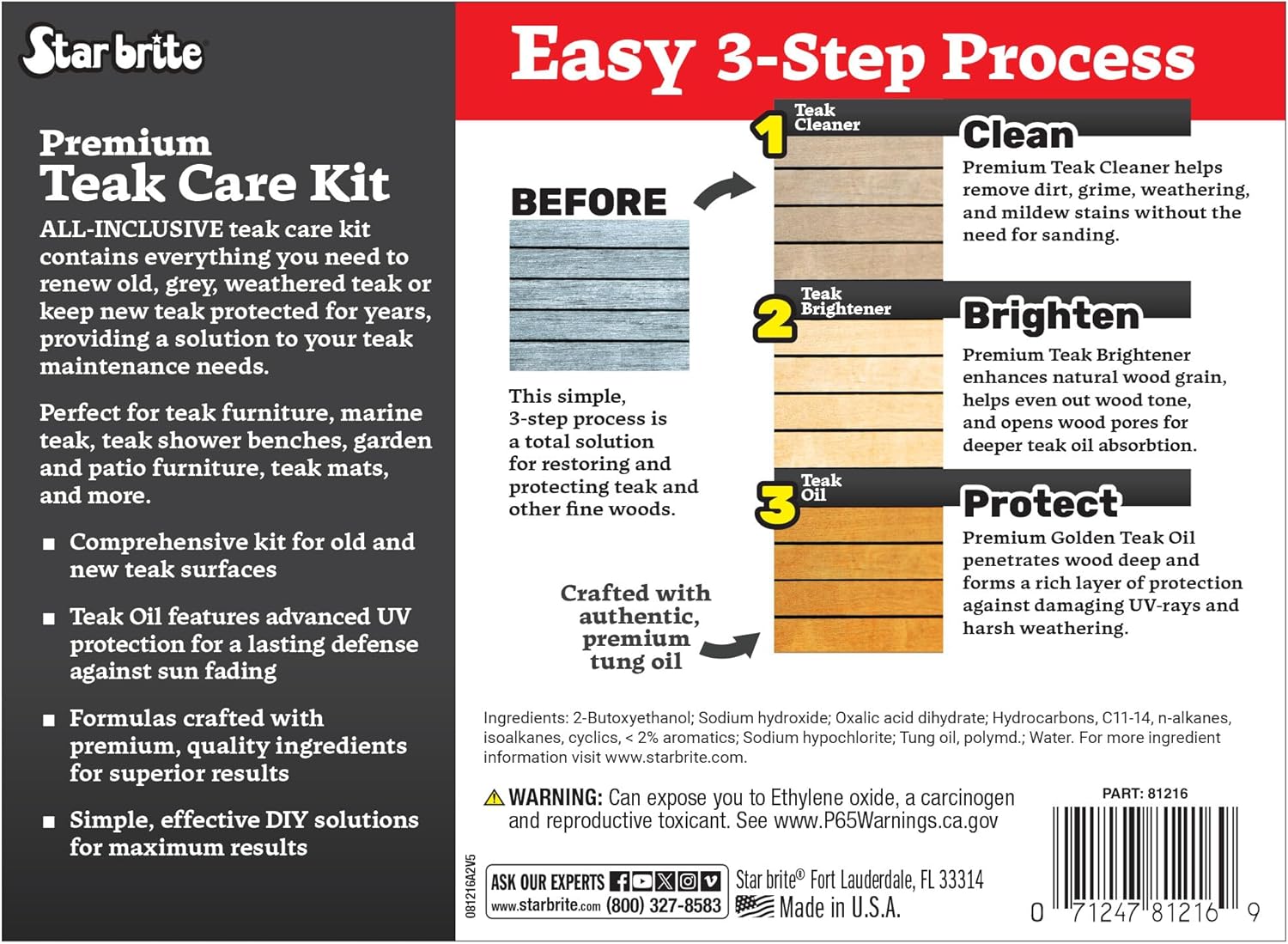
No one-step formula is aggressive enough to rehabilitate seriously neglected wood in a single pass. The three-step approach — dedicated alkaline cleaner, acid brightener, and a finishing neutralizing rinse — is the only system that reliably delivers the gray-to-gold result described in Star Brite Premium Teak Care 3-Step Kit reviews. Practical Sailor’s “Teak Cleaner Shootout” evaluation framing explicitly positions preparation system aggressiveness, not oil quality, as the variable that separates failed and successful rehabilitations on weathered teak.
Session time runs 120–180 minutes per section, and coverage on deeply weathered grain falls to the low end of estimates (15 sq ft per 16 oz or less on heavily checked surfaces). For a full teak deck over 150 sq ft, budget three to four full kits per treatment cycle. Ordering more than you think you need is not overcaution — running out mid-deck and leaving the brightener unevenly applied creates streaking that requires a full re-treatment to correct.
BoatUS’s “Teak Care and Maintenance Guide,” available on boatus.com, recommends cleaning boat deck teak at least once per season (spring commissioning), with a second cleaning mid-season for heavily used decks or boats in tropical climates. For severely neglected teak reaching this tier, the first-season goal is rehabilitation; the second season returns you to the mid-tier maintenance schedule.
STAR 081216
$54.26
In stock on Amazon
Check price on AmazonCoverage Math: How Far Does Your Kit Actually Go?
This is where buyer expectations most frequently diverge from reality. Both Star Brite and AquaTeak kit reviewers note that products “don’t go as far as expected” on larger surfaces. This isn’t a product failure — it’s a surface-area math problem that’s worth solving before you order.
Reference coverage bands (drawn from Jamestown Distributors Boatbuilder Central wood care documentation and aggregated reviewer consensus):
- Heavily oxidized, open-grain teak: 15–25 sq ft per 16 oz
- Moderately oxidized teak: 20–30 sq ft per 16 oz
- Lightly oxidized, maintained teak: 30–45 sq ft per 16 oz
Common boat surface areas for planning:
- Teak cockpit sole, 38–42 ft sailboat: approximately 40–60 sq ft
- Teak companionway surround and hatch boards: approximately 8–12 sq ft
- Full teak side decks, 40 ft vessel: 80–120 sq ft
- Complete teak deck, 40 ft vessel: 180–250 sq ft
Practical ordering rule: For a cockpit sole in moderate condition, one 32 oz two-step kit is marginal — have a second on hand. For a full teak deck in any condition, plan for three to four kits minimum per treatment cycle. Where concentrate versions are available, buy concentrate and dilute more aggressively for maintenance passes, less so for rehabilitation.
When Wood Species Changes the Equation
The cleaner-brightener logic applies specifically to teak’s tannin profile and oil chemistry. For ipe, eucalyptus, or other non-teak tropical hardwoods, the same approach requires caution.
WoodenBoat Magazine’s guide on oily wood care notes that oxalic-acid brighteners formulated for teak can interact differently with ipe’s high iron content, sometimes producing dark staining rather than brightening. The mechanism: iron-tannin reactions that teak’s chemistry doesn’t trigger. Always test an oxalic-based brightener on an inconspicuous section of ipe before full application, and check the manufacturer’s product data sheet for explicit species compatibility. Most teak-specific oil products are similarly not appropriate for ipe without confirmation from the manufacturer.
Eucalyptus, commonly used in replacement teak furniture, has lower natural oil content and responds more predictably to teak-formulated systems — but still warrants a test patch given the variability in eucalyptus species used in marine applications.
Frequently Asked Questions
Do you really need a separate brightener after the cleaner, or can you go straight to oil?
For lightly maintained teak, a one-step product handles both functions adequately. For gray or neglected wood, skipping the standalone brightener step is the single most common reason owners report poor oil performance — and then blame the oil. The brightener neutralizes pH, opens grain, and physically lifts tannin discoloration that the cleaner alone doesn’t fully address. Per Practical Sailor’s “Teak Cleaner Shootout” framing, preparation is the primary predictor of outcome. Don’t skip it on compromised wood.
How long should teak cleaner sit before scrubbing?
Most manufacturers specify 3–5 minutes of dwell time on typical oxidation, with a maximum of 10 minutes for heavy gray. The brightener step usually calls for 2–3 minutes before scrubbing and rinsing. Letting either product dry on the wood surface re-deposits the contamination you just lifted. Work in sections, keep the surface wet, and rinse thoroughly between steps.
What about caulking? Will two-step kits damage it?
Alkaline cleaners in two-step kits will swell and degrade compromised caulk — the flexible sealant between deck planks. If your caulking is old or showing surface cracking, use the mildest system that gets the job done, apply with care, and rinse aggressively. BoatUS’s teak maintenance guide specifically flags this as a reason to assess caulk condition before committing to an aggressive cleaning system.
How often should I clean and re-oil boat deck teak?
BoatUS’s “Teak Care and Maintenance Guide” recommends at least once per season for deck teak, with a second mid-season pass for heavily used decks or boats in tropical climates. Outdoor patio teak in a temperate climate typically needs a full clean-and-oil cycle once per year. Boat deck teak faces salt spray, foot traffic, and UV simultaneously — a combination that accelerates oxidation faster than sheltered patio exposure.
Coverage estimates in this article are drawn from Jamestown Distributors Boatbuilder Central wood care documentation and aggregated reviewer consensus across marine retail platforms. Practical Sailor’s “Teak Cleaner Shootout” and WoodenBoat Magazine’s “Caring for Teak and Other Oily Woods” inform the preparation methodology framing. BoatUS’s “Teak Care and Maintenance Guide” (boatus.com) informs seasonal maintenance frequency recommendations. All source citations are plain-text named references; no URLs are asserted.