August 2, 2026 • Carmen Reyes • 10 min reading time • Specs verified June 25, 2026
Teak Finish Systems Ranked by Durability: Covered Slip vs. Open Mooring Reality
You spent three weekends stripping, sanding, and lovingly restoring the teak toerail — the wooden strip running along the edge of a boat’s deck that protects the hull-deck joint — on your 36-footer. It looks stunning. Now the honest question: how long will it stay that way, and does the answer change depending on whether your boat sits in a covered slip or on a mooring in full sun and spray? Teak finish systems fall into three broad families: penetrating oils (which soak into the wood grain and feed it from within), film-building varnishes (which cure into a protective layer on top of the wood), and penetrating sealers (a middle-ground category that repels water without building a thick surface film). Each family holds up differently depending on UV exposure, salt air, and how much maintenance time you’re willing to trade for beauty. This guide ranks the leading products in each category by real-world durability and gives you a clear decision framework based on where your boat actually lives.
Why Storage Conditions Change the Math Completely
Before comparing products, you need to internalize one uncomfortable truth: the finish that performs best in a covered slip is often the wrong choice at an open mooring, and vice versa.
A covered slip — a roofed or partially enclosed dock space — limits two of the three main teak enemies: ultraviolet radiation (the UV portion of sunlight that breaks down both wood lignin and finish chemistry) and thermal cycling (the expansion and contraction of wood and finish layers as temperatures swing between day and night). What remains is moisture — rain, humidity, and occasional splash — plus the mechanical wear of foot traffic.
An open mooring exposes teak to the full triad: UV, thermal cycling, and saltwater spray. Yachting Monthly’s Teak Deck Maintenance Guide notes that UV-driven photodegradation can degrade an unprotected finish in as little as 90 days in tropical latitudes, a timeline that extends to six to twelve months in temperate northern climates. Saltwater isn’t just cosmetically damaging; the hygroscopic salts — salts that absorb moisture from the air — it deposits draw water into any micro-crack in a film finish, accelerating delamination from below.
The practical implication is straightforward. Film-building varnishes are durable in covered, low-UV environments but are maintenance-intensive and failure-prone when UV load is high. Penetrating oils and sealers are more forgiving at open moorings because they have no film to crack or delaminate — they simply need periodic reapplication as they deplete.
The Three Finish Families, Compared by Environment
Penetrating Oils
Best for: Open moorings, liveaboards, high-maintenance-tolerance owners
Penetrating oils — anchored by Deks Olje D1 (the saturating base coat) and Deks Olje D2 (the satin-gloss topcoat from the same Owatrol-owned line), as well as Semco Teak Sealer — work by displacing moisture from wood cells and leaving a flexible, water-repellent residue. Because there is no brittle film on the surface, they cannot blister, crack, or peel. When they fail, they simply look gray and dry — a condition that owners and editors consistently describe as far easier to remediate than a varnish that has begun to lift.
Practical Sailor’s teak oil and sealer comparison — one of the most rigorous editorial evaluations of this product category — found that the Deks Olje two-step system typically outperforms single-component teak oils on both water repellency and color retention, with the D1/D2 combination showing measurable improvement over D1 alone in UV-exposed test panels. The publication’s testing corroborates what experienced owners report: the D1 plus D2 combination at open moorings in mid-Atlantic climates draws reapplication intervals of roughly four to six months for the D2 topcoat, with a full D1 re-saturation recommended annually.
Semco Teak Sealer occupies a similar position. Jamestown Distributors Boatbuilder Central product technical notes characterize it as a penetrating sealer rather than a true oil, with a solvent-based formula that cures faster than Deks Olje and is often preferred in high-humidity environments where slow-drying products are problematic. Boatbuilder Central’s notes on the product also flag its reliability in tropical conditions, though color consistency batch-to-batch draws occasional mention in editorial reviews.
Durability at a covered slip: Eight to twelve-plus months between reapplications of the topcoat, because UV depletion is the primary driver of penetrating-oil degradation. In covered storage, penetrating oils become nearly low-effort.
Durability at an open mooring: Four to six months for the D2 or Semco topcoat; ten to fourteen months before a D1 base re-saturation is needed. The formula’s resilience to cracking means failure is graceful, but frequency is higher than in sheltered conditions.
The tradeoff: Penetrating oils will never deliver the deep, glassy, mirror-bright appearance of a high-build varnish. If aesthetics are primary and you’re at a covered slip, you’re leaving beauty on the table.
STAR 081400N
$38.28
In stock on Amazon
Check price on AmazonFilm-Building Varnishes
Best for: Covered slips, show boats, owners who commit to a maintenance schedule
Film-building varnishes — Epifanes Clear Gloss Varnish, Interlux Schooner Varnish, and the more UV-resistant Epifanes Woodfinish Gloss — create a crosslinked polymer film on top of the wood. When properly built up (typically six to eight coats with full cure time between applications), they deliver unmatched depth of finish and a hard surface that resists foot traffic and mechanical abrasion far better than oils or sealers.
The problem is the film itself. WoodenBoat Magazine’s editorial coverage of modern teak finishing consistently flags the core vulnerability: any breach in the film — a scratch, a micro-crack from thermal cycling, or even a pinhole from improper application — allows water to migrate under the finish, where it has nowhere to go. The result is blistering, then delamination. Cruising World’s reader project reporting on finish degradation rates documents varnish systems beginning to show UV crazing — a network of hairline surface cracks — within a single season on horizontal surfaces at open moorings in southern latitudes.
In a covered slip, this math reverses dramatically. Without significant UV load, a properly applied eight-coat varnish system with annual maintenance coats can hold for two to three seasons before requiring a full strip-and-rebuild. The covered-slip maintenance cycle is typically one thin maintenance coat per year — roughly four to six hours of light abrading and recoating versus the full stripping cycles that open-mooring varnish demands.
Durability at a covered slip: Eighteen to thirty months before a full rebuild is required. Annual maintenance coats extend the system substantially.
Durability at an open mooring: Six to ten months on horizontal surfaces before crazing or lift begins. Owners who commit to varnish at open moorings frequently report abandoning the system within two seasons.
The tradeoff: The setup investment is real. Eight coats of Epifanes, plus the labor of proper intercoat sanding, represents a meaningful time-and-money commitment before the finish pays off aesthetically. That investment earns its keep in covered storage; at an open mooring it is largely consumed by UV before it can.
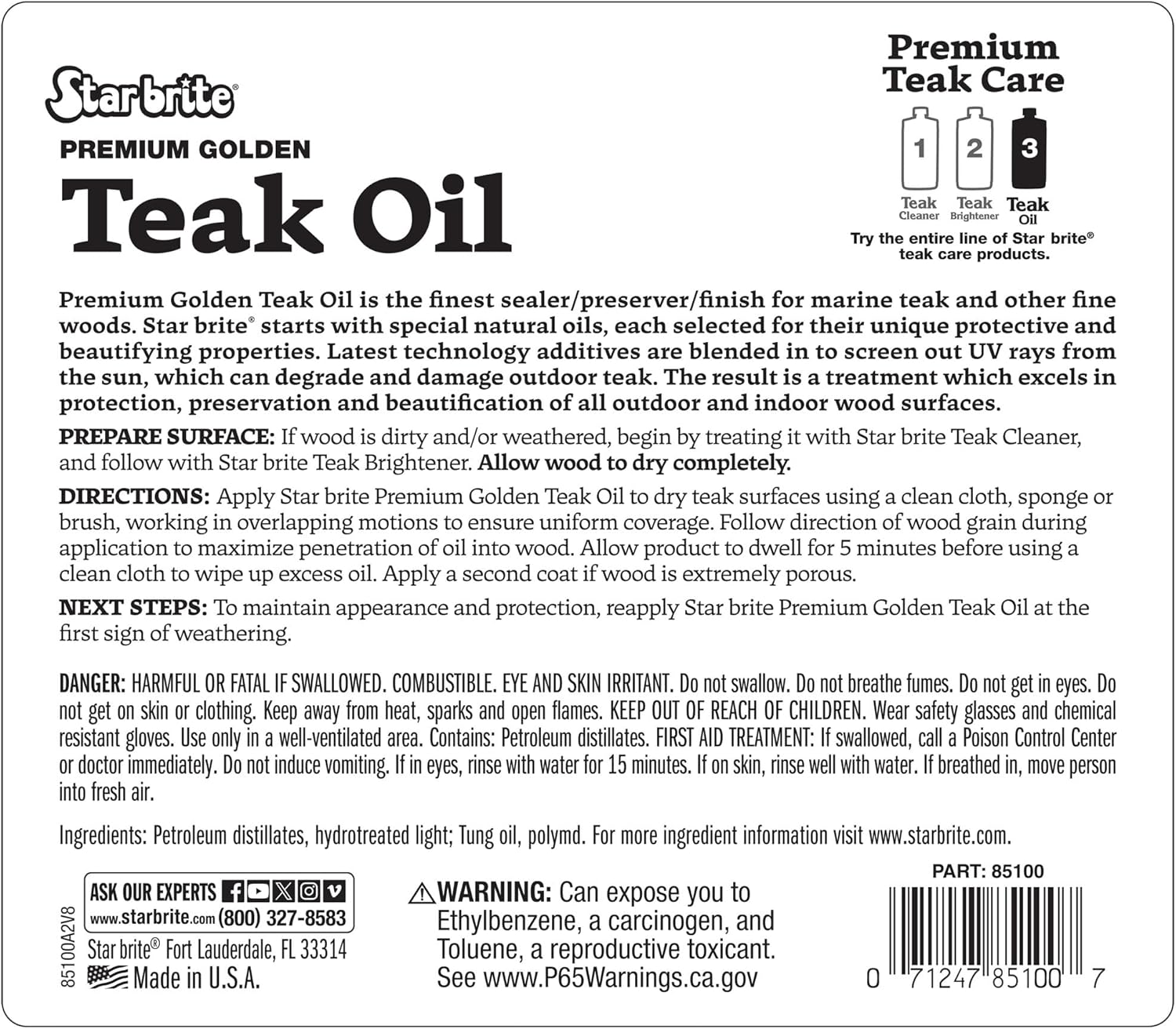
STAR
$70.89
In stock on Amazon
Check price on AmazonPenetrating Sealers — The Middle Path
Best for: Open moorings where some aesthetic improvement over bare weathered wood is desired, or owners unwilling to commit to full varnish upkeep
Penetrating sealers — products like Semco Natural (the clear variant), Star Brite Teak Oil, and Sikkens Cetol Marine (which straddles sealer and thin-film varnish) — sit between the two categories above in both performance and maintenance demand. Cetol Marine deserves particular attention: it builds a very thin, flexible film that provides more UV resistance than a pure penetrating oil but far less brittleness than a traditional varnish. Yachting Monthly’s Teak Deck Maintenance Guide describes products in this category as particularly forgiving on curved surfaces and irregular grain, where full-film varnishes are prone to bridging and early edge delamination.
Cruising World’s coverage of tropical teak maintenance positions Cetol Marine as the pragmatic open-mooring choice for owners who want some amber color depth and UV protection without committing to a varnish program. The typical reapplication interval reported in that coverage is six to nine months on horizontal surfaces at open moorings in temperate climates, extending to twelve to eighteen months on vertical surfaces with lower UV and water exposure.
Durability at a covered slip: Twelve to eighteen months. Cetol Marine is arguably overkill for a covered slip — you are paying for UV resistance you largely don’t need.
Durability at an open mooring: Six to nine months on horizontal surfaces; twelve to eighteen months on vertical surfaces. Failure mode is dulling and color fade rather than cracking, which most owners find more manageable than a varnish system that has begun to lift.
The tradeoff: Cetol Marine’s amber tint is fixed — it cannot replicate the clear, neutral look of Epifanes varnish or the near-natural appearance of Deks Olje D2. If color neutrality matters, this is not the system.
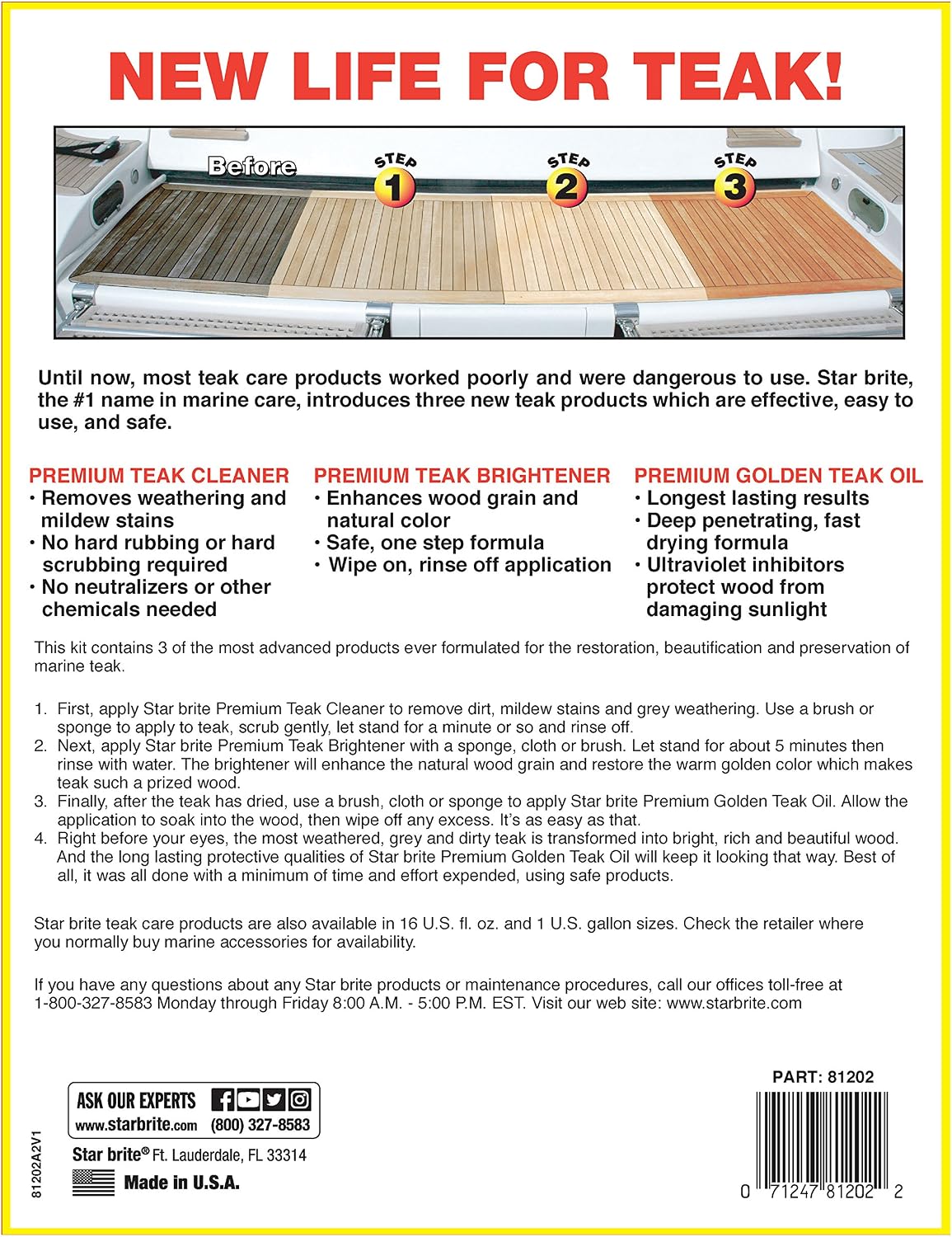
STAR 081202
$43.91
In stock on Amazon
Check price on AmazonApproximate Reapplication Intervals by System and Environment
| Finish System | Covered Slip (Topcoat) | Open Mooring (Topcoat) | Failure Mode |
|---|---|---|---|
| Deks Olje D1 + D2 | 10–14 months | 4–6 months | Graying, dryness |
| Semco Teak Sealer | 10–14 months | 4–6 months | Color fade |
| Epifanes / Interlux Varnish | 18–30 months (+ maint. coat) | 6–10 months | Crazing, delamination |
| Sikkens Cetol Marine | 12–18 months | 6–9 months | Dulling, color fade |
Intervals reflect horizontal surfaces — decks, toerails, cockpit sole — in temperate-climate conditions. Tropical and high-UV latitudes compress all intervals by roughly 30 to 40 percent.
Switching Systems: The Compatibility Warning Most Owners Learn the Hard Way
One of the most consistent sources of finish failure in the intermediate-practitioner segment isn’t product selection — it’s switching systems without adequate preparation. Oil-saturated wood will not accept a film-building varnish. The residual oil in the wood cells prevents proper adhesion, and the new film lifts within weeks.
If you’re transitioning from a penetrating-oil system to varnish — say, because you’ve moved your boat into a covered slip and want to upgrade the aesthetics — the standard protocol per manufacturer technical data sheets from both Epifanes and Interlux requires the following steps:
- Full mechanical strip of all old finish
- Solvent wash with acetone or the manufacturer’s specified wash solvent, to pull residual oil from the surface layers
- A minimum 48 to 72 hours of dry time in low-humidity conditions before the first varnish coat is applied
Jamestown Distributors Boatbuilder Central technical notes on Deks Olje specifically flag this transition risk, noting that the solvent-wash step is the most commonly skipped — and the most commonly blamed — cause of adhesion failure on previously oiled teak. Skipping it is not a shortcut; it is a guarantee of remediation work within a season.
The Decision Rule
If your boat lives at an open mooring and you’re realistic about maintenance windows, Deks Olje D1 plus D2 is the ranked durability leader for horizontal teak — it delivers the best water repellency, the most graceful failure mode, and the lowest remediation cost when reapplication is overdue. Semco Teak Sealer is the practical alternative in humid or tropical conditions where faster dry times matter.
If your boat lives in a covered slip and aesthetics are a priority, a properly built varnish system — Epifanes Clear Gloss or Interlux Schooner — is worth the setup investment. The UV-protected environment neutralizes the one serious vulnerability of film finishes, and you’ll get two to three seasons of show-quality finish from an annual maintenance coat.
If your situation is open mooring but you want something richer-looking than raw oil, Sikkens Cetol Marine threads the needle — more color depth than Deks Olje D2, more forgiving than varnish, and a failure mode that won’t require emergency intervention if you miss a maintenance window by a month or two.
The finish that looks best in a showroom photograph is not always the finish that looks best on your boat in May, three years from now, with real weather between here and there. Match the system to the environment, not the brochure.