September 4, 2026 • Carmen Reyes • 10 min reading time • Specs verified June 25, 2026
Teak Deck vs. Shower Bench vs. Patio Furniture: Sizing Your Oil System to the Job
Teak is a dense, oily tropical hardwood prized on boats, in bathrooms, and on patios for one core reason: it resists water and rot better than almost anything else at its price point. But “teak oil” — a generic term for penetrating oil finishes designed to feed and protect teak’s grain — is not a one-size-fits-all product, and the surface you’re treating changes almost everything about how you buy and apply it. A marine deck baking in UV and saltwater spray has wildly different needs than a shower bench sitting in a steamy bathroom three times a week, or a patio chair that’s been ignored through two Pacific Northwest winters. If you’ve already burned through a can of oil on a patio set and run out halfway through, or wondered whether the marine-grade product you bought for your boat is overkill (or underkill) for indoor use, this guide is built for exactly that moment.
The goal here is practical: match the right product tier to the right surface, size your purchase correctly the first time, and understand where the tradeoffs actually live.
Why Surface Context Reshapes the Entire Decision
The instinct to grab one good teak oil and use it everywhere is reasonable — and mostly wrong. Three variables diverge sharply across surface types: UV exposure, moisture cycling, and the wood’s starting condition (new vs. weathered vs. heavily neglected).
Marine decks face the harshest combined load: direct sun, saltwater, foot traffic, and the thermal expansion that comes from a deck surface that can hit 130°F on a summer afternoon. Practical Sailor’s comparative coverage of teak brightwork products consistently notes that marine environments demand formulations with UV inhibitors and strong water-repellency — properties that also make marine-grade products attractive to buyers in other contexts.
Shower benches and stools operate in a completely different stress mode: near-zero UV, but constant moisture cycling — wet, dry, wet, dry — often daily. The enemy here isn’t sun degradation; it’s mold, mildew, and the gradual graying that comes from mineral deposits in water. Reviewers of Star Brite Premium Golden Teak Oil using it specifically on shower shelves and benches consistently highlight the wipe-off method and strong water beading as the features that matter most in that context. Aggregated reviews at StarBrite.com show a clear pattern: indoor users are specifically choosing marine-grade products because of their moisture-resistance reputation, not because they need UV protection.
Patio furniture sits in the middle — UV matters (especially in desert or high-altitude climates), but the surfaces are typically not structural, not underfoot, and often sit neglected for a season or two before an owner decides to restore them. The critical variable here is wood condition: weathered patio teak is thirsty in a way that new or maintained marine teak simply isn’t. Reviewers across multiple products, including Watco Teak Oil, consistently report significantly underestimating how much product a weathered chair will absorb on the first coat. This is the number-one cause of mid-project stockouts.
Product-by-Product Fit: Where Each Oil Belongs
Star Brite Premium Golden Teak Oil
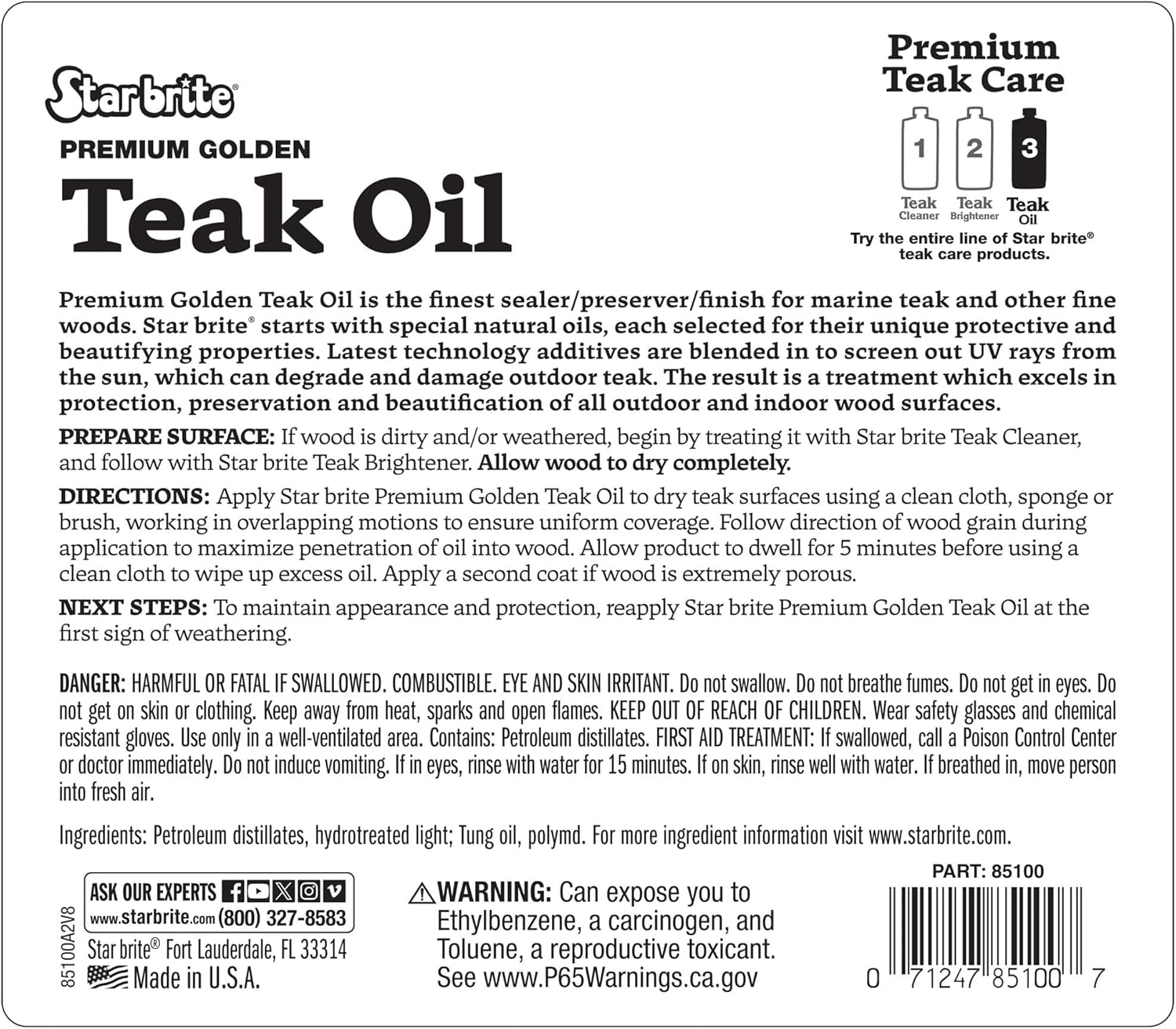
Star Brite Premium Golden Teak Oil is a penetrating oil designed for marine use, but its wipe-on/wipe-off application and low odor profile make it one of the most versatile options across all three surface categories. Aggregated reviews show it performing particularly well in shower and bath contexts — buyers specifically call out the water-beading performance and ease of application without professional tools.
The color darkening is worth flagging: AquaTeak product reviewers in particular call out color shift as a surprise. Star Brite’s formula tends toward golden tones (as the name suggests), which reads as a benefit on weathered gray wood but can be a concern for someone who wants to preserve the natural silver patina on aged teak.
Best fit: Shower benches, indoor teak furniture, light-duty outdoor applications. Works on marine surfaces but may need more frequent reapplication than purpose-built marine sealers.
Watco Teak Oil
Watco Teak Oil has one of the longest trust signals in the category — reviewers citing 10–16 years of continuous use on outdoor hardwood furniture appear across multiple retail aggregators. That kind of longevity data is unusual and worth weighting.
But Watco’s safety profile deserves direct attention. The Rust-Oleum Corporation Safety Data Sheet for Watco Teak Oil (2024) flags significant VOC (volatile organic compound) content, and at least one long-term user review explicitly warns about dermal absorption risk, recommending organic vapor respirators — not just nitrile gloves — during application. This is not a product to use in an unventilated bathroom without respiratory protection. Outdoors, in moving air, the risk profile is manageable with standard PPE. Indoors, it’s a genuine constraint.
Best fit: Outdoor hardwood patio furniture (especially weathered pieces), exterior teak structures. Use with proper ventilation and respiratory protection. Not the right call for enclosed shower environments.
TotalBoat Danish Teak Sealer
TotalBoat Danish Teak Sealer occupies a slightly different product category — it’s a sealer rather than a pure penetrating oil, which means it forms more of a surface film alongside the penetrating component. The TotalBoat Technical Data Sheet available through Jamestown Distributors specifies a fast dry time that reviewers in both Arizona pool environments and Pacific Northwest marine settings consistently call out as a practical feature — not marketing language. In hot, dry climates, fast dry time prevents dust and debris from embedding in a tacky surface. In wet climates, it means you can get multiple coats in a single weather window.
The tradeoff with sealers: they tend to require more surface prep before reapplication (light sanding to break adhesion) compared to straight oils, which can often be recoated without mechanical prep if the surface is clean.
Best fit: Marine decks, cockpit furniture, any surface where you want longer intervals between maintenance and can commit to proper prep when you do reapply.
Sizing Your Purchase: The Math Most Buyers Get Wrong
By the numbers:
| Surface Type | Condition | Estimated Coverage (1 qt.) |
|---|---|---|
| Marine teak deck | Maintained, annual oil | 80–100 sq ft |
| Marine teak deck | Neglected 2+ seasons | 40–60 sq ft (first coat) |
| Patio furniture set (4 chairs + table) | Weathered | 1–2 qt minimum; budget 2 |
| Shower bench/stool | New or maintained | 1 qt covers 3–5 pieces |
The coverage figures above are synthesized from manufacturer data sheets and aggregated reviewer reports — and the pattern is consistent: weathered wood can absorb 30–50% more product on the first coat than maintained wood. WoodenBoat Magazine’s guidance on caring for teak brightwork makes this point explicitly: the first coat on neglected wood is essentially a priming coat, not a finishing coat, and coverage rates from that application should not be used to project total project needs.
The practical rule: if your teak has grayed and you can feel the grain raised and roughened to the touch, double your estimated first-coat quantity. Buy the larger container. The differential in cost between a quart and a half-gallon is almost always smaller than the cost of a second shipping charge or emergency mid-project trip.
Application Mistakes That Compound Across All Three Surface Types
Skipping the wipe-off step
Every product in this category — oils and sealers alike — requires wiping off excess product within a manufacturer-specified window (typically 15–30 minutes, depending on temperature). Skipping this step doesn’t give you a thicker protective layer; it gives you a sticky, gummy surface that collects dirt, resists future coats, and often has to be stripped before you can start over. Across aggregated reviews for multiple teak oil products, this is the most consistent source of negative outcomes — and it’s entirely avoidable.
Applying over wet or dirty wood
Teak oil penetrates by displacing air in the wood’s pores. Moisture in those pores blocks penetration and can cause adhesion failures or mold growth beneath the finish. On marine surfaces, Practical Sailor’s teak coverage recommends allowing at least 48 hours of dry weather before application. On shower benches, the surface needs to be completely dry — not just surface-dry — before recoating.
Ignoring temperature at application
Watco’s SDS and TotalBoat’s TDS both specify application temperature ranges. Below about 50°F, penetrating oils thicken and don’t absorb properly. Above 90°F in direct sun, they can flash-dry before penetrating. The ideal window is 60–80°F in shade, which is worth timing your project around.
Frequently Asked Questions
How much teak oil do I actually need for a full patio set vs. a single shower bench?
A single shower bench or stool — assuming it’s in maintained condition — is well within the coverage of a single quart, with product left over. A full patio set (four chairs plus a table) in weathered condition is a different calculation entirely: budget at minimum two quarts, and plan for the first coat to absorb heavily into open grain. One quart mid-project is a common and avoidable problem.
Will teak oil darken or change the color of my wood?
Yes, in almost all cases. Penetrating oils add warmth and depth to teak grain, shifting gray or silver-weathered wood toward golden or honey tones. This is often the desired outcome, but AquaTeak reviewers specifically flag color darkening as a surprise worth knowing before you start — especially if you’re treating only part of a surface and need consistent color across the whole piece.
Is marine teak oil safe to use indoors on a shower bench or stool?
For most marine-grade oils with low VOC formulations (Star Brite Premium Golden Teak Oil is a common choice here), indoor use is reasonable with normal ventilation — open a window, run the fan. For Watco Teak Oil specifically, the Rust-Oleum SDS flags VOC absorption risk significant enough that long-term users recommend organic vapor respirators. In a small, enclosed bathroom with no ventilation, that’s a meaningful constraint. Match the product to the ventilation you actually have.
How often do I need to reapply teak oil vs. teak sealer?
Penetrating oils on marine decks or outdoor furniture typically need reapplication every 3–6 months in active-use conditions. Teak sealers, including TotalBoat Danish Teak Sealer, generally extend that interval to 6–12 months in comparable conditions — but reapplication requires more prep work (light sanding). On shower benches, many owners report annual reapplication is sufficient with a penetrating oil if the surface was properly saturated on the first application.
What happens if I skip wiping off the excess after application?
The surface becomes tacky, attracts dust and debris, and often develops a blotchy, uneven appearance as the excess cures unevenly. The sticky layer also prevents future coats from penetrating properly. In most cases, you’ll need to strip the surface before you can successfully recoat — more work than the original application would have been.
Is Watco Teak Oil the same thing as marine teak oil or a different product category?
Watco Teak Oil is a penetrating hardwood oil originally developed for furniture and outdoor woodwork — not a purpose-built marine product, though it’s widely used on teak in outdoor and light marine contexts. Purpose-built marine teak oils (Star Brite, TotalBoat) are typically formulated with higher UV inhibitor concentrations and tested specifically against saltwater exposure. For a patio set or outdoor furniture, the distinction is minimal. For a working marine deck in saltwater conditions, marine-specific formulations generally have a better track record in long-run owner reports.
The Decision Rule
If your surface is indoors or in a low-ventilation space (shower bench, bathroom stool): choose a low-VOC marine-grade oil with a wipe-off method. Star Brite Premium Golden Teak Oil has the broadest owner consensus in this context.
If your surface is outdoor patio furniture, especially weathered: buy more than you think you need on the first coat, plan for two full applications, and choose a product you’re comfortable working with over a long weekend. Watco Teak Oil has the longest documented track record in this category — respect its VOC profile and work outdoors.
If your surface is a marine deck or cockpit that you want to maintain long-term with fewer application cycles: move toward a sealer rather than a straight oil. TotalBoat Danish Teak Sealer’s fast-dry formulation and documented performance across climate extremes make it the logical anchor for a maintenance schedule you’ll actually stick to.
Underbuying product is the most common and most expensive mistake in this category. Size up, apply correctly, wipe off the excess, and the wood will tell you what it needs on the second coat.