July 24, 2026 • Carmen Reyes • 10 min reading time • Specs verified June 25, 2026
Teak Oil on Non-Teak Wood: What Shower Benches, Patio Furniture, and Exotic Hardwood Owners Actually Report
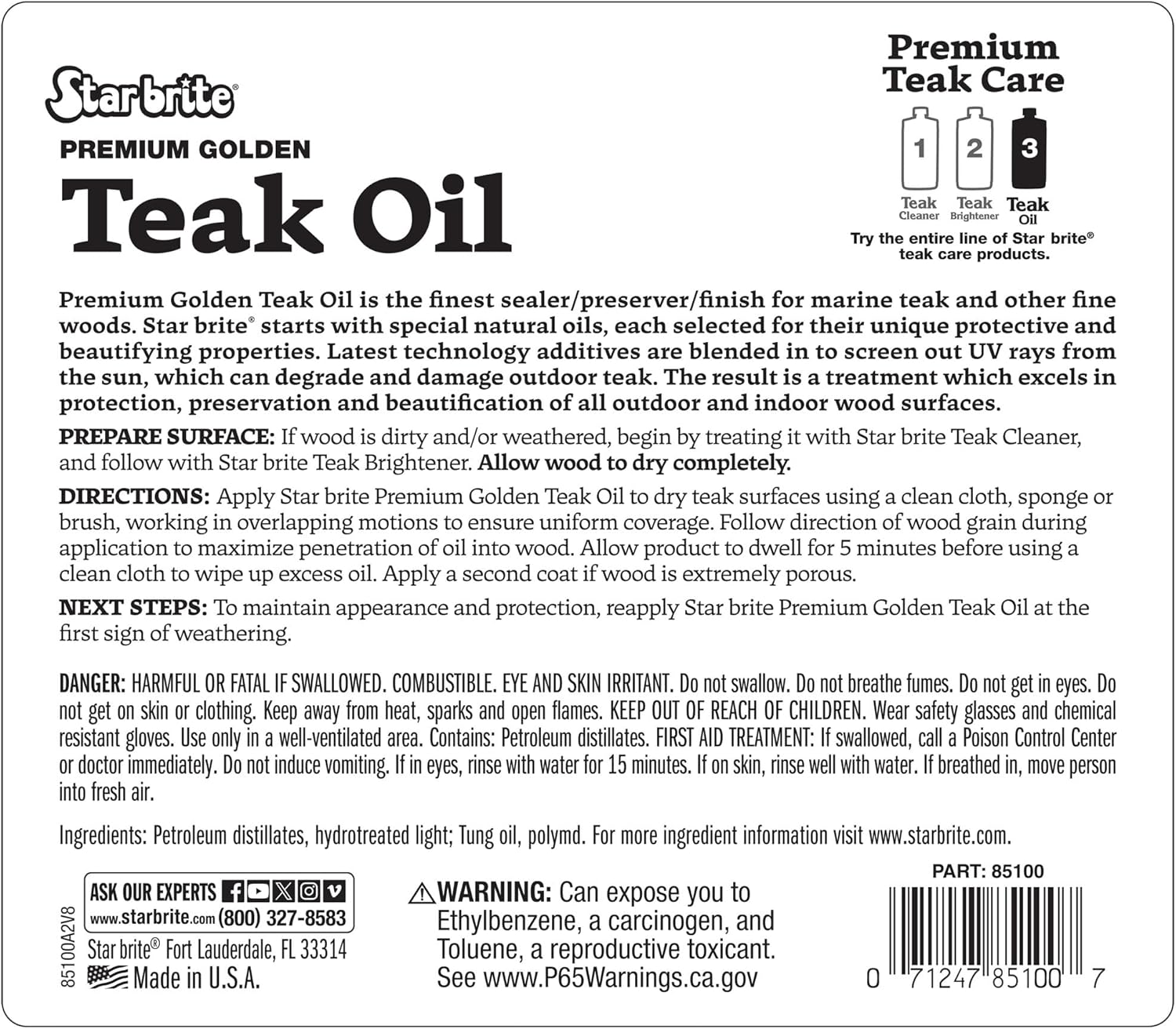
If you’ve ever bought a bottle of teak oil and realized the label shows a teak deck on a sailboat but your actual project is a shower bench, a set of Adirondack chairs, or an Ipe (a dense Brazilian hardwood, pronounced “ee-pay”) patio deck, you’re in very good company. Teak oil — a penetrating finish (meaning it soaks into the wood grain rather than sitting on top as a hard film) — is marketed primarily to the marine crowd but is purchased overwhelmingly by people who have never set foot on a boat. That’s not a problem. It’s actually useful data, because those non-marine owners tend to write detailed, long-horizon reviews that reveal things laboratory tests don’t: what the oil looks like after two rainy seasons, whether the color shift is something you can live with, and exactly when penetrating oil protection stops being enough. This article synthesizes that owner-reported data so you can make a clear decision — right finish, right substrate, right expectations — before you crack a lid.
The Buyer Pattern Nobody Talks About
Pull up the review corpus for any major teak oil product and the substrate list reads like a home-improvement store inventory: shower benches, garden benches, Adirondack chairs, teak patio dining sets, Ipe decking, outdoor bar tops, mahogany railings, eucalyptus furniture. Actual boat teak is a distinct minority. This matters for one underappreciated reason: the performance variables on non-marine wood are different, and the owners reporting on them are often more methodical than boaters because they’re applying oil to furniture they live around daily and can observe closely.
Across the aggregated review pools for Star Brite Golden Teak Oil, AquaTeak, Watco Teak Oil, and DITEC Triton, several patterns repeat with enough consistency to treat as signal rather than noise:
-
The two-step process is the real product. Star Brite Golden Teak Oil reviewers reliably report that the cleaner/brightener step used before the oil is the variable that separates good results from mediocre ones. The phrase “a little goes a long way” appears repeatedly for the oil itself, but it’s almost always paired with a comment crediting the prep. The oil is finishing what the prep started.
-
Color shift is real and documented. AquaTeak reviewers are unusually transparent about this, with multiple before/after photo submissions showing a clear shift toward a golden-orange/brown tone. This isn’t a defect — it’s the oil’s silicone or linseed carrier interacting with the wood’s natural tannins — but it catches buyers off guard when they expected to preserve a pale, raw-wood look.
-
Long-term durability is achievable but requires reapplication discipline. The standout data point in the Watco review pool is a single owner who documents 16 years of continuous use on outdoor hardwood furniture. Their maintenance cadence: one application per season, light sanding between coats every three to four years. That’s a legitimate durability track record — but it’s inseparable from the maintenance schedule.
-
Penetrating oil has an inherent ceiling. DITEC Triton’s most instructive review is a one-star entry from an owner who followed every prep and application step correctly and still saw water marks on their furniture surface one month after a rain event. This isn’t a product failure in the traditional sense — it’s an honest upper-limit data point. Penetrating oils don’t form a waterproof barrier; they modify the wood’s surface energy and slow moisture ingress. Heavy, sustained rain stress-tests that limit quickly.
Color, Grain, and the Substrate Variables That Change the Math
The color-shift question is where non-teak substrates get complicated, and it deserves more precision than most product pages offer.
Teak oil was formulated around teak’s specific tannin profile and density. When applied to other hardwoods — particularly lighter-toned species like white oak, maple, or lighter Ipe — the result can be noticeably darker and warmer than expected. AquaTeak reviewers with pale teak shower benches consistently flag this: the “golden orange/brown” they describe represents a meaningful departure from the raw wood’s appearance. Whether that’s desirable depends entirely on the application. On weathered gray Ipe decking, that warmth is often exactly what owners want. On a brand-new pale hardwood dining table, it can be jarring.
The reversibility question is harder. Once a penetrating oil is absorbed into the wood, you cannot simply wipe it off. Reversing the color shift requires mechanical abrasion (sanding back to raw wood), which means accepting scratches, grain disruption, and additional labor. This is not a “just try it” situation — treat the first application as a commitment, and test on an inconspicuous area or scrap piece first.
By the numbers — substrate density and oil absorption:
| Substrate | Janka Hardness (lbf) | Expected Absorption | Reapplication Cadence |
|---|---|---|---|
| True teak | ~1,000 | Moderate | 1–2x/season (marine) |
| Ipe | ~3,510 | Low (dense grain) | 1x/season minimum |
| White oak | ~1,360 | Moderate-high | 1–2x/season |
| Eucalyptus | ~1,125 | Moderate | 1–2x/season |
Janka hardness (a measure of wood density, rated by the force needed to embed a steel ball to half its diameter) predicts how much oil a substrate will absorb. Ipe’s extreme density means oil sits near the surface longer and is more vulnerable to rain wash-off — which is exactly the failure mode the DITEC Triton one-star reviewer encountered. Per WoodenBoat Magazine’s coverage of penetrating finishes on tropical hardwoods, dense exotics often respond better to modified oil systems (those with added resin or UV blockers) than to pure penetrating oils.
VOCs, Ventilation, and the Shower Bench Problem
The shower bench use case is worth isolating because it generates specific safety questions that reviewers raise and that deserve a direct answer.
Most teak oil formulations carry meaningful VOC (volatile organic compound) loads. VOCs are the chemical compounds that evaporate as the oil cures — they’re responsible for the characteristic solvent odor and for the skin-absorption and inhalation risks flagged in product safety data sheets. The Watco Teak Oil long-term reviewer includes an unusually detailed warning about VOC exposure and skin contact that merits amplification here: teak oil applied in an enclosed bathroom environment needs to be fully cured before the space is used for its intended purpose.
Per manufacturer safety data sheets (SDS) for oil-based teak finishes, cure times for safe indoor occupancy typically range from 24 to 72 hours depending on ventilation, temperature, and humidity — conditions that a bathroom, by definition, works against. High-humidity environments also slow cure time and can cause oil to remain tacky longer, increasing skin contact risk during the first post-application shower.
Practical Sailor’s comparative teak finish coverage consistently distinguishes between finishes that are appropriate for enclosed, skin-contact applications (typically water-based, low-VOC formulations) and those designed for ventilated outdoor or above-deck use. If your shower bench application can’t guarantee 48+ hours of open-window ventilation followed by a full wipe-down of any surface residue before first use, a water-based, low-VOC penetrating oil or a purpose-formulated bathroom wood sealer is the more defensible choice.
When Penetrating Oil Isn’t Enough: The Switch Decision
The DITEC Triton failure case points to a decision most owners hit eventually: at what point does penetrating oil protection reach its ceiling and a film finish (varnish, spar urethane, or two-part polyurethane) become the right call?
The honest answer from the aggregated owner pool is that penetrating oil is a maintenance-mode finish, not a one-time protection solution. It works well when:
- The wood is in good initial condition (not checking, splitting, or deeply weathered)
- The owner is genuinely willing to reapply on a defined schedule (annually at minimum for outdoor applications in full sun)
- The application environment gets moderate rather than intense water exposure
- Color enrichment is acceptable or desirable
It starts to underperform when:
- The wood faces sustained rain, standing water, or spray exposure (docks, outdoor kitchen counters, high-traffic decking)
- The owner has missed two or more reapplication cycles and the wood has begun to gray or check
- The substrate is extremely dense (Ipe, Brazilian cherry) and oil simply isn’t penetrating effectively
- A hard, cleanable surface is needed (dining table tops, bar surfaces)
Per WoodenBoat Magazine’s analysis of tropical hardwood finishing, dense exotics like Ipe that resist penetrating oils often respond better to a modified alkyd or phenolic resin varnish, which builds a thin film layer while still allowing some wood movement. For marine-adjacent applications — cockpit furniture, swim platform surrounds — Practical Sailor’s testing records consistently favor products in the modified oil-varnish hybrid category over straight penetrating oils for longevity beyond a single season.
The decision rule: if you’ve reapplied penetrating oil twice in a season and the wood is still showing water absorption (dark wet spots, grain raising), you’ve hit the ceiling. Move to a film finish.
Frequently Asked Questions
Will teak oil darken or change the color of my wood, and is that reversible?
Yes, most teak oil formulations will shift wood toward a golden-orange or amber-brown tone, particularly on lighter hardwoods. AquaTeak reviewers document this clearly with before/after photos. The shift is not reversible without mechanical sanding back to raw wood. Test on a hidden area or scrap piece before committing to the full application.
Can I use marine teak oil on a teak shower bench safely given the VOCs involved?
With caution and adequate planning. Most oil-based formulations carry significant VOC loads and require 24–72 hours of cure time in well-ventilated conditions before the space is safe for occupancy. Enclosed bathrooms complicate that cure window. If guaranteed ventilation time isn’t available, a water-based, low-VOC penetrating oil or bathroom-specific wood sealer is the safer choice.
How long does teak oil protection actually last on furniture left in full sun?
The Watco long-term owner review — 16 years of continuous outdoor use — establishes that durability is achievable, but it requires annual reapplication and periodic light sanding. In full sun without shade cover, most owners in the review corpus report noticeable degradation (graying, dullness) within one season without reapplication. Six months is a realistic protection window for unshaded full-sun exposure.
Do I have to use a teak cleaner first, or can I apply teak oil directly to weathered wood?
The Star Brite review pool treats the cleaner/brightener step as the essential variable — not optional. Applying oil directly to weathered, gray, or dirty wood seals in contamination, compromises penetration, and produces uneven color results. The two-step process (clean/brighten, then oil) is the documented basis for the positive results owners report.
Is there a point where penetrating oil just isn’t enough and I need to switch to a sealer or varnish?
Yes, and the DITEC Triton failure case identifies it clearly: if prep-compliant, correct application is still producing water marks and surface staining within weeks of application, penetrating oil has reached its protection ceiling for that substrate and exposure level. Dense exotics under heavy water exposure, high-traffic surfaces, and applications requiring a cleanable hard surface are all candidates for a film finish (spar varnish, spar urethane, or two-part polyurethane) rather than a penetrating oil.
The bottom line: Teak oil is a legitimate, well-documented finish for a wide range of non-teak hardwoods — if you understand it as a maintenance system rather than a one-time application, accept the color shift as a feature rather than a flaw, and respect the VOC and ventilation requirements that most product labels understate. If X is a dense exotic substrate with heavy water exposure, then Y is either a modified oil-varnish hybrid or a proper film finish. The penetrating oil category earns its place on the shelf — just not for every project that walks in the door.