October 15, 2026 • Carmen Reyes • 12 min reading time • Specs verified June 25, 2026
Teak Shower Benches, Patio Furniture, and Boat Decks: One Oil System for All Three?
Teak is a dense, oily tropical hardwood that has been prized aboard boats for centuries because it sheds water, stays cool underfoot, and holds up to punishment that would rot softer woods within a season. Those same properties have made it enormously popular for shower benches, patio furniture, and pool decks — settings that have nothing to do with sailing. If you’ve landed here after searching for a teak oil to protect your shower bench or your backyard chairs, you’re in the right place. And if you’re a boat owner wondering whether the products at the marine supply house are overkill — or whether the big-box hardware store option is a shortcut that’ll bite you — this article answers that directly. What follows is a comparison-focused breakdown of five products that shoppers across all three environments are actively buying, with honest tradeoffs on darkening, VOC hazard, reapplication frequency, and where each one actually holds up.
| EDITOR'S PICKSTAR BRITE Premium Golden Teak… | Mid-tierTotalBoat Teak Oil - Premium Ma… | Budget pickWatco Teak Oil Wood Finish | |
|---|---|---|---|
| Volume | 128 fl oz | 1 qt | 1 qt |
| Application | — | — | Wipe-on |
| Wood type | Teak & fine woods | Teak | Teak |
| Finish | Golden | — | Clear |
| Container | Gallon | Quart | Quart |
| Price | $70.89 | $26.18 | $18.92 |
| See on Amazon → | See on Amazon → | See on Amazon → |
Why Environment Is the Variable That Overrides Everything
The marketing on most “teak oil” products implies a universal solution. The reviews tell a different story, and the pattern is worth naming clearly before we get into specific products.
A shower bench lives in an enclosed, poorly ventilated space with brief but frequent freshwater contact, high humidity, and no UV exposure. The primary enemy is mildew and water marking on the wood surface, not UV degradation or saltwater intrusion.
Patio furniture in a temperate or sun-belt climate faces the opposite problem: extended UV exposure, temperature cycling, occasional hard rain followed by drying wind, and periodic re-wetting from hoses or sprinklers. The wood grays and checks — develops small surface cracks — primarily because of UV and drying cycles, not moisture alone.
Teak boat decks deal with all of the above simultaneously: UV radiation amplified by water reflection, salt residue that accelerates surface degradation, foot traffic, and the structural reality that caulked seams between teak planks will fail if the wood swells unevenly. On a boat deck, slip resistance is also a safety variable — an over-oiled deck is a liability.
This distinction matters because the product characteristics that win in one environment are actively counterproductive in another. A fast-drying sealer that cures hard enough to resist foot traffic may be exactly wrong for indoor shower use if it off-gasses solvents in a bathroom with no ventilation. A penetrating oil that keeps wood deeply conditioned may perform beautifully on a shower bench and create a maintenance burden on a sun-exposed patio where reapplication has to happen every few months.
WoodenBoat Magazine’s general guidance on teak finishing consistently distinguishes between penetrating oils appropriate for small surfaces and interior wood versus the more demanding requirements of deck applications — a distinction product marketing rarely makes clearly.
Typical reapplication intervals by environment:
| Environment | Penetrating Oil | Film-Building Sealer |
|---|---|---|
| Indoor shower bench | 6–18 months | 12–36 months |
| Outdoor patio furniture | 3–6 months (sun-belt) / 6–12 months (temperate) | 12–24 months |
| Boat deck (saltwater, tropical) | 4–8 weeks | 3–6 months |
Intervals reflect manufacturer technical data sheet guidance and editorial analysis from Practical Sailor’s teak deck treatment coverage and WoodenBoat Magazine’s teak finishing references.
Product-by-Product Breakdown
Star Brite Premium Golden Teak Oil
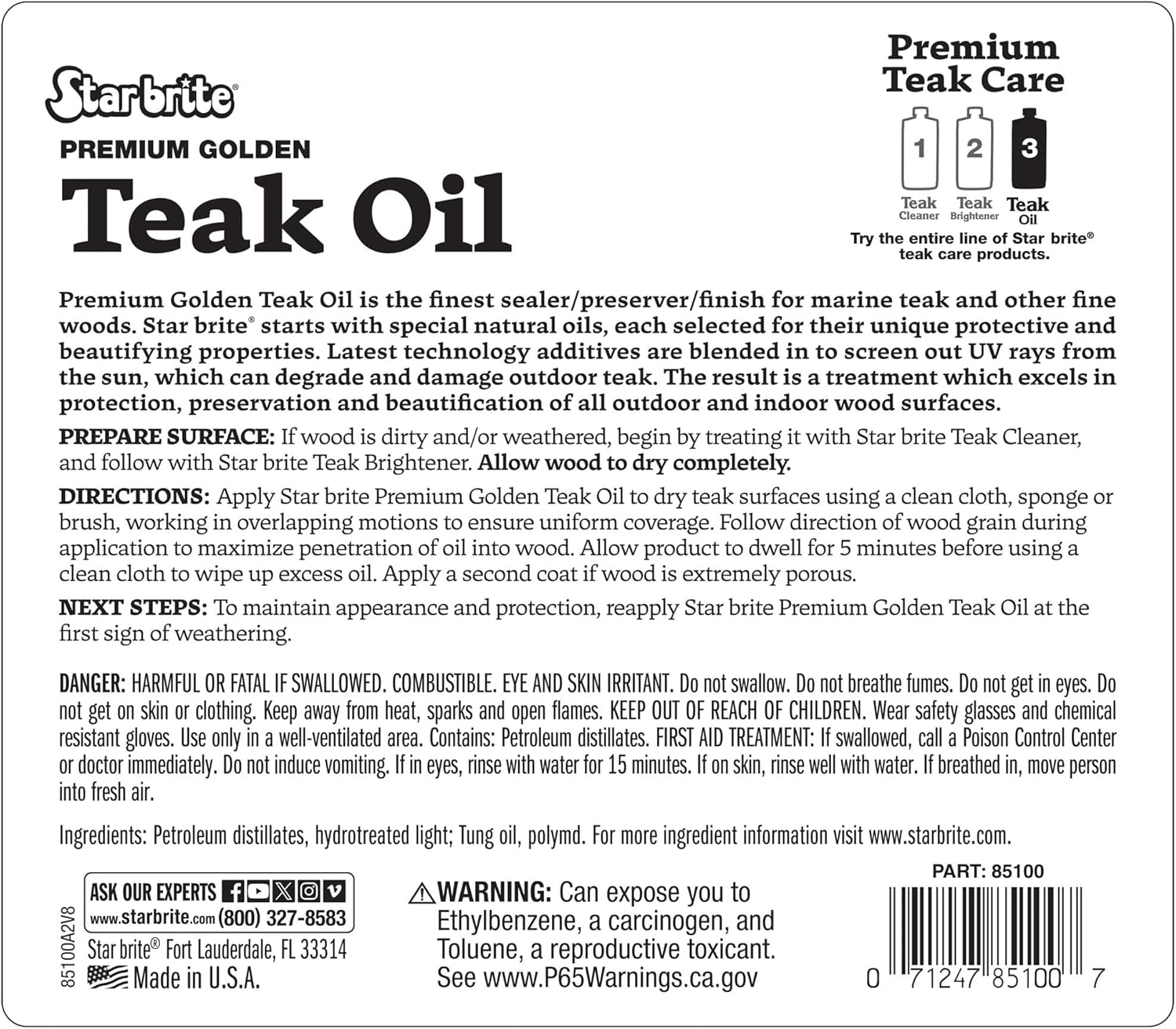
Aggregated buyer reviews for Star Brite Premium Golden Teak Oil reveal something telling: a meaningful portion of buyers are explicitly using this product on teak shower benches and interior shelf units, not boats. The pattern makes sense. This is a penetrating oil formulation that conditions the wood from within rather than forming a hard surface film. Owners consistently report strong water-beading performance after the first application, which is exactly what you want on a shower bench where standing water is the primary stressor.
The “Golden” in the name is a color description, not just branding. Owners report a warm amber shift in wood tone — noticeable but generally described as flattering rather than jarring. For shower use, the absence of a hard film means the finish is forgiving: there’s no coating to peel or crack, and reapplication is straightforward without stripping.
Where Star Brite Golden becomes less compelling is on heavily sun-exposed patio furniture. Penetrating oils, by definition, don’t provide the UV-blocking surface protection that a sealer with UV inhibitors can offer. For a teak Adirondack chair in an Arizona backyard, the reapplication burden compounds quickly. Practical Sailor’s teak deck treatment editorial analysis identifies reapplication frequency as the single most decisive factor in long-term owner satisfaction — a pattern that applies equally to patio furniture.
Best fit: Indoor shower bench; sheltered covered porch furniture; interior boat woodwork.
Watco
$18.92
In stock on Amazon
Check price on AmazonAquaTeak Teak Oil and Treatment
AquaTeak buyers appear in two distinct camps in aggregated reviews: boaters, and people who purchased an AquaTeak-brand shower mat or bench and are looking for the matching maintenance product. The second group is large, and their experience illuminates the product’s most-discussed attribute: significant color darkening.
Multiple reviewers have photographed before-and-after comparisons, and the contrast is striking. Light, kiln-dried teak that starts out blond can shift to a deep honey-amber or even a medium brown after AquaTeak treatment. If your goal is to preserve a light, natural wood tone, this is the wrong product regardless of environment.
For boat use, AquaTeak performs credibly on above-waterline wood: grab rails, cockpit trim, and companionway surrounds. WoodenBoat Magazine’s teak finishing guidance reinforces that penetrating oils are appropriate for interior and accent wood, while deck applications require a more careful product evaluation — a distinction AquaTeak’s positioning doesn’t always make explicit.
Best fit: Shower mats and benches where darkening is acceptable; boat interior wood trim; situations where deep conditioning and a rich color shift is the deliberate goal.
TotalBoat
$26.18
In stock on Amazon
Check price on AmazonWatco Teak Oil
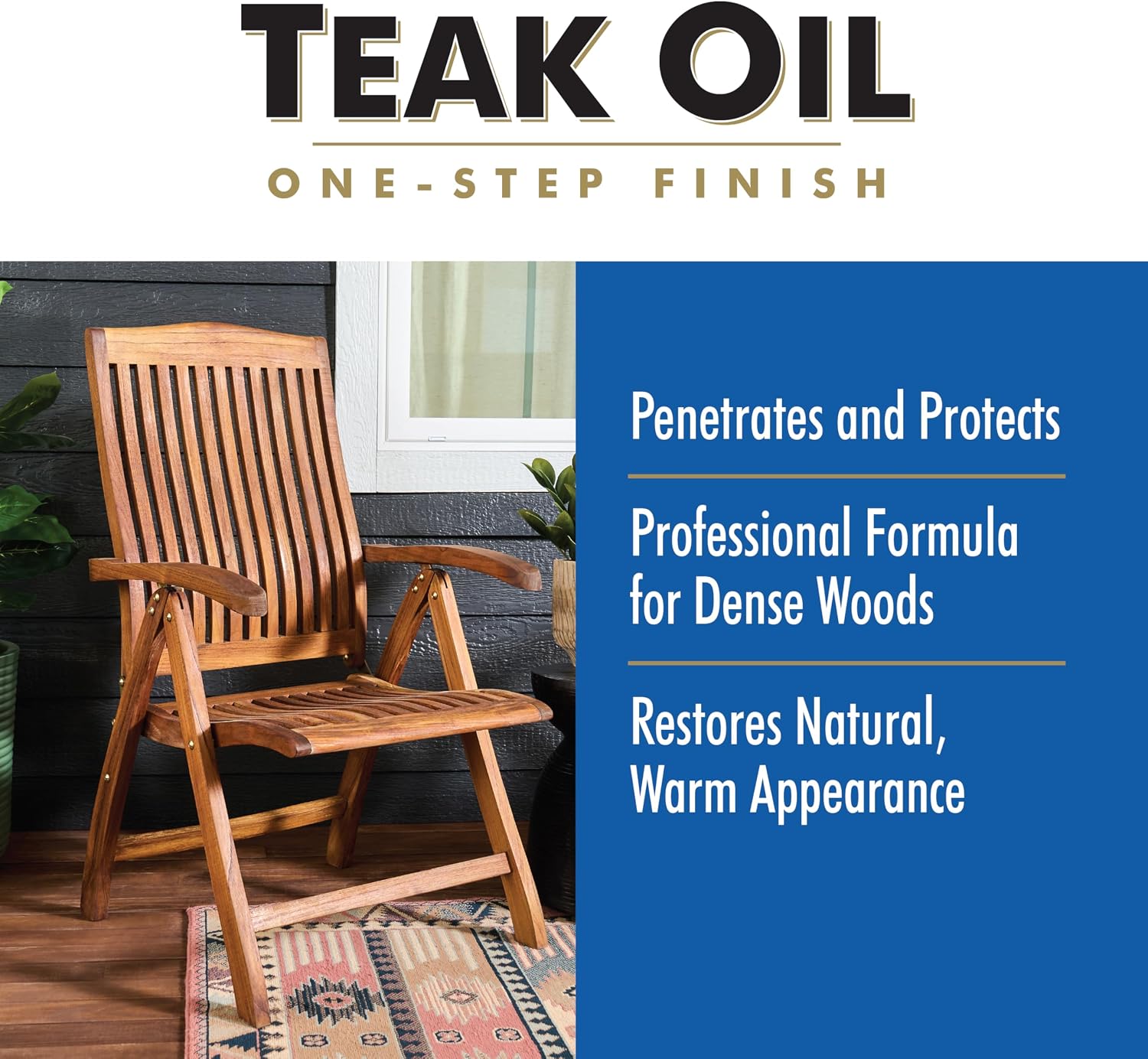
Watco is a hardware-channel product — widely available, familiar to woodworkers — and its teak oil formulation is popular for both boat work and furniture. But the reviewer pattern here is more emphatic about safety concerns than any other product in this comparison, and that deserves direct treatment rather than a footnote.
Per the Watco Teak Oil Safety Data Sheet published by Rust-Oleum Corporation (SDS document current as of 2025), Watco Teak Oil contains petroleum distillate solvents classified as skin-absorption hazards. The published SDS specifies that application requires not only nitrile gloves but organic vapor respiratory protection. For outdoor use on a patio chair in a well-ventilated environment, this is manageable. For use on a shower bench in a closed bathroom — even with a window open — it is genuinely problematic. The product is not designed for enclosed, unventilated spaces.
Practical Sailor’s teak finish editorial analysis notes that solvent-heavy penetrating oils are effective wood conditioners but require full cure time before the treated surface returns to regular use — an additional consideration for a shower bench used daily.
Best fit: Outdoor patio furniture in well-ventilated application conditions; boat exterior trim where VOC exposure is manageable. Not recommended for shower benches or enclosed indoor spaces.
TotalBoat
$26.18
In stock on Amazon
Check price on AmazonDITEC Triton Teak Treatment
DITEC Triton occupies the premium end of the market and is positioned primarily at the marine customer. Its product documentation describes a penetrating, water-repellent treatment with UV stabilizers. That positioning should put it ahead of basic penetrating oils for sun-exposed patio furniture.
However, one critical review from a patio furniture owner — who described an extensive prep process including thorough sanding before applying multiple coats — still reported water marking on the surface within a month. That outcome is worth examining rather than dismissing.
The most likely explanation is one WoodenBoat Magazine’s finishing guidance addresses directly: prep determines outcomes more than product choice does. If teak is not properly cleaned and brightened before treatment, existing gray surface oxidation and residual oils prevent full penetration. The new treatment sits partially on top of an incompatible substrate rather than absorbing through it. DITEC Triton may have underperformed in that documented case because the prep work — however extensive in terms of sanding — skipped the chemical cleaning step that opens the wood grain. Sanding and chemical cleaning are not interchangeable. This is not the same as the product failing under correct conditions.
Best fit: Marine use on handrails, cap rails, and above-waterline teak where UV stabilizers add real value; patio furniture when full prep protocol including two-part chemical cleaning is followed. Premium products still require proper prep to perform.
STAR
$70.89
In stock on Amazon
Check price on AmazonTotalBoat Danish Teak Sealer
TotalBoat Danish Teak Sealer draws notably positive reviews from two specific buyer profiles: a Pacific Northwest boater who values fast dry time between rain showers, and a sun-belt pool furniture owner who invested two full days in prep work before application. Both are meaningful data points.
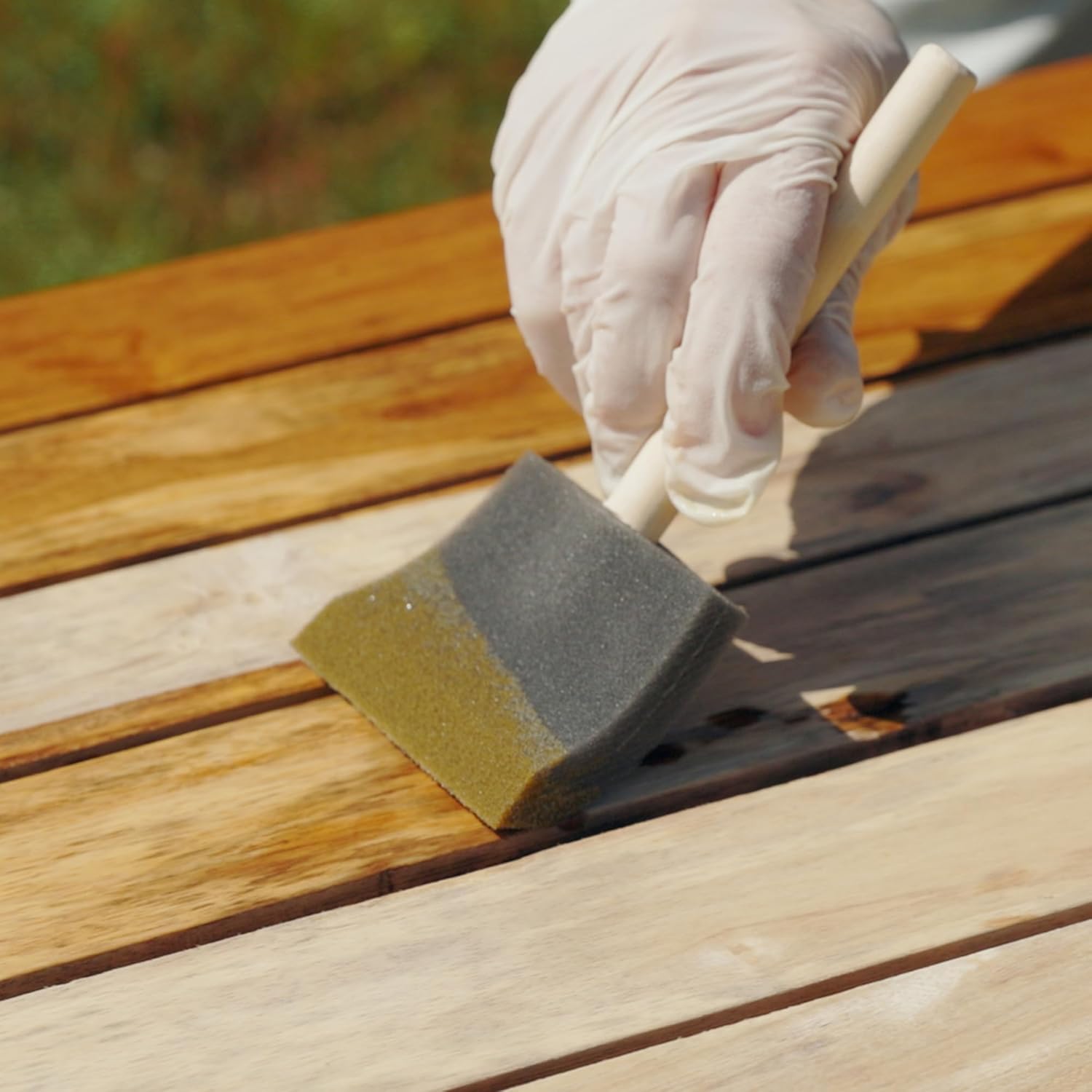
The fast-drying formulation addresses a real Pacific Northwest problem — if you’re working around a weather window and need the treatment to cure before the next squall arrives, a sealer that tacks off quickly is a practical advantage over a penetrating oil that stays tacky for several hours in humid conditions. Per TotalBoat’s Technical Data Sheet for the Danish Teak Sealer, available through the Jamestown Distributors Boatbuilder Central resource library, this is a semi-penetrating finish with a degree of film formation that provides better water-marking resistance than a purely penetrating oil. That makes it a reasonable candidate for shower bench use, though it is designed and marketed for exterior applications.
The sun-belt pool furniture owner’s two-day prep investment is the buried lead: that’s what good outcomes on weathered, sun-damaged teak actually require. Sanding, cleaning with a two-step teak cleaner and brightener, allowing the wood to dry fully, then applying the sealer. Skipping steps in a five-step protocol doesn’t yield eighty percent of the result — it often yields thirty percent.
Best fit: Boat exterior wood in high-rainfall environments; pool and patio furniture where the owner is committed to proper prep; potentially viable for shower bench applications where a more durable, water-marking-resistant finish is desired.
STAR
$70.89
In stock on Amazon
Check price on AmazonFrequently Asked Questions
Will teak oil prevent water marks on a shower bench, or is a sealer better? For water marking specifically, a semi-penetrating sealer with film-forming properties will outperform a pure penetrating oil. Penetrating oils condition the wood but don’t create a sealed surface; water can still mark the grain if it sits long enough. If water marking is your primary concern, TotalBoat Danish Teak Sealer or a similar semi-penetrating finish is the more defensible choice. Star Brite Golden’s water-beading performance is real, but it reflects oil repellency rather than a film coat.
How dark will AquaTeak or Star Brite Golden actually make my wood? AquaTeak reviewers document significant darkening — expect a shift of two to three color tones deeper than untreated wood. Star Brite Golden produces a warm amber shift owners generally describe as moderate. If your teak is currently blond and you want to keep it that way, test on an inconspicuous area first, or look for products marketed specifically as “natural” or “clear” finish.
Is Watco Teak Oil safe to use in a poorly ventilated indoor space? No. Per the Rust-Oleum Corporation Safety Data Sheet for Watco Teak Oil (current as of 2025), the solvent content requires adequate ventilation, skin protection, and organic vapor respiratory protection during application and cure. A bathroom — even with a window cracked — does not constitute adequate ventilation for this product. Use outdoors only.
How often do you need to reapply teak oil on outdoor patio furniture versus a boat deck? In a sun-belt climate, outdoor patio furniture treated with a penetrating oil typically needs reapplication every three to six months. A boat deck in tropical saltwater conditions may need treatment every four to eight weeks with a penetrating oil — which is why many experienced bluewater owners eventually move to sealer systems, or accept the gray patina and maintain with periodic cleaning only. Practical Sailor’s teak deck treatment editorial analysis identifies maintenance frequency as the decisive factor in long-term product satisfaction across all treatment categories.
Does the teak cleaner and brightener step actually matter if the wood isn’t visibly gray? Yes, more than almost any other variable. Teak oxidizes at the surface even when it doesn’t look visibly gray — that oxidized layer blocks penetration and prevents bonding. A two-part teak cleaner and acid-based brightener opens the grain and removes oxidation. Skipping it because the wood “looks okay” is the single most common reason premium products underperform regardless of environment. WoodenBoat Magazine’s teak finishing references are consistent on this point: chemical prep and mechanical prep serve different functions and neither substitutes for the other.
Did DITEC Triton actually fail on patio furniture, or was it a prep issue? Based on available review evidence, the most probable explanation is prep failure rather than product failure. Multiple-coat application on sanded but not chemically cleaned teak is a well-documented path to poor penetration and early treatment failure. DITEC Triton’s formulation is designed for properly prepared wood. The failure mode is consistent with inadequate prep rather than a product defect — though clearer prep instructions from the manufacturer would reduce this outcome.
The Decision Rule
If your teak is indoors — shower bench, bath shelf, interior cabin trim — choose a penetrating oil formulation with low solvent content and confirm ventilation requirements on the manufacturer’s SDS before purchasing. Star Brite Premium Golden Teak Oil fits this use case well based on owner-reported performance in shower environments. Avoid Watco indoors categorically.
If your teak is outdoors in a high-UV environment — patio, pool deck, sun-exposed boat exterior — prioritize UV inhibitors and be honest about your willingness to reapply. TotalBoat Danish Teak Sealer extends intervals and resists water marking better than a penetrating oil alone, but only if you execute the two-part chemical cleaning prep correctly. Budget two days for a meaningful furniture set.
If your teak is on a boat deck with foot traffic: the calculus shifts to slip resistance, planking movement, and maintenance cadence. Heavy oiling of a boat deck creates slip hazards and can swell planks against seam caulk. Practical Sailor’s teak deck treatment editorial analysis consistently recommends lighter, more frequent applications over saturating coats. For bluewater cruising vessels, many experienced owners eventually let the deck silver naturally and maintain with cleaning only — the maintenance-free argument becomes real at scale.
One system for all three environments? The evidence says no. The good news is that the right match for each environment is knowable before you buy.