July 6, 2026 • Carmen Reyes • 9 min reading time • Specs verified June 25, 2026
Epoxy Slick Coats for Airboats, Jon Boats, and Aluminum Hulls: When Bottom Paint Isn't the Answer
You’ve just picked up a used 16-foot aluminum jon boat — the flat-bottomed, lightweight skiff that’s the workhorse of bass fishing, duck hunting, and shallow-water work — and someone at the marina tells you to slap some bottom paint on it before the season starts. Stop. That advice, while well-intentioned, can actively damage an aluminum hull. Most conventional antifouling bottom paints (coatings designed to prevent barnacles and algae from growing on a submerged hull) rely on cuprous oxide, a copper compound that is galvanically incompatible with aluminum. In plain English: copper and aluminum in the presence of saltwater create a battery, and your hull is the terminal that gets eaten. What aluminum boat owners — jon boats, airboats, canoes, and pontoon rigs alike — actually need is a different category of solution entirely: an epoxy slick coat. This article breaks down what that is, when it makes sense, how to apply it correctly, and which products have earned consistent respect from owners who’ve done it the hard way first.
What Is an Epoxy Slick Coat and Why Does Aluminum Need a Different Approach?
An epoxy slick coat is a two-part epoxy coating — meaning it uses a resin and a hardener that chemically cure rather than just drying — applied to the hull’s exterior to create a smooth, hard, low-friction surface. The goal is not barnacle prevention (that’s antifouling paint’s job) but rather drag reduction, abrasion resistance, and in some cases, sealing of rivets and minor surface porosity. On aluminum hulls, this matters for several interconnected reasons.
First, freshwater environments — where the majority of jon boats, airboats, and aluminum canoes operate — don’t generate significant fouling pressure. You don’t need biocides. What you do need is a surface that slides through the water efficiently and resists the dents, scratches, and oxidation that bare aluminum accumulates over seasons of hard use.
Second, aluminum’s surface chemistry is tricky. The metal naturally forms an aluminum oxide layer when exposed to air — which actually protects it from deeper corrosion, but also makes adhesion notoriously difficult. Any coating you apply has to bond through or to that oxide layer, which is why etching primers (acid-based primers that chemically “bite” into the aluminum surface) are non-negotiable rather than optional.
Practical Sailor’s aluminum hull coating compatibility reviews consistently flag this prep step as the number-one place where DIY jobs fail: the product gets blamed when the surface was the actual problem.
The Core Products: Fasco Super Slick 2000 vs. TotalBoat Aluminum Boat Paint
These two products occupy different positions in the market, and understanding the tradeoff is the first decision you need to make.
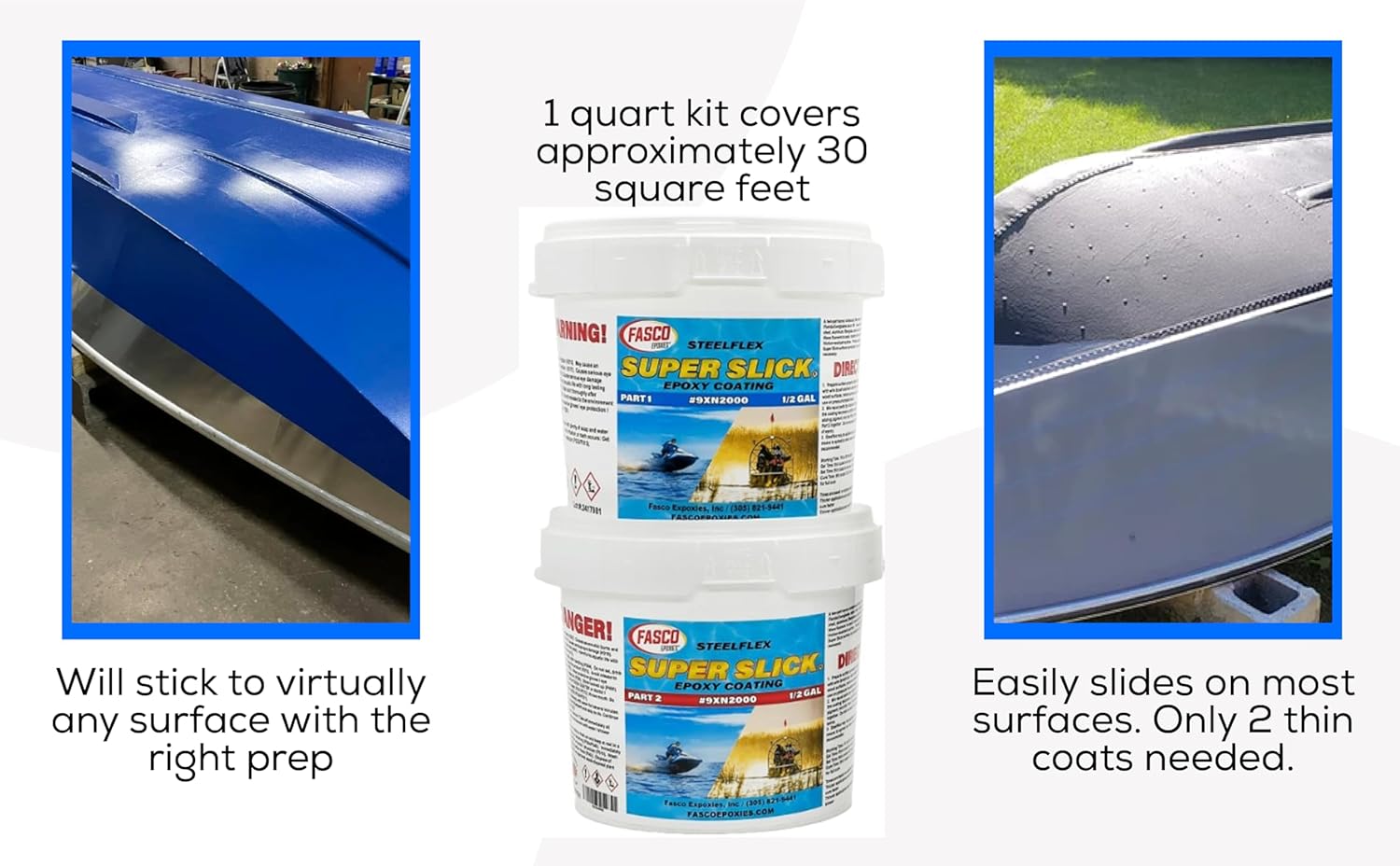
Fasco Super Slick 2000 is an epoxy-based hull coating that has developed a loyal following among airboat operators and aluminum canoe owners specifically. What sets it apart in owner-reported experience is a dual-purpose benefit: it reduces hull drag noticeably on aluminum hulls, and owners consistently call out its rivet-sealing side effect. Aluminum riveted hulls — the construction method used on most jon boats and airboats — develop micro-leaks and surface irregularities around rivet heads over time. Super Slick 2000 fills and seals those imperfections as part of the coating process, which is a meaningful structural benefit beyond cosmetics.
Owners who’ve documented their prep workflow recommend aluminum brightener (a phosphoric or oxalic acid-based solution that cleans oxidation and lightly etches the surface simultaneously) as a prerequisite step before applying Super Slick 2000. The field-proven sequence looks like this:
- Wash and degrease thoroughly
- Apply aluminum brightener, scrub, rinse
- Scuff-sand with 80–120 grit
- Apply Super Slick 2000 per manufacturer schedule
That’s a leaner prep stack than some alternatives require, which partly explains its popularity among airboat operators who want results without a weekend-long project.
TotalBoat Aluminum Boat Paint is a different animal — it’s positioned as an antifouling paint for aluminum hulls specifically, engineered without cuprous oxide to avoid the galvanic corrosion problem. Owners consistently praise the finish quality and durability. The friction point that comes up repeatedly in reviews is the price-to-coverage ratio: on a 16-foot boat requiring the manufacturer-recommended three coats, the per-gallon cost adds up faster than buyers expect, and some owners report needing more product than the label coverage estimates suggest.
One reviewer documented a particularly thorough prep sequence for TotalBoat’s aluminum antifouling system: sand, fill pinholes with JB Weld, apply etch primer, apply barrier coat, then apply the antifouling paint. That’s five distinct steps. It reads as excessive until you understand why each one exists — the JB Weld step in particular handles the rivet and seam porosity that would otherwise let water wick under the paint film and cause premature lifting. This level of prep is normal, not neurotic, and the article you’re reading is here to validate that instinct.
By the Numbers
| Factor | Super Slick 2000 | TotalBoat Aluminum Boat Paint |
|---|---|---|
| Primary use case | Freshwater drag reduction + rivet sealing | Antifouling (saltwater/brackish) |
| Galvanic risk to aluminum | None (epoxy-based) | None (copper-free formula) |
| Prep steps (field-reported) | 4 | 4–5 |
| Recoat interval | 1–3 seasons (use-dependent) | Annual (antifouling) |
Prep Is the Product: Why Aluminum Brightener Isn’t Optional
If there’s one place intermediate-level boat owners consistently underinvest, it’s surface prep on aluminum. The instinct is to sand and prime and call it ready. Aluminum requires an additional chemical step because mechanical abrasion alone doesn’t fully address the oxide layer or the embedded contamination from years of water exposure, tannins, and oxidation.
Aluminum brightener — products containing phosphoric acid, oxalic acid, or a blend — accomplishes two things simultaneously: it removes the dull gray oxide layer that forms on weathered aluminum, and it micro-etches the surface to create mechanical profile for the primer or coating to grip. Owner accounts on aluminum-specific coating projects, including those documented in Fasco’s application guidance, consistently cite this as the step that separates lasting finishes from peeling ones.
The BoatUS Foundation’s antifouling paint selection guide for aluminum hulls reinforces this point, noting that adhesion failure on aluminum coatings is most commonly traced back to inadequate chemical prep rather than product defects.
For Rust-Oleum Metal Primer — which earns consistent positive reviews for above-waterline aluminum applications and has an established track record in metal-bonding contexts including RC aircraft fabrication — the same principle applies. It works well on aluminum above the waterline because the substrate is properly cleaned and scuffed before application. The primer itself is credible; the prep makes it stick.
When Slick Coat Beats Bottom Paint: The Decision Framework
Here’s the honest decision tree:
If your boat operates primarily in freshwater (rivers, lakes, reservoirs) and isn’t stored in the water year-round, fouling is not your problem. An epoxy slick coat like Super Slick 2000 gives you drag reduction, rivet sealing, and abrasion protection without the annual reapplication cycle of antifouling paint. This is the right call for most jon boats, airboats, and aluminum canoes.
If your boat lives in brackish or saltwater for extended periods — pontoon on a tidal river, aluminum skiff on a saltwater flat — you need antifouling protection, but you must use a copper-free formula rated for aluminum. TotalBoat Aluminum Boat Paint and TotalBoat Krypton (a copper-free antifouling option) are designed for this use case. Standard cuprous oxide bottom paint on aluminum is not a shortcut; it’s a hull-eating mistake.
If you’re dealing with a riveted hull with known porosity — water getting in around rivets, minor seeping — the combination of JB Weld pinhole repair followed by epoxy coating addresses both the structural and cosmetic issues in one workflow. Don’t skip the pinhole step hoping the coating will bridge it.
If your budget is constrained and you’re choosing between thorough prep with one product versus skipping prep to afford two coats, always invest in prep. A single well-adhered coat outlasts two coats on a poorly prepped surface by a factor of multiple seasons, based on the pattern consistently reported across owner reviews and documented in Practical Sailor’s long-term coating evaluations.
Frequently Asked Questions
Can you use Super Slick 2000 on a fiberglass bass boat hull, or is it aluminum-only?
Super Slick 2000 is not aluminum-only — owners and product documentation indicate it can be applied to fiberglass hulls as well. That said, its strongest documented track record and most enthusiastic owner reviews come from aluminum applications, specifically riveted airboat and jon boat hulls where the rivet-sealing benefit is most tangible. On fiberglass, you’d want to confirm it’s compatible with any existing coatings on the hull before applying.
Do you need to prime aluminum before applying a slick epoxy coat?
For most epoxy slick coat products, a dedicated etch primer is either required or strongly recommended. The aluminum brightener step cleans and micro-etches the surface, but an etch primer provides the chemical bonding layer that gives the topcoat something to grip. Check the specific product’s TDS (technical data sheet) — some products like Super Slick 2000 are applied over a prepped-but-unprimed surface in certain workflows, while others specify primer as mandatory. When in doubt, prime.
How long does Super Slick 2000 last before it needs to be reapplied?
Owner accounts vary based on use intensity, but the general consensus is one to three seasons for boats in regular use. Airboats operating in vegetation-heavy environments or over sand and shell will wear through the coating faster than boats in open-water use. Inspect the hull at the start of each season; if drag has noticeably increased or the coating shows through-wear, it’s time to recoat. The prep for reapplication is lighter than the initial application since you’re bonding to a compatible existing surface.
Will TotalBoat Aluminum Boat Paint corrode bare aluminum if applied without an etching primer?
TotalBoat’s technical data sheet for Aluminum Boat Paint specifies etching primer as part of the application system. Applying directly to bare unprimed aluminum risks adhesion failure over time — the paint may appear to bond initially but can lift, particularly under the thermal cycling and UV exposure of regular use. More critically, any moisture that wicks under a poorly adhered coating can initiate corrosion underneath the film, which is harder to catch and address than surface oxidation. Use the etch primer. It’s not optional.
Can a copper-free antifouling paint like TotalBoat Krypton be used safely on aluminum pontoon tubes?
Yes — copper-free antifouling paints specifically formulated for aluminum are the appropriate choice for aluminum pontoon tubes in saltwater or brackish environments. TotalBoat Krypton is designed without cuprous oxide and is compatible with aluminum substrates when applied over the correct primer system. Standard copper-based bottom paints — which dominate the antifouling market — are explicitly incompatible with aluminum and should never be used on pontoon tubes or any other aluminum underwater surface. Confirm the product’s TDS specifies aluminum compatibility before purchase; “antifouling” alone is not sufficient.
Sources consulted: TotalBoat Technical Data Sheet — AluminPaint AF Antifouling Paint; Fasco Industries Product Documentation — Super Slick 2000 Application Guide; Practical Sailor aluminum hull coating compatibility coverage; BoatUS Foundation Antifouling Paint Selection Guide for Freshwater and Aluminum Hulls.